

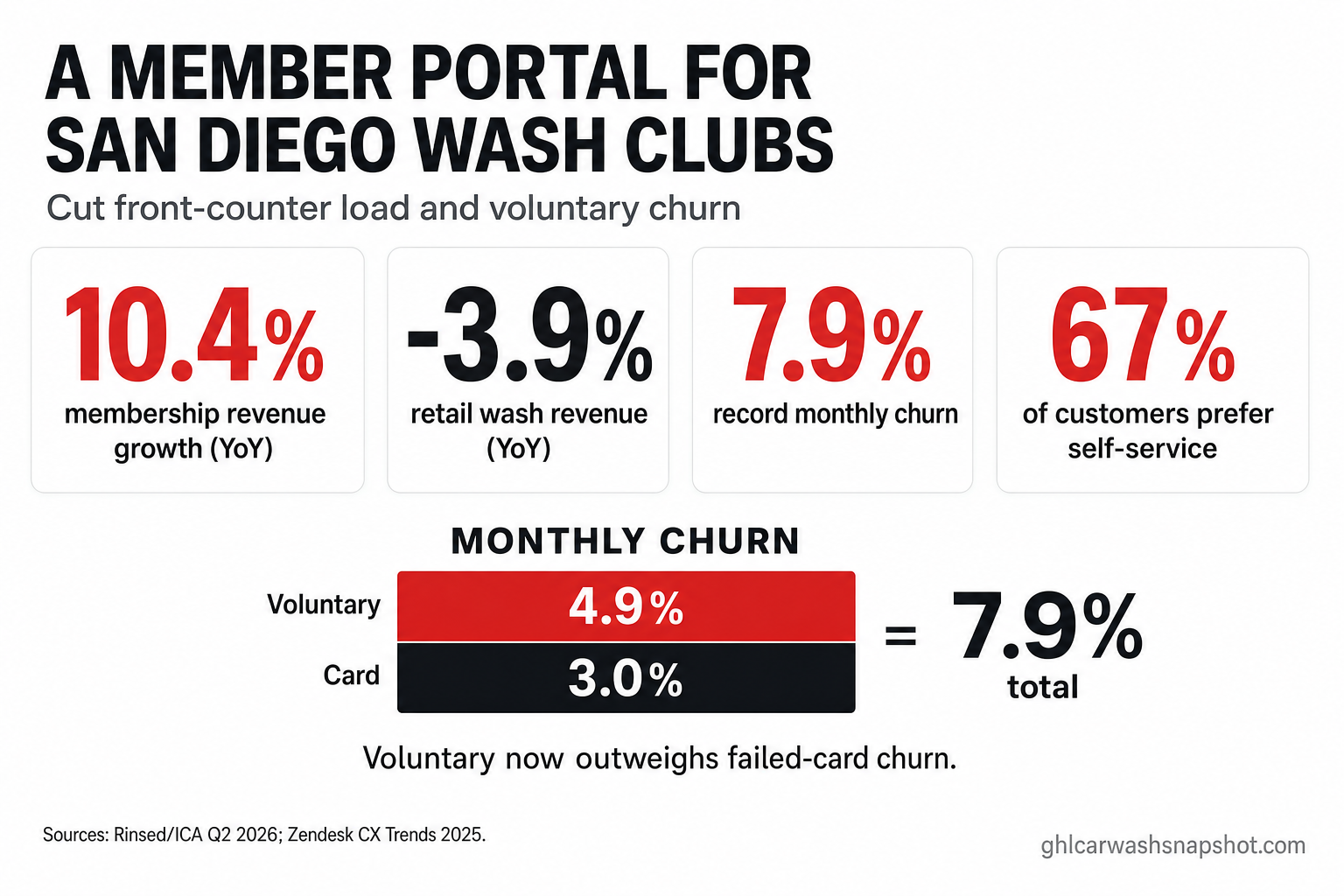
If your San Diego unlimited-wash club still makes members call the counter to pause a plan, swap a card, or change a vehicle, you are quietly manufacturing your own churn. The fastest-growing revenue in the wash business is memberships — membership revenue grew 10.4% year over year in Q2 2026 while retail washes fell 3.9% (Rinsed / International Carwash Association) — but monthly churn just hit a record 7.9%, and for the first time voluntary cancellations (4.9%) outrank failed-card churn (3.0%). A big share of that voluntary churn is pure friction: a member who can’t self-serve a small change simply cancels. A branded member self-service portal — where drivers pause, upgrade, update a card or plate, and see their history without ever tying up a bay attendant — is how you plug that leak. And customers already want it: 67% prefer self-service over talking to a rep for basic issues (Zendesk CX Trends 2025).
This is a build-it playbook for San Diego and Southern California operators: why front-counter-only account management leaks members, exactly what a member portal should let drivers do, the six steps to launch one, and the honest design rule that separates a portal that saves members from one that annoys them.
Table of contents
- Why front-counter-only account management costs San Diego washes members
- What the churn numbers actually say in 2026
- What a car wash member portal should let drivers do
- How to build and launch a member portal: 6 steps
- The design rule that separates a save from an annoyance
- Phone-only vs generic app vs branded portal
- What it costs and what it returns
- FAQ
Why front-counter-only account management costs San Diego washes members
San Diego is one of the densest wash markets in the country. California alone has 7,503 car wash and auto-detailing businesses generating about $3.1 billion a year (IBISWorld), and along the 8, the 15, and the 805 a driver has an unlimited plan within a few minutes in almost any direction. In a market that saturated, the wash that makes staying easy wins, and the wash that makes leaving or changing a plan a phone-tag ordeal loses — because the frustrated member doesn’t fight you, they just cancel and drive to the next tunnel.
Here’s the trap most operators are in. Every plan pause (“I’m traveling for a month”), every plan change (“upgrade me to ceramic”), every card update, every plate or RFID swap, and every “just cancel me” runs through one channel: a human at the counter or on the phone, during business hours. That’s a problem on three fronts at once:
- It’s a labor sink. Your bay attendants and managers spend real hours on account admin that has nothing to do with washing cars — during the exact weekend rush when they should be moving the line.
- It’s a customer-experience failure. A member who wants to pause for a deployment or a trip, and can’t reach anyone, feels trapped. Feeling trapped is how a “pause” becomes a “cancel.”
- It’s invisible. You never see the lost member as a support failure. It just shows up next month as a slightly higher churn number with no obvious cause.
Meanwhile your customers have already told you what they want. 67% of customers prefer self-service over talking to a company representative for basic issues, and 75% of CX leaders expect 80% of customer interactions to be resolved without a human agent within the next few years (Zendesk CX Trends 2025). The unlimited-club member who wants to swap a card at 9 p.m. is not looking for a conversation with your front desk. They want a login, two taps, and done.
What the churn numbers actually say in 2026
The membership model is winning and leaking at the same time, and the 2026 data makes the leak specific. Across more than 3,000 car wash locations, Rinsed’s Q2 2026 industry report (published through the International Carwash Association) found membership revenue up 10.4% year over year while retail washes declined 3.9%, with total same-store sales up 5.4% (Rinsed / ICA). Memberships are carrying the industry.
But in the same report, total monthly churn rose to a record 7.9% — and the composition is the part every operator should read twice. Voluntary cancellations climbed to 4.9% per month, while credit-card (involuntary) churn declined to 3.0%. For years the standard advice was to obsess over failed-card recovery, and you still should — that’s the silent card churn problem, and automated dunning is the fix. But the data has flipped: the bigger bucket is now people choosing to leave. And a meaningful slice of “choosing to leave” is really “couldn’t easily pause, downgrade, or get an answer, so I cancelled.”
That reframes the whole retention problem. If half your monthly bleed is people actively deciding to cancel — and if the friction of reaching you is part of that decision — then the single highest-leverage retention build isn’t another discount. It’s removing the friction: give members a place to pause instead of cancel, downgrade instead of quit, and fix a card in ten seconds instead of ignoring the decline notice. That’s the job of a member portal, and it feeds the same membership funnel and customer-retention system the rest of the snapshot runs on.
What a car wash member portal should let drivers do
A member portal is a branded, secure area — on the web and on a phone — where your unlimited-club members manage their own account. The specific actions matter more than the buzzword, so here’s the concrete list every wash portal should cover:
- Pause a plan. The single most important save action. A member traveling, deployed (San Diego is a huge military market), or between cars should be able to pause for 30–90 days instead of cancelling. A pause you offer is a member you keep.
- Upgrade or downgrade. Move from basic to ceramic, or step down a tier when money’s tight, without cancelling and losing them entirely. A downgrade beats a cancel every time.
- Cancel — with a save offer in the flow. Yes, let them cancel. But put a pause offer, a one-month discount, or a downgrade in front of the confirm button first. This is where voluntary churn gets recovered.
- Update the card on file. Members fix their own expired or replaced card the moment they get the prompt — the cleanest cut you can make in involuntary card churn.
- Update the vehicle, plate, or RFID. New car, new plate, new sticker — a self-serve swap keeps plate-on-file recognition working at the tunnel and stops “the scanner won’t read me” complaints.
- See history and receipts. Wash count, next billing date, downloadable receipts. Transparency reduces disputes and “why was I charged?” calls.
- Add a vehicle or a family plan. Expansion revenue the member initiates themselves.
If that list looks like most of what your counter staff currently do by hand, that’s exactly the point. Every one of these is a task a member would rather do on their phone — and every one you move into the portal is a phone call your weekend crew never has to take.
How to build and launch a member portal: 6 steps
You don’t buy a member portal off a shelf, because it has to talk to your systems to be real. Here’s the build sequence we use, and the same one covered on our custom software page.
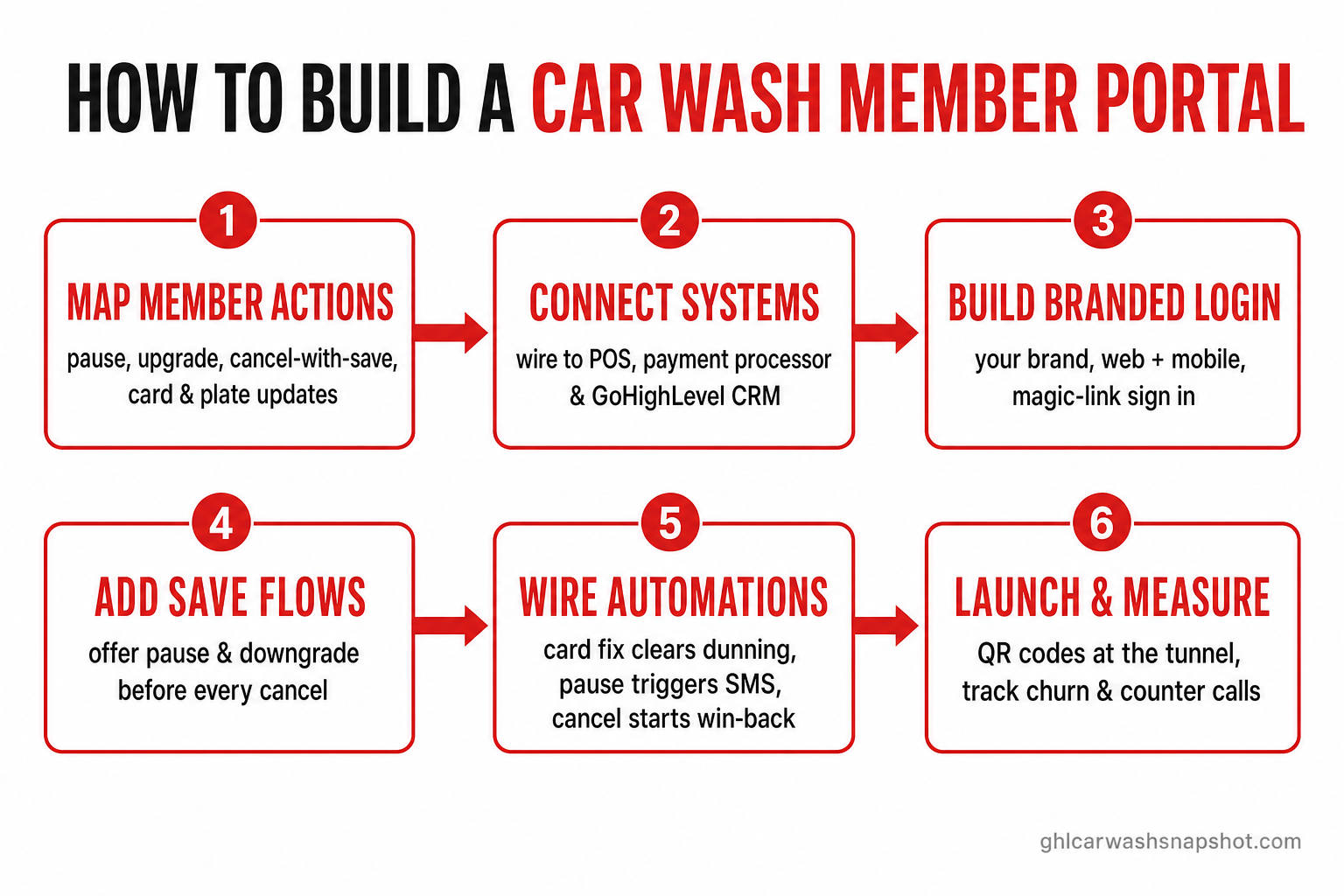
Step 1 — Map the member actions to self-serve. Start from the list above. Write down every account task your staff handles today and decide which move into the portal. Pause, upgrade/downgrade, cancel-with-save, card update, plate/RFID update, receipts, add-a-vehicle is the standard set for a San Diego unlimited club.
Step 2 — Connect to your real systems. A portal that just emails your staff a request is worse than useless — it’s a ticket queue with extra steps. The changes have to be live, which means integrating with your wash POS or membership platform (DRB, Washify, Everwash, Sonny’s), your payment processor (Stripe or Square), and your GoHighLevel CRM so a pause in the portal is a real pause in billing. This is the hard part, and it’s why it’s a build, not a plugin.
Step 3 — Build the branded portal, web and mobile. Your logo, your colors, your plan names — not a third-party app that makes members feel like they left your brand. Keep login frictionless: a magic link by text, or plate-plus-phone, beats forcing a password on a driver in a wash line.
Step 4 — Put save-the-member flows in the cancel path. Before the final “confirm cancellation,” present the pause, the downgrade, and a targeted retention offer. This is the direct counter to the 4.9% voluntary churn — you’re intercepting the decision at the exact moment it’s made.
Step 5 — Wire it to your automations. The portal shouldn’t be an island. A card update clears the dunning flow; a pause triggers a “we’ll miss you — here’s when your plan resumes” SMS sequence; a cancel drops the member into a win-back campaign 30 days out. The portal is the front end; your CRM does the follow-through.
Step 6 — Launch and measure. QR codes at the kiosk, the tunnel entrance, and on the receipt; an SMS and email invite to your existing base; and a one-line staff script (“you can pause or update that yourself in the app — here’s the link”). Then watch two numbers: voluntary churn and account-related calls to the counter. Both should fall.
The design rule that separates a save from an annoyance
Here’s the honest counterpoint, because a portal built badly makes things worse. Gartner’s research is blunt: only 14% of customer service issues are fully resolved in self-service, and 53% of customers still go straight to a human (Gartner). Most self-service fails not because customers won’t use it, but because it can’t finish the task — it collects a request and dumps them back to a phone number anyway.
So the design rule is simple and non-negotiable: every action in the portal must complete end-to-end without a human. A pause must actually pause billing. A card update must actually re-run the charge. A cancel-with-save must actually apply the downgrade. If any path secretly becomes “we’ll call you back,” you’ve built the thing Gartner is warning about — the portal that erodes trust instead of saving members. This is precisely why the integration work in Step 2 is the whole ballgame, and why a generic “member app” bolted loosely onto your POS usually disappoints. Build it to finish the job, or don’t build it.
Phone-only vs generic app vs branded portal
Three ways a San Diego member changes a plan
| Plan | Phone-only counter | Generic member app | Branded member portal (built for you) recommended |
|---|---|---|---|
| Price | $0 tools · high labor | Off-the-shelf, limited | Custom build · owned |
| Feature 1 | Member must call or visit during business hours | Self-serve login, but not your brand | Pause, upgrade, downgrade, cancel-with-save |
| Feature 2 | Every change is staff time during the rush | Only does what the vendor built | Live card, plate & RFID updates that stick |
| Feature 3 | No pause option in the moment = more cancels | Often can't reach your POS or plate-on-file | Wired to POS, processor & GoHighLevel CRM |
| Feature 4 | Card declines ignored until member churns | Requests may still route back to staff | Save-the-member offers in the cancel flow |
| Feature 5 | You never see it as a support failure | You rent it; you don't own it | Your brand, your data, fully owned |
| Build a member portal |
The gap between column one and column three is the whole argument. A phone-only counter turns every small account change into labor and a cancellation risk; a generic app self-serves the easy stuff but stalls on the wash-specific things (plate-on-file, your tiers, your processor). A branded portal built against your actual systems is the only one that removes the friction and keeps the member inside your brand — the same “outgrow the off-the-shelf tools” logic we walk through for multi-site operators.
What it costs and what it returns
A custom member portal is a real software project, not a $30/month subscription — think a defined build with your POS, processor, and CRM integrations, then a system you own. The way to size the decision isn’t the sticker price; it’s the churn math.
Run your own numbers. Say your San Diego club has 2,000 members and sits near the industry’s 4.9% monthly voluntary churn — that’s about 98 voluntary cancellations a month. You will never save all of them, but if a portal with pause, downgrade, and in-flow save offers rescues even 15 a month, at roughly $440 in three-year member value each (Cinch, vendor estimate), that’s about $6,600 in retained member value every month — before you count the counter hours you hand back to your crew during the weekend rush. That’s the return a one-time build has to clear, and for most multi-thousand-member clubs it clears it in the first quarter.
The membership wave is real — up 10.4% and carrying the industry (Rinsed / ICA). Riding it means keeping the members you convert, and in 2026 the members you lose are mostly leaving by choice. Give them an easier reason to stay than to go. If you want a portal built right — wired to your systems, finishing every task, in your brand — that’s exactly what our custom software team does. Not sure whether you need a portal, a deeper GoHighLevel build, or both? Book a call and we’ll point you to the right one.
FAQ
What is a car wash member portal?
It's a branded, secure area on your website and on members' phones where your unlimited-wash-club customers manage their own account — pause or resume a plan, upgrade or downgrade, cancel (with a save offer in the flow), update the card on file, change a vehicle, plate, or RFID sticker, and view wash history and receipts. Instead of calling your counter during business hours, a member does it themselves in a few taps, and the change is applied live in your billing and CRM. It's the self-service layer 67% of customers now prefer over talking to a rep.
Why does a member portal reduce churn for a San Diego wash club?
Because most churn in 2026 is now voluntary. Rinsed's Q2 2026 industry data shows monthly wash-club churn at a record 7.9%, with voluntary cancellations (4.9%) larger than failed-card churn (3.0%). A lot of voluntary churn is friction — a member who can't easily pause for a trip or deployment, downgrade when money's tight, or fix a declined card just cancels. A portal converts those moments into pauses, downgrades, and card fixes, and puts save offers directly in the cancel path, so fewer members leave outright.
Can't I just use the member app from my POS (DRB, Washify, Everwash)?
Sometimes, partially. Off-the-shelf member apps self-serve the easy actions but often can't do the wash-specific things — your exact tiers, plate-on-file/RFID updates, or a save-the-member cancel flow — and some route requests back to your staff rather than completing them. Gartner found only 14% of self-service issues are fully resolved without a human, usually because the tool can't finish the task. A custom portal is built against your actual POS, processor, and CRM so every action completes end-to-end, and it stays in your brand and your ownership.
How is a member portal different from the GHL Car Wash Snapshot's built-in tools?
The snapshot installs the automation engine — AI caller and chatbot, SMS, review and social automation, online booking, dunning, and CRM workflows. A member portal is a customer-facing self-service app that sits on top of that engine, giving members a branded place to manage their own plan. Many operators run both: the snapshot automates the follow-through (dunning, win-back, confirmations) while the portal is the front door members log into. Our custom software team builds the portal and wires it to your GoHighLevel setup.
How long does it take to build a car wash member portal, and do I own it?
Because we build with AI-assisted development, portal and dashboard projects typically run several weeks rather than several months, with the exact timeline depending on how many systems it integrates (POS, processor, CRM). You own the result outright — it's your software, your brand, and your data, deployable to your own infrastructure, not a seat you rent. Every build includes a bug-fix warranty, and you can keep a dedicated engineer on for ongoing changes. Start at the custom software page or book a call to scope it.
Is this worth it for a smaller single-location San Diego wash?
It depends on your member count. The return comes from retained members and reclaimed staff hours, so the math is strongest for clubs with a few thousand members. A single small location might start with the snapshot's automation (self-serve card updates via dunning, SMS-based pause requests) and add a full custom portal once membership volume makes the churn savings clearly outrun the build cost. Book a call and we'll tell you honestly which stage you're at.
About the author
Nico Ferraro is a Car Wash Membership Strategist based in Tampa, Florida. He spent nine years running the membership program for a three-location express tunnel operation before moving into GoHighLevel consulting, and he thinks in conversion rates and churn cohorts. He has designed unlimited-wash clubs and retention systems for operators from Florida panhandles to Southern California express tunnels — and he has watched more members lost to friction than to price.
Related posts
- The Silent Card Churn: Recover the 3% You Lose Every Month
- 7 Membership Automations That Pay for the Snapshot in 30 Days
- How to Launch an Unlimited-Wash Club
- Car Wash Customer Retention: Match the Lever to the Churn
- Custom Car Wash Software: When Charlotte Multi-Site Operators Outgrow Off-the-Shelf Tools