
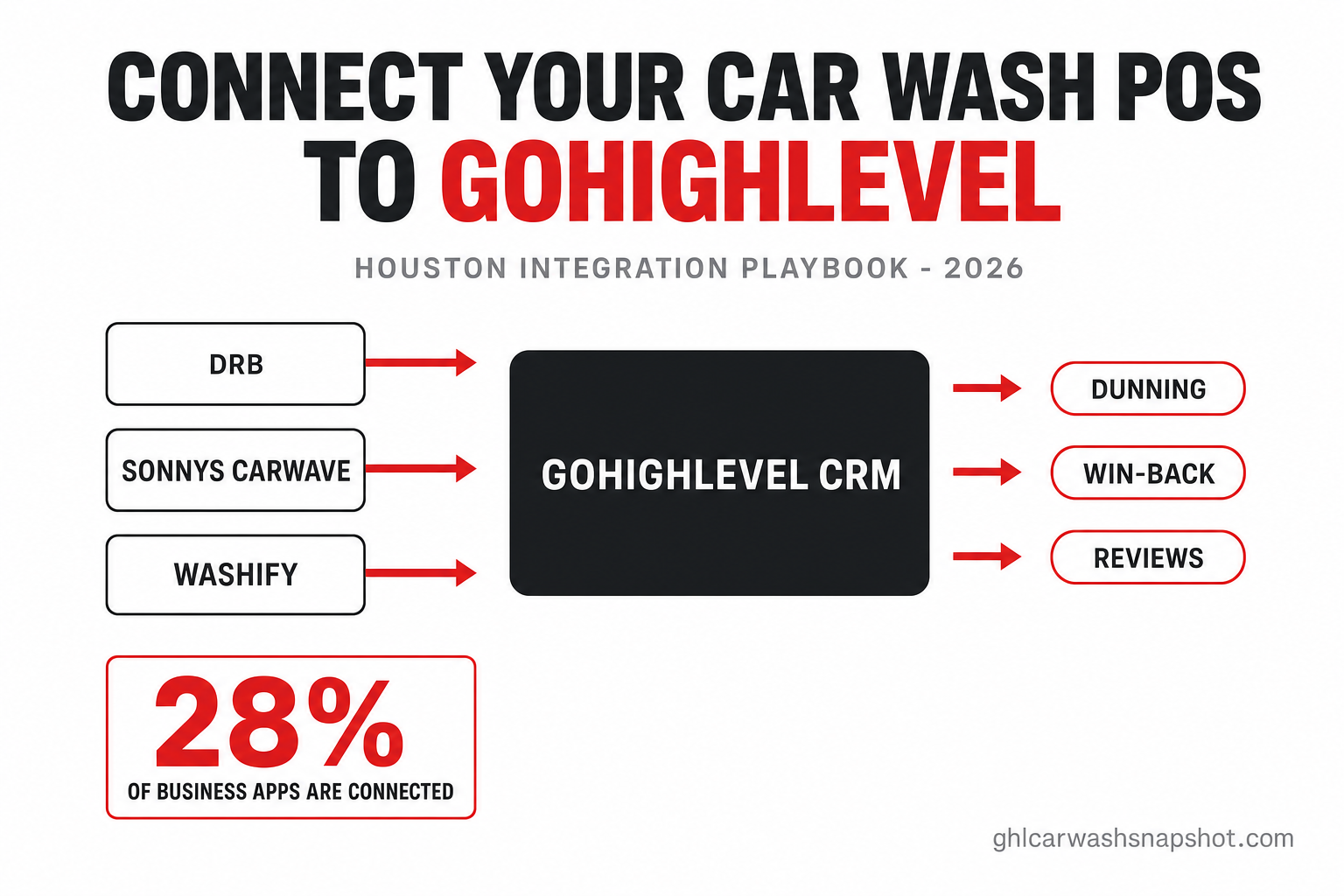
A car wash–to–GoHighLevel integration is a data bridge that pushes your wash’s operational events — a new unlimited-plan signup, a failed card, an RFID scan, a fleet invoice — out of DRB, Sonny’s CarWave, Washify, Everwash, or your POS kiosk and into GoHighLevel, where your marketing and retention automations can act on them in real time. It is not a migration: you keep the tunnel controller and payment system you already run, and simply make them talk to your CRM. For a Houston operator running two or three express locations, that connection is the difference between a member’s expired card silently walking out the tunnel and a dunning text firing the same afternoon.
This is a build-focused playbook — what an integration actually does, why a disconnected stack quietly costs a Houston wash money, and the exact seven steps to wire your systems together. If you’d rather leave your current platform entirely and run everything inside GHL, that’s a migration, and we cover that path in the Chicago migration playbook. This post is for the operator who wants to keep DRB or Sonny’s running the lane and bolt a smart CRM on top.
Table of contents
- What “connecting your POS to GoHighLevel” actually means
- Why a disconnected stack costs a Houston wash money
- The 7-step integration playbook
- Integration vs migration vs custom build — which do you need?
- What it costs and how long it takes
- What an integration can’t fix
- FAQ
What “connecting your POS to GoHighLevel” actually means
Most Houston washes already run a capable operations platform — DRB or Sonny’s CarWave controlling the tunnel and the unlimited plans, Washify or Everwash handling membership, a POS kiosk taking payment, QuickBooks doing the books. Each does its job. The problem is that they do their jobs in separate silos, and nothing carries the events that matter for revenue from one system to the next.
An integration closes that gap. It listens for the events your operations platform generates and mirrors them into GoHighLevel as contact records, tags, and triggers:
- A new unlimited-plan signup at the kiosk becomes a tagged GHL contact and drops into a welcome sequence.
- A failed recharge in DRB fires a GHL dunning flow — a friendly “your wash plan card didn’t go through” text with an update link — the same day, not whenever someone next exports a report.
- An RFID scan / wash count flows in, so a lapsed member who hasn’t washed in 21 days gets a win-back nudge.
- A fleet invoice in QuickBooks tags the account and triggers a net-30 follow-up pipeline.
This isn’t the same decision as leaving your platform. Three distinct paths get confused constantly, so name yours before you spend a dollar:
- Integration — keep your wash platform, sync it to GHL (this post).
- Migration — move members, plates, and billing off your platform into GHL (the Chicago playbook).
- Custom build — software GHL doesn’t have out of the box, like a multi-location member dashboard (custom software).
Why a disconnected stack costs a Houston wash money
Every wash misses revenue at the seams between its systems. A busy multi-location Houston operator misses more of it, for reasons baked into the market.
The data that drives money is trapped in the wrong system. The average organization runs about 900+ applications and integrates only ~28% of them (MuleSoft / Salesforce Connectivity Benchmark). Your wash is a smaller version of the same story: the failed-card event lives in DRB, the member’s phone number lives in Washify, and your follow-up marketing lives in GHL — three places that never sync. So the automation that would save the member never fires, because the tool that could send it never learns the card failed.
Hand-keying is slow and wrong. The alternative to a live sync is someone exporting a CSV on Monday and pasting it into the CRM. Skilled manual data entry still carries an error rate of roughly 1% (human-factors research; see the widely-cited Panko error studies) — and at a wash doing thousands of transactions, 1% of plates, phone numbers, and card statuses entered wrong is a steady drip of broken automations and missed members. Worse, it’s always late: a Monday export can’t power a same-day dunning text.
A member is worth 4× a one-time wash — if you capture them. A converted membership is worth about $440 over three years, versus ~$106 for a one-time retail customer (Cinch), and unlimited members average roughly 2.4–2.6 washes a month (Cinch Tunnel Car Wash Trends). Every plate scanned at your Houston kiosk that never becomes a GHL contact is a $440 relationship you can’t nurture, upsell, or win back.
The clearest example is the silent card leak. Failed and expired cards drive an estimated 30–40% of a wash’s monthly membership churn (Superoperator) — not people who quit, just cards that stopped working. It’s the most recoverable churn there is: in one DRB case, 8.6% of member cards failed on the first recharge and daily retries over 14 days recovered about half (DRB). But recovery only happens if GoHighLevel knows the card failed. Without the integration, the decline sits in your payment system and the member is gone by the time anyone notices. (We break down that leak in depth in The Silent Card Churn.)
The 7-step integration playbook
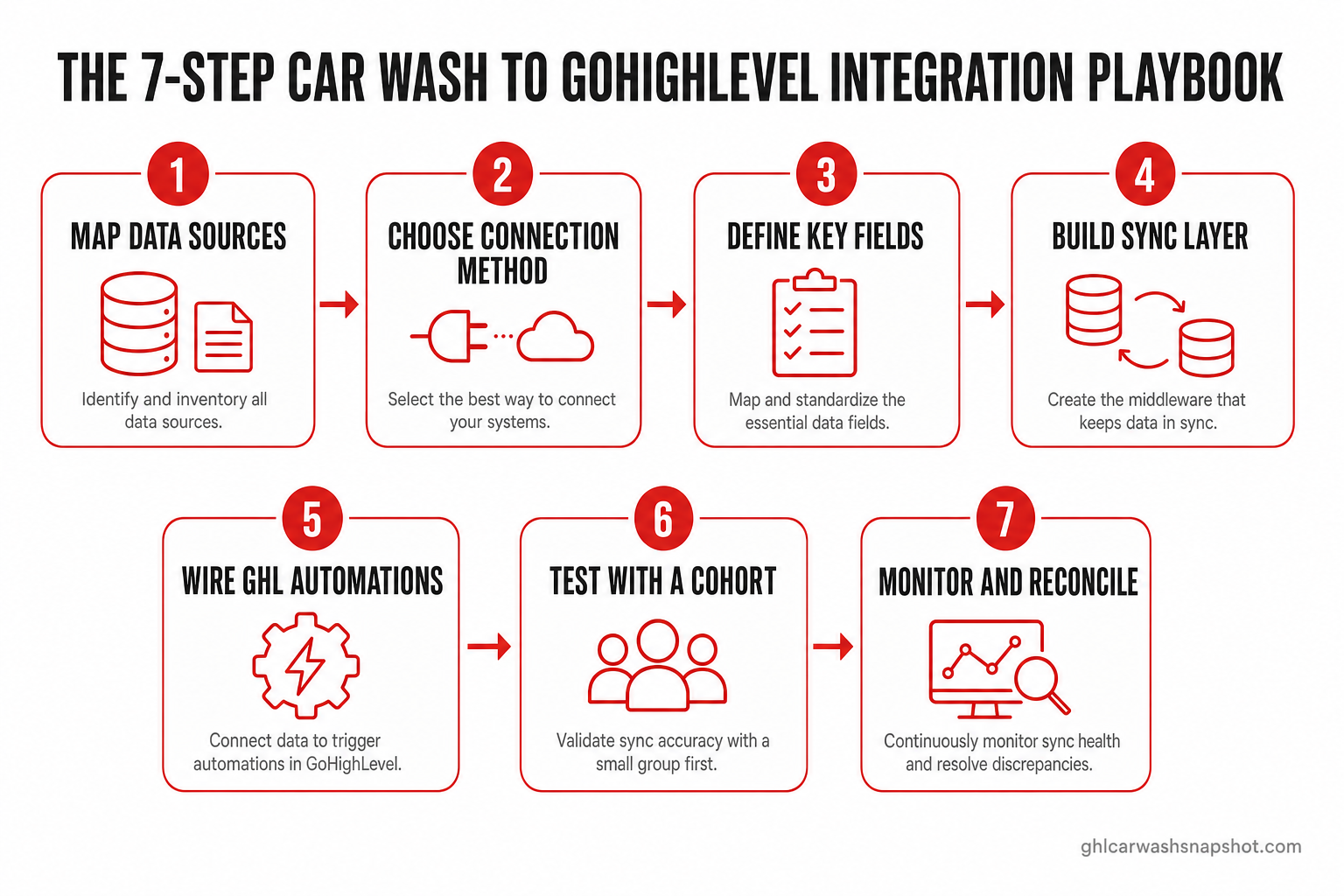
Here’s the exact sequence a good build follows to connect a Houston wash’s stack to GoHighLevel. Steps 1–3 are decisions you make; steps 4–7 are the build and run.
Step 1 — Map every data source
List every system that holds a customer fact: DRB or Sonny’s CarWave (plans, RFID, wash counts), Washify or Everwash (membership), your POS kiosk (signups, one-time sales), your processor (card status), and QuickBooks (fleet invoices). For each, note what it exposes — a webhook, an API, a scheduled export, or nothing but a manual report. This map is the whole project in miniature; skip it and you’ll discover a silo two weeks in.
Step 2 — Choose the connection method per source
There’s no single “connect” button, and that’s fine. Each source gets the tightest method it supports:
- Webhook (best): the platform pushes events to GHL the instant they happen — the right choice for failed cards and new signups.
- API polling: a scheduled job asks the platform “what changed?” every few minutes — good when there’s no webhook for the event you need.
- Scheduled file / CSV sync: a nightly reconciliation for systems that only export — good enough for wash counts, too slow for dunning.
Step 3 — Define the fields that actually matter
You do not need to sync everything. Syncing the wrong 40 fields is how integrations get slow and brittle. For a wash, the revenue-driving fields are short: phone, email, plate-on-file, plan tier, wash count / last-visit date, and card-fail events. Those six power nearly every automation worth running.
Step 4 — Build the sync layer
This is the connector itself — a small service (webhook receiver, polling worker, or scheduled job) that receives events from your wash platform, maps them to GHL contact fields and tags, and writes them via the GoHighLevel API. A good build handles the unglamorous parts: retries when GHL is briefly unavailable, de-duplication so one member isn’t created twice, and a reconciliation pass that catches anything a real-time webhook dropped.
Step 5 — Wire the GoHighLevel automations
Now the synced data earns its keep. Point the incoming events at the workflows that recover and grow revenue: a dunning sequence on card-fail, a win-back on a lapsed wash count, a welcome/onboarding flow on new signups, a review request after a great visit, and a fleet pipeline on a QuickBooks invoice tag. These are the same CRM workflow automations the snapshot ships — the integration is what feeds them live data instead of stale exports.
Step 6 — Test with a small member cohort
Never flip the switch on your whole book. Run the integration against a controlled group — a few dozen members, ideally spanning a new signup, a lapsed member, and a deliberately failed test card — and confirm each event lands in GHL and fires the right workflow. Catch the mapping mistakes here, not on 5,000 live members.
Step 7 — Monitor and reconcile
Integrations aren’t “set and forget.” Platforms change APIs, webhooks silently miss events, and cards fail in new ways. A production connector needs a daily reconciliation job and basic alerting so a broken sync surfaces in a dashboard — not three weeks later when someone notices the win-back texts stopped. Ongoing coverage can run through a dedicated GHL VA with developer support or an hourly retainer.
Integration vs migration vs custom build — which do you need?
Most Houston operators actually want an integration and describe it as a “migration” — a distinction that changes the price and the risk. Here’s how to tell which project you’re really asking for.
Which GHL project fits your wash?
| Plan | Integration (this post) recommended | Migration | Custom build |
|---|---|---|---|
| Price | From ~$3K | Quoted by data volume | $15K+ |
| Feature 1 | You keep DRB / Sonny's / Washify running the tunnel | Move members, plates & billing off your platform | Software GHL doesn't offer out of the box |
| Feature 2 | Sync events into GHL for marketing & retention | Everything lives inside GoHighLevel | Multi-location member dashboards, portals |
| Feature 3 | Lowest risk — your billing never moves | Higher effort — billing continuity is critical | Built on the GHL API, branded to you |
| Feature 4 | Best when the ops platform works but the CRM is blind | Best when you're leaving a platform for good | Best when you've outgrown standard workflows |
| Feature 5 | Webhooks + scheduled sync jobs | See the Chicago migration playbook | Next.js / Python + GHL API |
| Scope an integration | Read migration guide | Explore custom software |
If you’re weighing GoHighLevel against a purpose-built wash CRM in the first place, we compare the trade-offs in Rinsed vs GoHighLevel — the short version is that an integration lets you keep a specialist tool and get GHL’s marketing engine, instead of choosing one.
What it costs and how long it takes
Real numbers, not “contact us.” A small, single-source connector — say, a DRB failed-card webhook into a GHL dunning flow — is a fixed-price build starting around $3K. Two-way bridges (new signups in, cancellations out, dunning from GHL) run higher, and full custom member dashboards start around $15K. If you’d rather pay as you go, the GHL development hourly retainer is $75/hr with a 30-day bug-fix warranty on fixed-price work. A focused connector typically ships in a few weeks — the timeline is driven by what your platform exposes, which is exactly why Step 1 matters.
Set that against the leak. If a synced dunning flow recovers even a fraction of the 30–40% of churn that’s failed-card churn on a book of a few thousand members, the connector pays for itself in the first month or two — and keeps paying every month after.
What an integration can’t fix
An integration is a data bridge, not a strategy. It’s worth being honest about the edges:
- It won’t fix a bad offer. If your unlimited plan is priced wrong or your win-back text is weak, syncing it faster just sends a weak message faster. Get the membership and retention plays right first.
- It won’t replace your processor. GoHighLevel isn’t your merchant account; recurring charges still run through Stripe, Square, or your wash processor. The integration surfaces card events so GHL can respond — it doesn’t move the money.
- It won’t survive without maintenance. As Step 7 says, a connector needs monitoring. An unmaintained integration is worse than none, because you’ll trust automations that silently stopped firing.
Used right, though, a connected stack is one of the highest-leverage upgrades a Houston wash can make — it turns the operational data you’re already collecting into the recurring revenue you’re currently leaving in the silos. For the bigger picture on where automation fits across the wash, start with AI for Car Washes and car wash CRM software.
FAQ
Car wash GoHighLevel integration — FAQ
What's the difference between integrating and migrating to GoHighLevel?
Integration keeps your existing wash platform (DRB, Sonny's CarWave, Washify, Everwash, or a POS kiosk) running and syncs its events into GoHighLevel so your CRM can act on them. Migration moves your members, plates, and billing off that platform and into GHL entirely. Integration is lower risk because your billing never moves — see our migration playbook if you'd rather leave your platform for good.
Can you connect DRB, Sonny's CarWave, Washify, or Everwash to GoHighLevel?
Yes — connecting wash platforms to GoHighLevel is the most common build. We use whatever the platform exposes: webhooks, API polling, scheduled jobs, or file feeds. Members, plates, plan tiers, wash counts, and failed-card events flow into GHL so your automations can act on them. QuickBooks, Stripe, and POS kiosks connect the same way. Details on the GHL development page.
How much does a car wash GoHighLevel integration cost?
Small, single-source connectors are fixed-price builds starting around $3,000. Two-way bridges cost more, and full custom member dashboards start around $15,000. If you prefer pay-as-you-go, the hourly retainer is $75/hr, and every fixed-price build includes a 30-day bug-fix warranty.
How long does an integration take to build?
A focused single-source connector typically ships in a few weeks. The timeline depends almost entirely on what your wash platform exposes — a clean webhook is fast; a system with only nightly exports takes longer to sync reliably. Mapping your data sources first (Step 1) is what keeps the timeline predictable.
Will an integration help recover failed member cards?
That's one of the biggest wins. Failed and expired cards drive an estimated 30–40% of monthly membership churn, and it's highly recoverable — but only if GoHighLevel knows a card failed. The integration pushes card-fail events from your processor or POS into GHL so a dunning sequence fires automatically. Without it, the decline sits in your payment system and the member churns silently.
Do I have to leave my current wash software?
No. The whole point of an integration is that you keep the tunnel controller and payment system you already trust. You're adding a CRM layer on top, not replacing what runs the lane. If your current platform genuinely isn't working, a migration is the alternative — but most operators just want their systems to talk.
Is this only for Houston car washes?
No — the playbook works for any operator, but Houston and the wider Texas market are dense and competitive, so an operational edge like a connected stack pays off faster where you're fighting for members block by block. The seven steps are the same whether you run one location or five.
About the author. Rhea Malhotra is the Recurring Revenue & Billing Automation Lead behind the GHL Car Wash Snapshot. A recovering RevOps analyst based in Austin, Texas, she builds the failed-payment recovery flows, processor integrations, and reporting dashboards behind the snapshot — and can tell you exactly which retry cadence wins back the most MRR. She writes about the quiet math of recurring billing: dunning windows, decline codes, and the members every wash loses to expired cards.
Related posts
- How to Migrate Your Chicago Car Wash to GoHighLevel Without Losing a Member
- The Silent Card Churn: Recovering the Members Your Wash Loses to Expired Cards
- Car Wash CRM Software: What Actually Matters for Wash Operators
- Rinsed vs GoHighLevel for Car Wash Operators
- AI for Car Washes: The 2026 Automation Stack