
A car pulls through your tunnel on a Saturday, pays $15 for the top wash, and drives off. You will probably never see that plate again, and if you do, you will not know it. The wash two exits down put that same driver on a $30 unlimited plan before they left the pay station, and now bills them every month whether it rains, snows, or they forget they signed up. Same car, same wash price, two completely different businesses. The only thing between them was a conversion system.
Here is the answer up front. Your retail-to-member conversion rate, the share of one-time washers you turn into monthly members, is the single number that decides whether your wash grows or stalls. The best-run operators convert 17.3% of eligible washers; the smallest convert 2.4% (Rinsed Q2 2026). The gap is not luck or location. It is a seven-stage capture-and-convert system that runs at the lane and over text. This is the build guide: the seven stages, the exact scripts and messages to steal, how each stage breaks, and the math at one, three, and eight locations.
Table of contents
- What retail-to-member conversion actually means
- What a low conversion rate is costing you
- The conversion engine: seven stages
- Steal these: the exact scripts and messages
- How each stage breaks (and the guard)
- The engine at one, three, and eight locations
- Keep it legal and honest
- Objections, answered
- FAQ
What retail-to-member conversion actually means
Retail-to-member conversion is the share of your one-time, pay-per-wash customers you turn into recurring members over a period. If 1,000 retail cars come through this month and 50 sign up for the club, your conversion rate is 5%.
That one number sits upstream of almost everything else. Churn, lifetime value, and pricing all operate on the member base you built, and you build that base one conversion at a time. A wash with a great pricing ladder and a weak capture system is a bucket with a hole in it. Most operators cannot even tell you their rate, which is the first tell there is no system: you cannot improve a number you do not watch.
What a low conversion rate is costing you
Start with the industry split. In the Q2 2026 data, membership revenue grew 10.4% year over year while retail revenue fell 3.9% (ICA / Rinsed). Same-store revenue across 3,000-plus locations was up 5.4%, and that growth came from members (Rinsed). Retail is not a growth engine anymore. It is your conversion inventory.
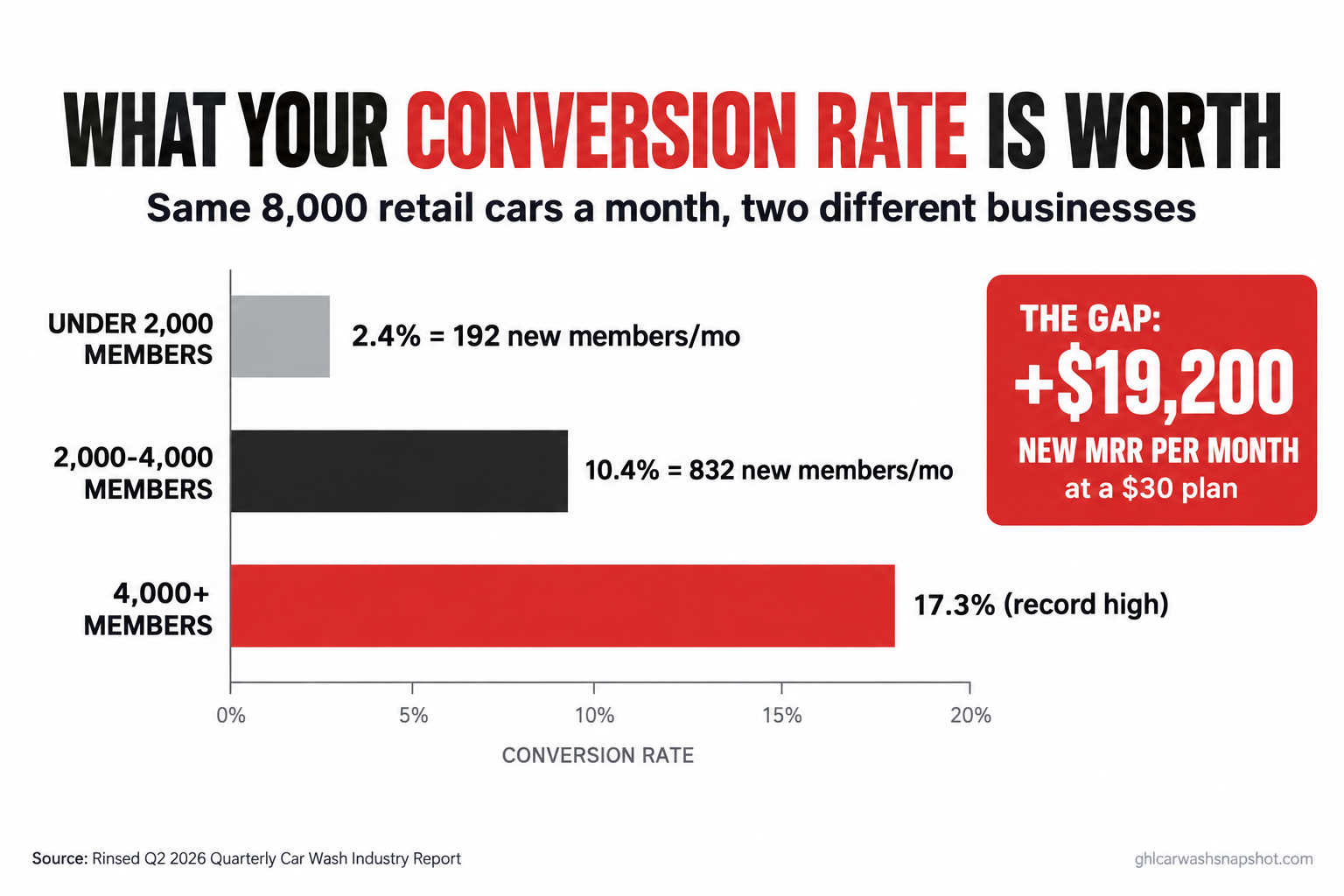
Now the gap that should keep you up at night. Conversion scales hard with size: washes with 4,000+ members convert at 17.3%, a record high; 2,000 to 4,000 convert at 10.4%; under 2,000 convert at just 2.4% (Rinsed Q2 2026). The big operators are not getting better cars. They built the capture-and-convert machine first, and it compounds.
Put dollars on it. Say you do 8,000 retail cars a month. At 2.4% you add 192 members; at 10.4% you add 832. At a $30 plan that gap is about $19,200 in new monthly recurring revenue, from cars you were already washing. Not a dollar more in marketing, just closing the back door.
And the member you convert is worth far more than the $15 wash they paid for. Members average roughly 2.6 washes a month versus a handful a year for casual customers (Cinch; Car Wash Advisory), and 91% say they plan to renew (ICA Pulse Q2 2026). Converting one washer is not one sale, it is a year or more of dues.
The conversion engine: seven stages
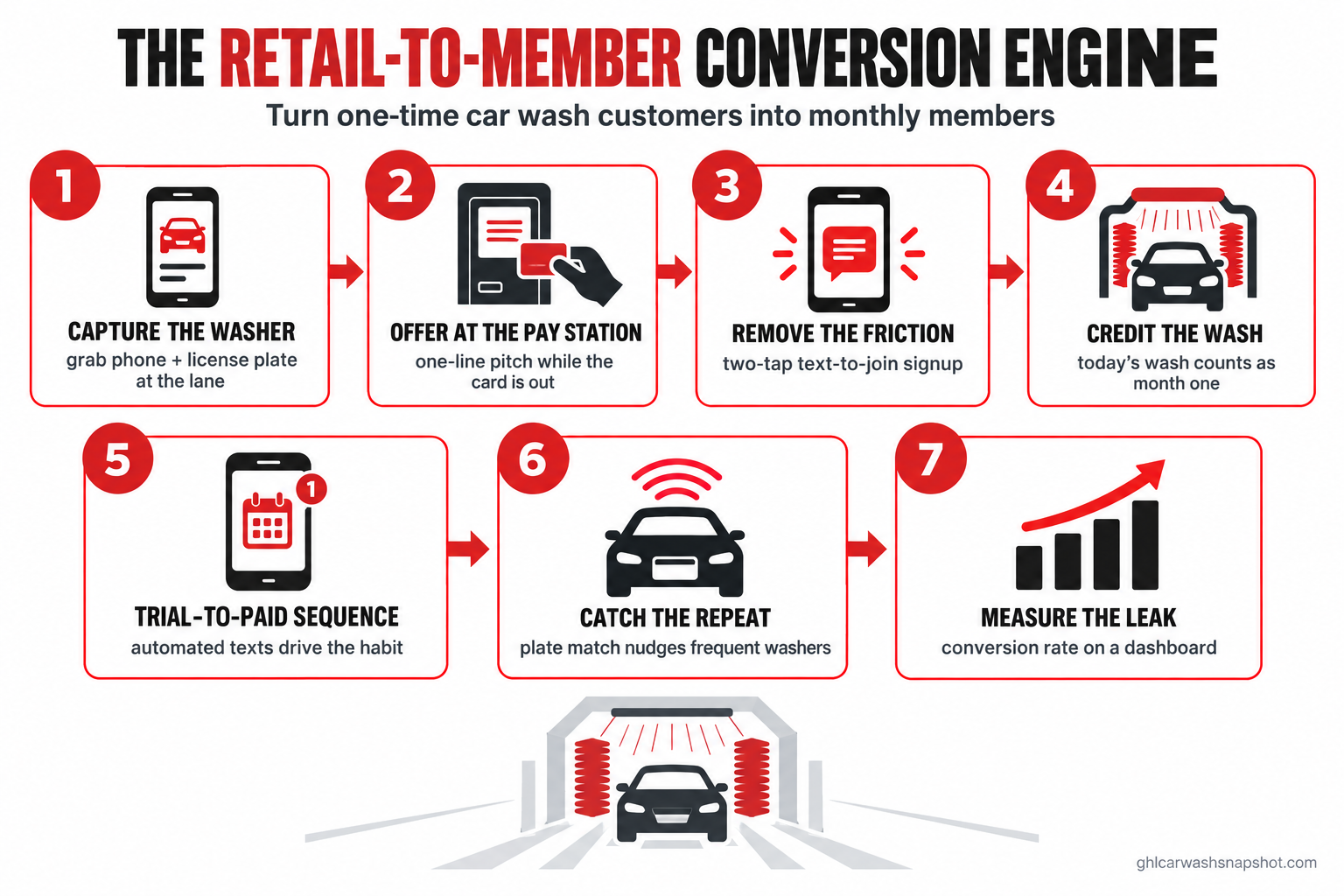
The whole system does one thing: it gets a capture and an offer in front of a retail washer inside the 60 seconds you have their attention, then follows up automatically with everyone who did not say yes. Seven stages.
Stage 1: Capture the washer. Before you convert anyone, you need a way to reach them: a phone number, ideally the plate. The tools are a plate reader at the lane, a QR on the pay station and receipt, and a “text this number for your receipt” prompt. No capture, no funnel.
Stage 2: Make the offer at the pay station. The highest-converting moment is before the car moves. A one-line attendant script or a kiosk prompt turns the wash they are already buying into the first month of a plan.
Stage 3: Remove the friction. A text-to-join link or QR that drops them onto a prebuilt signup page with the plan pre-selected and card entry in two taps beats any clipboard or “download our app” wall.
Stage 4: Credit the wash they just bought. The best offer is not a discount, it is “the wash you just paid for counts as your first wash, keep it unlimited the rest of the month.” It kills the feeling of paying twice, the number-one objection at the lane.
Stage 5: Run the trial-to-paid sequence. For everyone who took a first-month offer but has not committed, a short automated text and email sequence nudges the second and third wash (the habit) and confirms the plan before the first renewal.
Stage 6: Convert the repeat retail customer. A washer who comes back a second time within 30 days is a member who has not signed up yet. A plate match triggers a “you washed twice this month, a plan would be cheaper” message.
Stage 7: Measure and fix the leak. Put conversion on a dashboard by stage: capture rate, offer rate, trial starts, trial-to-paid rate. You cannot run an engine you cannot see.
The wash without a system vs. the wash with one
Attendant waves the car through. No plate, no number, no offer. The only path to membership is the customer finding the signup page alone. Conversion sits near 2%, and nobody can say what it is.
Plate and number captured at the lane, a one-line offer at the pay station, two-tap text-to-join, and a trial sequence for the maybes. Conversion climbs toward double digits, on a dashboard.
Steal these: the exact scripts and messages
Copy these, change the brand name, and load them into your signup funnel and SMS flows. Written to be said out loud or read on a phone: short, plain, no pressure.
Stage 2, the pay-station attendant script (said while the card is still out):
“Quick heads up, the wash you just got is $15. Our Unlimited plan is $30 a month and this wash counts as the first one, so you could wash every day for the same money. Want me to text you the link? Takes 20 seconds, cancel anytime.”
Stage 1 and 3, the text-to-join message (fires when they say yes or scan the QR):
Hey, it’s [Wash name]. Here’s your 20-second signup, your [Top Wash] plan is already picked: [link]. Today’s wash counts as your first. Reply STOP to opt out anytime.
Stage 4, the “wash you just bought counts” confirmation:
You’re in, [First name]. Your Unlimited plan is active and today’s wash is already on it. Just pull into the member lane and we’ll read your plate, no app needed. First renewal [date]; we’ll remind you.
Stage 5, the trial-to-paid sequence:
Day 2: Car still clean? Run it through again today, it’s included. Most members wash 2-3 times a week once they realize it’s unlimited.
Day 10: You’ve washed [X] times this month, [First name]. At $15 each that’d be $[X times 15]; your plan is $30. Nothing to do, just keep pulling through the member lane.
Day 25 (before renewal): Heads up, your plan renews [date] at $30. You’ve gotten [X] washes so far. Keep it rolling, or reply PAUSE and I’ll freeze it, no charge.
Stage 6, the repeat-retail nudge (fires on a second retail wash within 30 days):
Saw you through twice this month, [First name], that’s $30 in single washes. The Unlimited plan is $30 flat and today’s wash counts toward it. Reply YES for the link and you’ll be set before you leave the lot.
Notice what is missing: no countdown pressure, no “limited spots,” no guilt. The offer wins because the math is genuinely better for a frequent washer, and you make that obvious at the moment they can act on it.
How each stage breaks (and the guard)
A conversion engine fails quietly. The lane still moves, cars still pay, and the only symptom is a number nobody is watching. Here is how each stage breaks and the guard for it.
- Stage 1, no capture. You offer the plan but cannot follow up with the 80% who say “maybe later.” Guard: capture a phone number even when they decline the plan. The receipt-by-text prompt does this without feeling like a pitch.
- Stage 2, the offer never gets made. Attendants are busy, shy, or untrained, so the pitch dies. Guard: make it a required step. Put it on the kiosk screen so it fires with zero staff effort, and script the one line for the humans.
- Stage 3, friction kills the yes. The customer agrees, then hits a clipboard or a five-field form and bails. Guard: text-to-join with the plan pre-selected and two-tap card entry. Measure the drop between “sent the link” and “completed signup.”
- Stage 4, it feels like paying twice. “I just paid $15, now you want $30?” Guard: always credit the wash they just bought. That is the difference between a 2% and a double-digit close.
- Stage 5, the trial never converts. You give a first month but never build the habit, so they wash once and forget. Guard: the Day 2 / Day 10 / Day 25 sequence that drives the second and third wash, as the retention playbook covers in depth.
- Stage 6, repeat washers slip through. A plate comes back three times a month and you still charge retail. Guard: a plate-match trigger that fires the “a plan would be cheaper” nudge automatically.
- Stage 7, you fly blind. No dashboard, so you optimize nothing. Guard: track capture rate, offer rate, trial starts, and trial-to-paid separately. The LTV and churn calculator tells you what each member is worth.
The meta-failure is running it all on vibes. If you cannot say what your conversion rate was last month and which stage leaks most, you have a wash, not an engine.
The engine at one, three, and eight locations
The seven stages are the same at every size. What you optimize changes.
The single site (under 2,000 members, near 2.4%). Your problem is not analytics, it is that the offer rarely gets made in the Saturday rush. Two moves win: put the offer on the pay-station screen so it fires itself, and make text-to-join fast enough that a yes becomes a member before the car moves. Going from 2.4% to even 6% on 5,000 monthly cars adds about 180 members a month, roughly $5,400 in new MRR, for a flow you build in an afternoon. This is the groundwork behind a clean 30-day club launch.
The three-location chain (2,000 to 4,000 members, around 10.4%). Now consistency is the game. One site converts at 12% and another at 6% because of who works the lane, and you cannot see it. Wire the funnel into your CRM and workflow automations so capture, offer, and trial-to-paid rates roll up per site. Fix the lagging location and you lift the whole chain.
The eight-site regional operator (4,000+ members, near the 17.3% ceiling). The engine is now a data instrument. You A/B test the pay-station line, the trial timing, and the credit offer, because a single point of conversion is a six-figure annual number. At your volume the frictionless, app-free member lane is what keeps the 17.3% from sliding. Conversion sits next to pricing and churn on the same dashboard.
Keep it legal and honest
Two rules keep this system out of trouble. First, the texts are marketing messages, so capture real consent: a clear opt-in at capture (“text JOIN for your link and offers; reply STOP anytime”), and honor STOP instantly. That is TCPA basics, not optional.
Second, the plan is an auto-renewing subscription, so disclose the terms plainly at signup: the price, that it renews monthly, and how to cancel. The federal “click-to-cancel” rule was vacated in July 2025, but state auto-renewal laws still require clear disclosure and an easy cancel path (full breakdown in the car wash membership auto-renewal laws guide). A system that hides the renewal does not build members, it builds chargebacks and one-star reviews.
Objections, answered
“Won’t pushing memberships at the lane slow down my throughput?” Not if the offer is one line and the signup is a text. The attendant says the line while the card is already out, and signup happens on the customer’s phone after they pull forward. Done right it adds seconds, and the kiosk version adds zero.
“My customers are one-time washers, they don’t want a plan.” Some do not, and that is fine. But even small washes convert 2.4% and well-run ones hit double digits from the same traffic (Rinsed Q2 2026). You are not trying to convert everyone, just to stop missing the 1 in 10 who would say yes if you asked.
“I already run a POS with memberships. Doesn’t it do this?” Your POS takes payment and reads the plate. It usually does not run the pay-station script, the two-tap text-to-join, or the automated trial sequence. Those live in a marketing layer on top, which is what a GoHighLevel-based system adds.
“Do I need to be technical to set this up?” No. The capture funnel and sequences ship prebuilt for washes, and a GoHighLevel VA can wire them to your POS and watch the dashboard for you.
“Isn’t crediting the wash just giving away a wash?” You are not giving anything away. The customer already paid for it. You are reframing it as the first wash of a plan, which removes the “paying twice” objection and turns a $15 one-time sale into a $30 recurring one.
The bottom line
Membership is the part of the wash still growing, up 10.4% while retail fell 3.9% (ICA / Rinsed Q2 2026), and the operators winning it are not the ones with better cars. They built the capture-and-convert engine, which is why they convert at 17.3% while the field sits at 2.4%. The gap is a system: capture the washer, make the offer before the car moves, kill the friction, credit the wash, run the trial sequence, catch the repeat, and watch the number. Build the seven stages, steal the scripts, and stop letting paying customers drive off as strangers.
FAQ
What is a good retail-to-member conversion rate for a car wash?
In the Rinsed Q2 2026 report, washes under 2,000 members converted about 2.4% of eligible washers, 2,000 to 4,000 converted 10.4%, and 4,000+ hit a record 17.3%. A single-site operator should target high single digits to low double digits, and the main lever is making the offer at the pay station and removing signup friction.
When is the best moment to pitch a car wash membership?
Before the car moves, at the pay station, while the card is still out. The customer is already paying for a wash, so crediting it toward the first month removes the feeling of paying twice. Everyone who does not say yes on the spot goes into an automated text sequence.
How do I convert one-time washers without slowing down the lane?
Use a one-line attendant script or a kiosk prompt for the offer, then hand the signup to the customer's phone via a two-tap text-to-join link with the plan pre-selected. The pitch takes seconds and signup happens after they pull forward, so throughput is barely affected.
Should I offer a discount or a free trial to convert members?
Neither beats crediting the wash they just bought. Telling a customer the $15 wash they already paid for counts as the first wash of a $30 unlimited month removes the top objection at the lane. Save discounts for win-back; at the point of sale, the better math does the work.
How do I measure my car wash conversion rate?
Divide new members in a period by eligible retail washers in the same period, then break it into stages: capture rate, pay-station offer rate, trial starts, and trial-to-paid rate. Tracking the four separately tells you exactly where the funnel leaks.
Can GoHighLevel run a car wash membership conversion funnel?
Yes. It can host the two-tap signup page, send the text-to-join link and the Day 2 / Day 10 / Day 25 trial sequence, and trigger the repeat-retail nudge from a plate or purchase match. It sits as a marketing layer on top of the POS that handles payment and plate reading.
Related posts
- Car Wash Membership Pricing: How to Price an Unlimited Wash Club Members Actually Keep
- How to Launch an Unlimited Wash Club in 30 Days (Without Burning Through Cards)
- Car Wash Customer Retention: The 2026 Playbook to Cut Churn and Grow LTV
- Car Wash Membership Churn and LTV: The Calculator That Tells You If Your Wash Club Is Growing
- Rinsed vs. GoHighLevel for Car Washes: Which CRM Should Run Your Wash Club?