
It is a Tuesday morning and an email lands from your merchant processor. A member has filed a chargeback, reason code “cancellation not honored.” She swears she tried to cancel your unlimited plan twice, could not find how, and gave up. You know she kept pulling through the tunnel for two more months. Now you are eating the dispute fee, the refund, and a black mark on your dispute ratio.
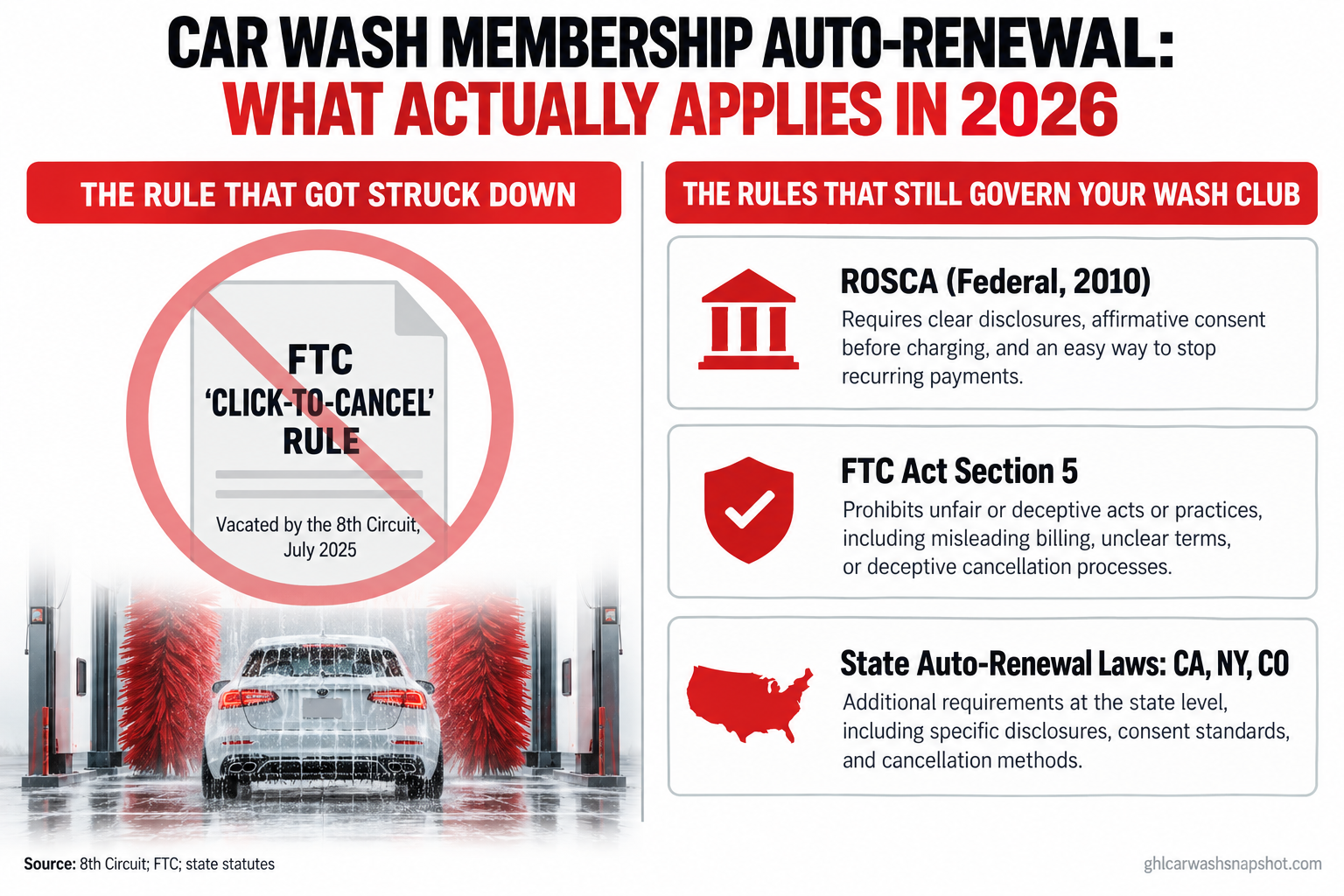
Here is the answer up front: the “click-to-cancel” rule you read about last year is not the thing that will bite you. A federal court threw it out in July 2025. But three other rules were already governing your wash membership before that rule existed, they never went away, and they are exactly what a chargeback, a state attorney general, or a class-action lawyer will use against you. If your flow was built for the old rumor, it is aimed at the wrong target.
What actually happened to “click-to-cancel”
In October 2024 the FTC finalized a revised Negative Option Rule, nicknamed “click-to-cancel.” It would have forced any business selling an auto-renewing subscription to get separate consent to the renewal, disclose the terms up front, and let members cancel through the channel they joined, with no retention maze. For an unlimited wash club, that is your entire membership.
It never took effect. On July 8, 2025, the Eighth Circuit vacated the rule in its entirety, six days before its July 14 compliance deadline. The court did not say the protections were wrong. It said the FTC skipped a required economic-impact analysis for a rule with more than a $100 million effect, and that procedural miss was fatal (Cooley).
So the specific federal mandate is gone, and that is where most operators assume the pressure is off. It is not. The FTC reopened the rulemaking in March 2026 (FTC), and both the agency and state attorneys general kept enforcing the rules already on the books (Arnold & Porter). The rumor got vacated. The duties did not.
The three rules that actually govern your wash membership right now
Strip away the headlines, and here is what a regulator or a member’s lawyer points to.
1. ROSCA, the federal floor
The Restore Online Shoppers’ Confidence Act has been law since 2010. It applies whenever you sell a negative-option plan (anything that keeps charging until the customer stops it) online. If a driver can join your unlimited plan on your website, a kiosk web form, or a link you text them, ROSCA reaches you. It requires three things: disclose the material terms clearly before you collect billing information, get express informed consent before the first charge, and give a simple mechanism to stop the recurring charge (FTC Negative Option Rule). Those three duties are the backbone of everything below, and the vacated rule never repealed them.
2. Section 5 of the FTC Act
Section 5 bans “unfair or deceptive acts or practices,” and it is broad on purpose. If your join page buries the auto-renewal in gray six-point type, or your only cancel path is a number nobody answers on a Sunday, the FTC does not need a special subscription rule to act. It uses Section 5, the authority behind its cases against Amazon, Uber, and others, and it is not going anywhere.
3. State auto-renewal laws, the fast-moving part
This is where it gets real for a multi-location operator. States have passed their own auto-renewal laws that look a lot like the vacated federal rule, and they are in force today. The three that matter most:
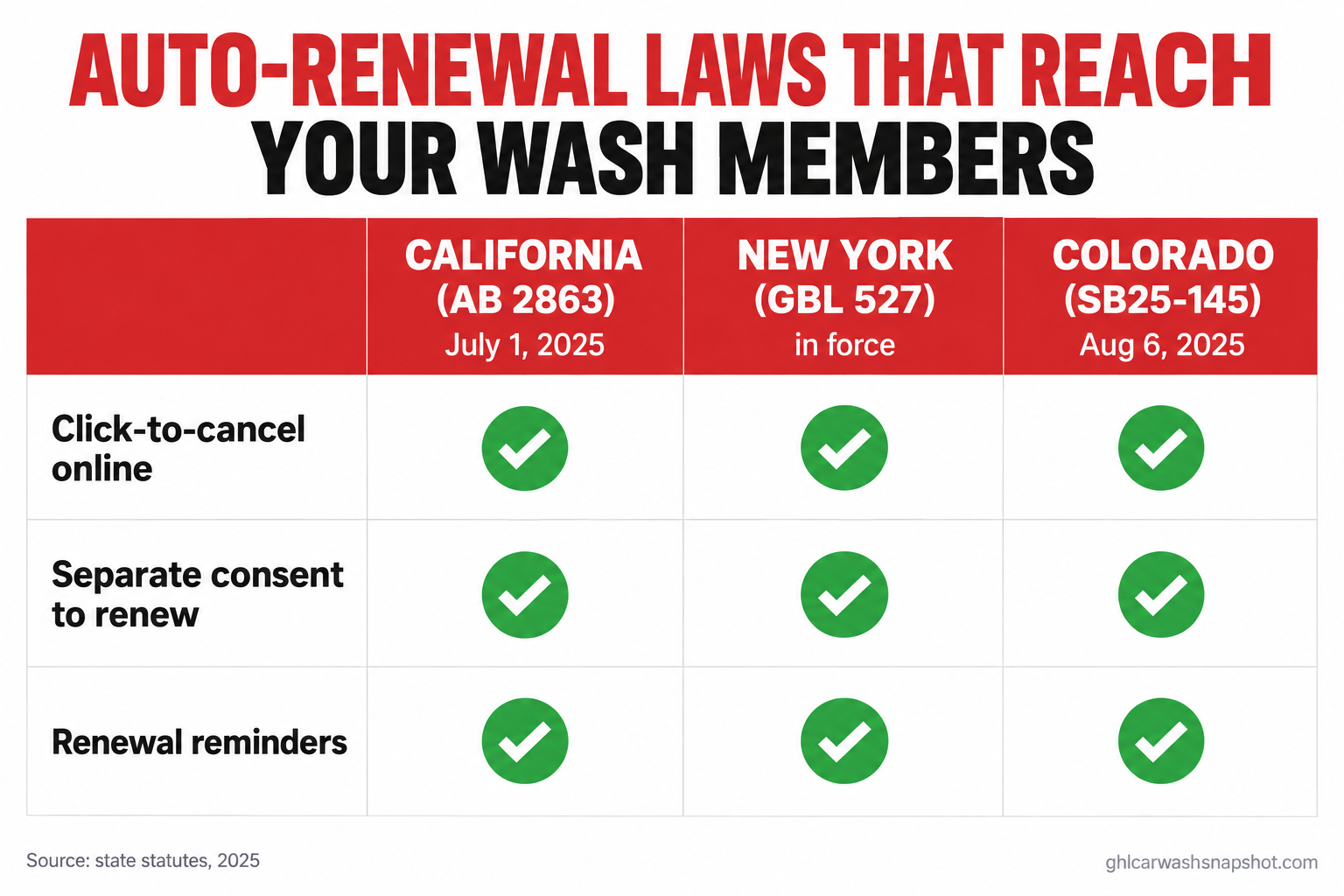
- California (AB 2863). Amendments effective July 1, 2025 require a genuine “click to cancel” path online, separate affirmative consent to the renewal (no pre-checked box, no burying it in the terms), annual reminders, and a 15-to-45-day notice before any renewal on plans a year or longer (Cooley; California DOJ).
- New York (Gen. Bus. Law §527). Requires clear disclosure, renewal notices, consent for price hikes, and a clear in-app cancel button.
- Colorado (SB25-145). The Online Cancellation Act requires one-step online cancellation for anyone who signed up online, effective August 6, 2025.
Here is the trap: your members do not stay inside state lines. If you run a wash on the Arizona-California border, have a location in Denver, or a member simply moves, the strictest law that touches any member effectively sets your standard. Far cheaper to build one flow than to maintain three.
What getting this wrong actually costs you
Auto-renewal complaints are not a rounding error. In its March 2026 rulemaking notice, the FTC said it had received more than 100,000 complaints about negative-option and hard-to-cancel programs over the prior five years (FTC). That is economy-wide, but the pattern behind it (an unexpected charge, a cancel path they could not find) is the same one that generates a chargeback in your merchant account.
A member is worth roughly $444 over 36 months, versus about $64 for a one-time washer and $104 for a repeat retail customer (Cinch). Membership is now the engine: Rinsed’s Q2 2026 report found membership revenue up 10.4% while retail fell 3.9% at the same locations (ICA / Rinsed). With roughly 90% of members saying they intend to renew (ICA Pulse Q1 2026), the money is in keeping them happy, not trapping the few who want out.
That is the part operators miss. A hard-to-cancel flow does not save the membership. It converts a quiet cancellation into a chargeback, a one-star review, and, if enough stack up, a letter from a state attorney general. The friction you added to protect revenue is the thing bleeding it.
The 6-point compliance checklist for a wash membership
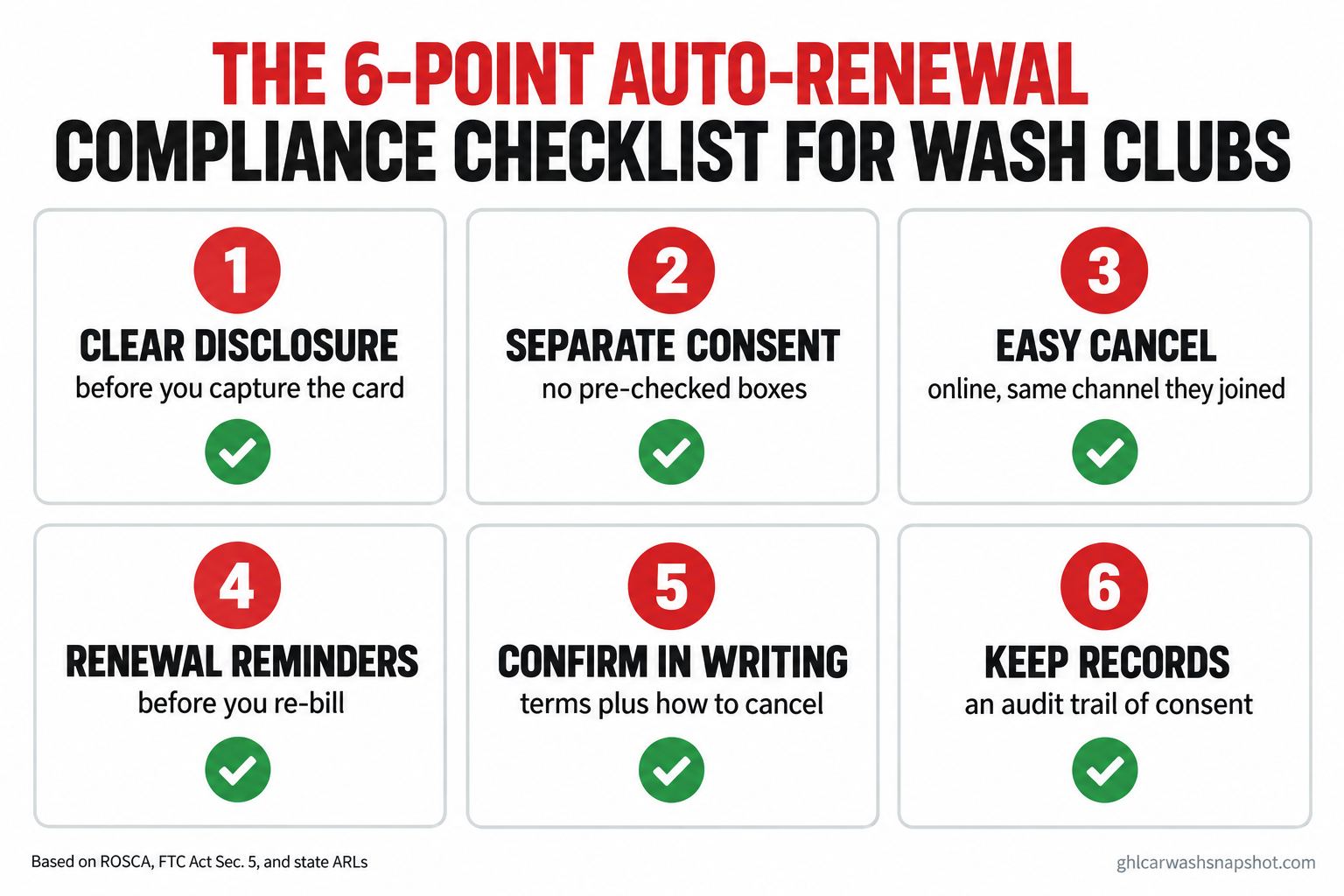
This is the whole job. Build these six controls once and you cover ROSCA, Section 5, and the current state laws in one flow. For each, I added the way it actually breaks in a real wash, because the failure mode is where operators lose.
1. Disclose the terms clearly, before you capture the card
Right next to the join button, in plain type the same size as the rest of the form, state the price, the billing frequency, that it renews automatically until canceled, and how to cancel. Not on a linked terms page, on the screen where the card goes in.
How it breaks: the kiosk shows a big “$29.99” and the renewal language lives behind a “Terms” link nobody taps. That is the classic ROSCA and Section 5 gap: a regulator reads it as the terms being hidden at the moment of sale.
2. Get separate, affirmative consent to the auto-renewal
The customer has to actively agree to the recurring charge as its own step: an unchecked box they tick, or a button that says “Start my auto-renewing membership.” Never a pre-checked box, and never consent bundled inside a giant terms-of-service acceptance.
How it breaks: the pre-checked box. California’s amended law bans exactly this, and it is the most common defect I see on wash signup forms. If your developer set a default-on checkbox to lift conversion, turn it off today.
3. Make canceling as easy as joining
If a member can sign up in 60 seconds on their phone, they must be able to cancel roughly that easily, through the same channel: a self-serve cancel link in the portal, a text path, or a reply actioned same-day. One clear button, not a retention maze.
How it breaks: “call during business hours to cancel,” then nobody picks up, or the rep runs a save script the member did not ask for. That is the number-one driver of “I tried to cancel” chargebacks, and exactly what Colorado’s one-step rule and New York’s in-app cancel button target.
4. Send renewal and price-change reminders
Before you raise a price or renew a longer commitment, tell the member in advance, in writing, with the new amount and the cancel path. California requires a 15-to-45-day heads-up on plans of a year or more, and consent for price hikes runs through the state laws.
How it breaks: you push a $5 increase silently. Members notice on the statement, feel ambushed, and dispute the charge instead of canceling cleanly. A reminder that costs one SMS avoids a chargeback that costs you the member.
5. Confirm the membership in writing right after signup
Immediately after they join, send an email or text that restates the terms and spells out how to cancel. It is both a legal record and your first retention touch.
How it breaks: no confirmation goes out, so 40 days later a member says “I never agreed to a recurring charge,” and you have nothing that shows they did.
6. Keep an audit trail of consent
Store, per member, what they saw and agreed to: the disclosure version, the timestamp, the consent checkbox state, and the confirmation you sent. It wins disputes.
How it breaks: the records live only in the payment processor, which shows the charge but not the consent. When a member disputes, you can prove you billed them, not that they agreed. You lose.
Steal this copy
You do not need a lawyer to draft the everyday language (though have one review the final version). Here is copy you can adapt. Swap in your real price, wash name, and cancel path.
The disclosure line, right above the join button:
Unlimited Wash Club: $29.99/month. Your card is charged automatically every month until you cancel. Cancel anytime in one click from your member account or by replying CANCEL to any of our texts.
The separate consent checkbox (unchecked by default):
☐ I agree to enroll in the Unlimited Wash Club and understand my card will be charged $29.99 every month until I cancel.
The signup confirmation (email or SMS, sent immediately):
You’re in the Unlimited Wash Club at [Wash Name]. You’ll be charged $29.99 on the 12th of each month until you cancel. Cancel anytime here: [self-serve cancel link]. Questions? Reply to this message.
The pre-renewal price-change notice (send 30 days ahead):
Heads up: your Unlimited plan renews on [date] at the new rate of $34.99/month. Nothing to do if you want to keep washing. If you’d rather stop, cancel in one click here: [cancel link]. Thanks for being a member.
The cancellation confirmation (the one most washes skip):
Your Unlimited Wash Club membership is canceled. You won’t be charged again. Your plan stays active through [paid-through date], so keep washing until then. Changed your mind? Rejoin anytime: [link].
That last message matters more than it looks. A clean cancel confirmation stops the “did it actually cancel?” chargeback, and the soft rejoin line quietly wins back a slice of leavers. Then pair this with a proper failed-payment sequence, where most washes lose members without ever getting a cancel request. Full playbook in silent card churn.
Three washes, three different answers
The rules are the same; how they land depends on how you sell memberships.
The single-location express tunnel with kiosk signup
Most joins happen at the pay station or on a QR-code web form. Because that form is online, ROSCA and your state’s law both apply in full. Priorities: fix the pre-checked box (control 2), put the disclosure on the kiosk screen next to the price (control 1), and add a self-serve cancel link to the confirmation text (controls 3 and 5). One afternoon removes most of your risk.
The three-location unlimited club across two states
Now you have members in more than one state, so the strictest rule sets your baseline. If even one location or member sits in California, build to AB 2863: separate consent, true one-click cancel, annual reminders, advance notice on price changes. Do not run three flows by ZIP code. Build the California-grade flow once and apply it everywhere. It is cheaper and it future-proofs you as more states pass copycat laws.
The wash that sells memberships only in the lane, on a tablet
If a member never touches an online form, the online-specific ROSCA hook is weaker, but do not relax. Section 5 still bans deceptive terms in any medium, and the moment you add an online join link or a “manage membership” page, you are squarely back under ROSCA. Build the compliant flow now so growth does not quietly put you offside. For how the signup should be structured, see the unlimited wash club launch guide.
Objections I hear from operators
“My members sign up in the lane, not online. Does this apply to me?” Section 5 applies to every medium, and most washes add an online “manage my plan” or QR signup within a year because it lifts conversion. The day you do, ROSCA and your state law switch on. Building the flow now costs an afternoon; retrofitting it after a complaint costs far more.
“Won’t a one-click cancel button tank my retention?” The data says the opposite: around 90% of unlimited members already intend to renew (ICA Pulse Q1 2026). An easy cancel button does not create leavers, it changes how the few who leave exit: cleanly, instead of via a chargeback and a one-star review. Put your retention effort into the failed-payment save and a real pause-instead-of-cancel offer, not into hiding the exit. See car wash customer retention.
“I already use Rinsed or Washify. Aren’t they handling compliance?” They give you tools; they do not assume your legal exposure. The disclosure copy, the consent step, and the cancel path are configured by you, and the liability is yours. Rinsed also carries cost that is easy to miss (a per-location setup fee plus an ongoing commission on memberships signed through its forms). I compared the approaches in Rinsed vs GoHighLevel.
“I’m not in California, so who cares?” Your members travel and move, New York and Colorado already have their own laws, and the FTC is drafting a fresh federal rule (Kirkland & Ellis). Build the strict version once and stop worrying about which line your next member lives on.
Frequently asked questions
Is the FTC click-to-cancel rule in effect in 2026?
No. The Eighth Circuit vacated the FTC's revised Negative Option Rule in full on July 8, 2025, six days before its July 14 compliance date, on procedural grounds. The FTC reopened rulemaking in March 2026, but as of September 2026 there is no federal click-to-cancel rule in force.
So do I still have to let car wash members cancel easily?
Yes. The vacated rule was never the only law. ROSCA requires a simple cancellation mechanism for online plans, Section 5 of the FTC Act bans deceptive cancellation practices in any medium, and California, New York, and Colorado all require online or one-step cancellation. Easy cancellation is still required.
Does auto-renewal law apply if members sign up on a kiosk, not my website?
If the kiosk uses a web-based form, ROSCA and state auto-renewal laws generally apply because the transaction happens through an electronic medium. Even an attendant-entered signup is covered by Section 5's ban on deceptive terms. The safest move is one compliant flow regardless of channel.
Which state's law do I follow if I have members in several states?
In practice, the strictest law that touches any of your members sets your standard, because running a different flow per state is expensive and error-prone. California's AB 2863 is currently the toughest, so building your flow to California's requirements generally keeps you compliant across states.
Can a member charge back a wash membership because they could not cancel?
Yes, and it is common. When a member cannot find a clear cancel path, many dispute the charge with their bank instead, using a 'cancellation not honored' reason. That costs you a dispute fee, the refund, and a hit to your dispute ratio, which is why an easy, documented cancel flow protects revenue rather than draining it.
The bottom line
Back to that Tuesday-morning chargeback. It did not happen because a federal rule got vacated. It happened because a member could not find the exit, so she used her bank instead. The rules that let that dispute stick, ROSCA, Section 5, and your state’s auto-renewal law, were on the books the whole time, and they still are.
You do not need to wait for the FTC’s next rule. Build the six controls, ship the steal-this copy, keep the receipts, and make canceling as easy as joining. You will lose fewer members, win the disputes you do get, and stop treating the one part of your business that is actually growing as a liability.
Related reading
- Silent Card Churn in Unlimited Wash Clubs
- How to Launch an Unlimited Wash Club in 30 Days
- Car Wash Membership Pricing That Converts
- Car Wash Customer Retention
- Rinsed vs GoHighLevel for Car Wash Clubs
Sources and further reading
- Cooley: Eighth Circuit vacates the FTC’s Negative Option Rule
- FTC: Negative Option Rule
- FTC: March 2026 notice reopening rulemaking (100,000+ complaints)
- Cooley: California ARL amendments (AB 2863), July 1, 2025
- California DOJ: Attorney General alert on the Automatic Renewal Law
- Kirkland & Ellis: FTC restarts subscription rulemaking (2026)
- Arnold & Porter: FTC and state AGs still scrutinizing subscriptions (2026)
- ICA / Rinsed: Q2 2026 Car Wash Industry Report
- ICA: CAR WASH Pulse Q1 2026
- Cinch: Retail-to-Member Report