

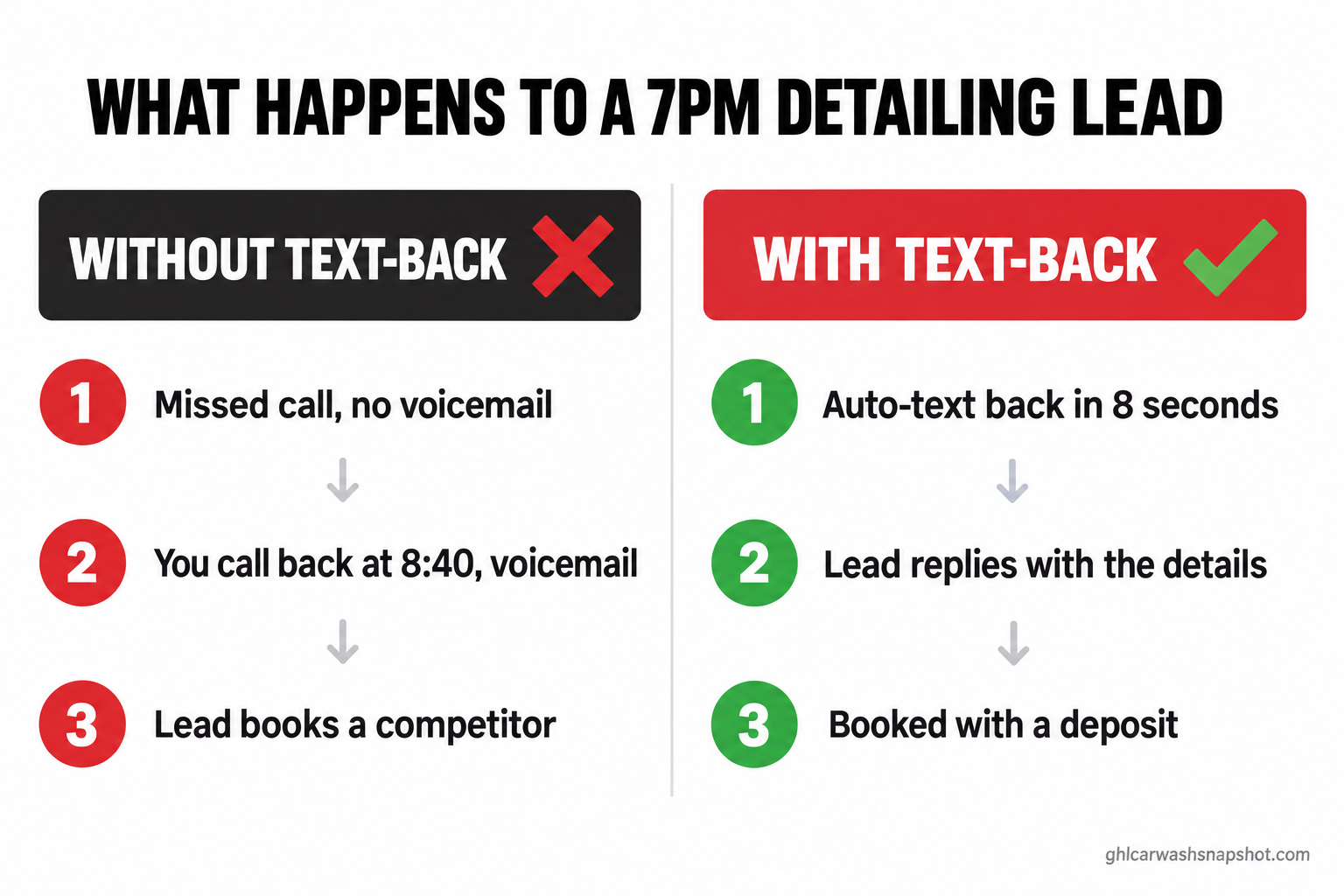
It is 7:12 on a Friday and you are elbow-deep in a ceramic prep, buffer running, phone buzzing in the cup holder. You cannot answer. By the time you wipe your hands there is a missed call and no voicemail. You call back at 8:40. Voicemail. You never hear from them again. What happened is simple: that person needed a detailer, they called three, and they booked the one who answered first. You did the work of getting the phone to ring and handed the job to a competitor.
Mobile detailers lose leads after hours because the lead arrives when you physically cannot pick up, and a detailing customer will not wait. The fix is not answering faster by hand. It is a text-back system that fires the second a call is missed or a form comes in, gets a real reply in front of the lead inside five minutes, quotes and books by text, and takes a deposit so the job sticks. Set that up and the leads that used to vanish after 6pm turn into booked, paid jobs while you are still under a car. Here is the full system, with the copy you can steal.
Table of contents
- What after-hours leads actually cost you
- Why you keep missing them
- The after-hours lead-catch system
- Stage 1: Catch the missed call in seconds
- Stage 2: Answer the after-hours web lead instantly
- Stage 3: Beat the five-minute window
- Stage 4: Quote fast, by text
- Stage 5: Lock it with a deposit
- Stage 6: Rescue the leads who go quiet
- Run it for your size
- Is it legal to text customers automatically?
- Objections
- FAQ
What after-hours leads actually cost you
Start with when the phone rings. AnswerConnect found 47% of business calls happen after hours and on weekends (AnswerConnect, 2024). For an office with a receptionist, that is an annoyance. For a solo detailer, it is the whole problem. When a lead calls at 7pm you are finishing a job, driving home, or off the clock, and the call goes nowhere.
It gets worse when nobody picks up. In one small-business study, roughly 62% of inbound calls went unanswered (411 Locals, 2016, a sample of 85, so treat it as directional). Most people do not leave a voicemail. They just move down the list to the next detailer.
That is why speed is the game. The Lead Response Management study of more than 100,000 call attempts found a lead contacted within five minutes is far more likely to convert than the same lead reached at 30 minutes, and the odds of even reaching them collapse after that first five minutes (Oldroyd / InsideSales). Harvard Business Review put a number on the flip side: 23% of companies never respond to an inbound lead at all (HBR, 2011). Roughly half of buyers choose whoever gets back to them first (InsideSales, via Fronetics). You do not have to be the best detailer in town. You have to be the first real reply in the thread.
Put a dollar figure on it. Miss five after-hours leads a week, close even two at a $180 average, and that is $360 a week walking to a competitor, roughly $18,700 a year from missed replies alone. The leads are already reaching you. You are losing them in the fifteen minutes after they raise their hand.
Why you keep missing them
It is not because you are lazy or bad at follow-up. It is structural. You are the tech and the front desk at the same time, and when your hands are on a car, the phone is not an option. You cannot buff a hood and qualify a lead in the same minute. Worse, the lead arrives on your worst channel at your worst time: people shop for a detail at night, after work, and fire off a call, a form, or a DM at 8pm. Your day ended at 6. Voicemail is dead weight, because almost nobody leaves one, and the few who do are not waiting for your callback tomorrow afternoon. By then they have booked.
None of that is fixed by trying harder. It is fixed by putting a system between the missed contact and the lost job, so the reply happens whether or not you are free.
The after-hours lead-catch system
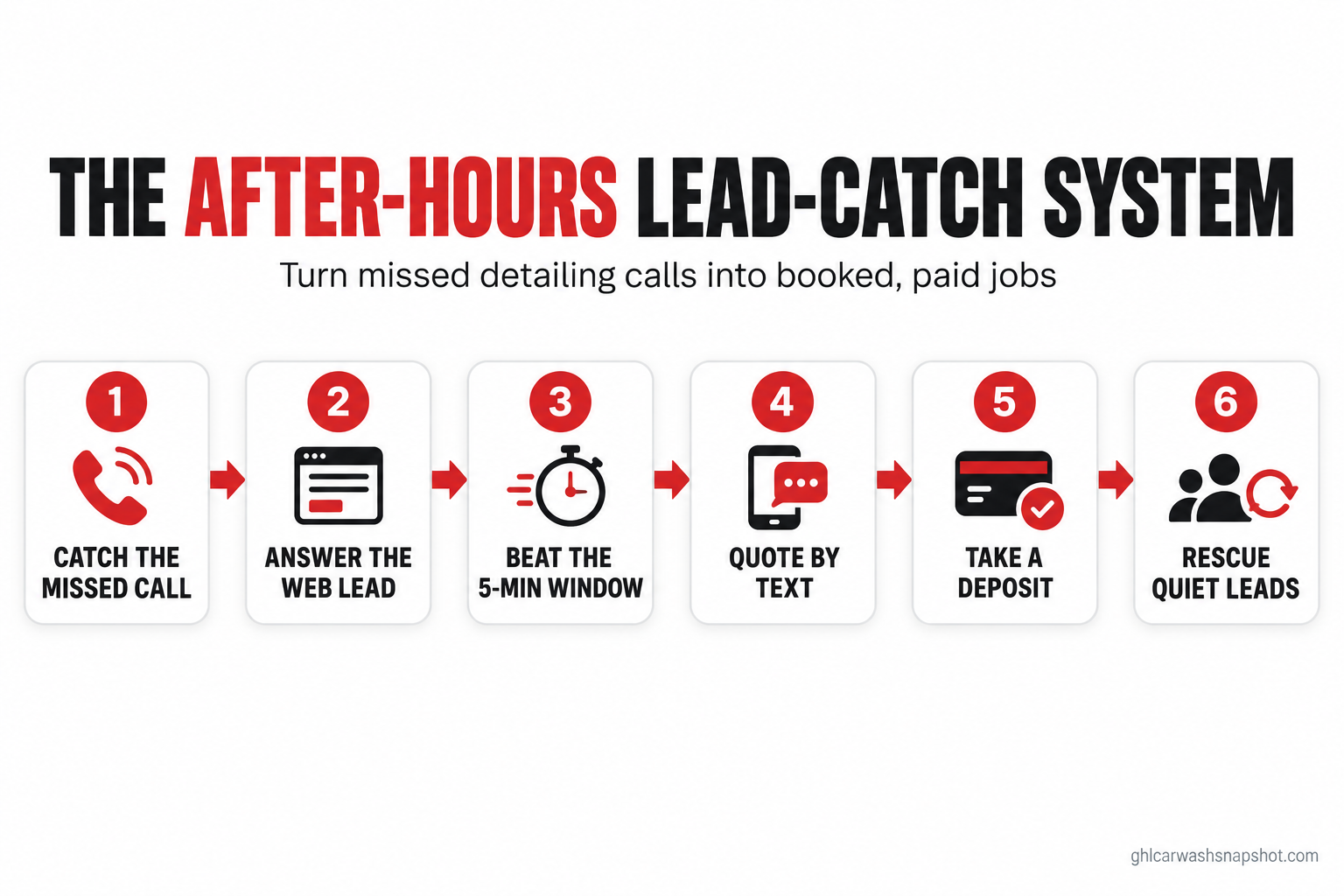
Six stages, each one closing a gap where leads fall out: catch the missed call, answer the after-hours web lead, beat the five-minute window, quote by text, lock it with a deposit, and rescue the leads who go quiet. Here is each one, with what it does and how it breaks.
Stage 1: Catch the missed call in seconds
This is the highest-return automation for a mobile detailer, and almost nobody has it. When a call to your business number goes unanswered, the system texts that number within seconds, turning the dead call into a live text thread the lead can answer while you finish the car. The copy has to sound like you, name the business, and give one clear next step.
How it breaks. Send it from your business line, not a different number, or it reads like spam and gets ignored. Never send a generic “call back during business hours,” because that tells an after-hours lead to go away. And if the reply lands in an app you never check, the whole thing is theater.
Stage 2: Answer the after-hours web lead instantly
Calls are half of it. The rest come through your website form, Google Business Profile, Instagram DMs, and Facebook, and those arrive at night even more than calls do. Every channel should trigger the same thing: an instant reply that acknowledges the lead, sets expectations, and hands them a self-serve booking link. It stops them from messaging your competitor while they wait, and lets the ready-to-go ones book themselves.
How it breaks. If the auto-reply asks for nothing, you wake up to “thanks, I’ll wait,” so always ask the qualifying question up front. If the booking link dumps them into a bare calendar with no services or prices, they bounce. And a channel you advertise on but never connected leaves those leads unread for days.
Stage 3: Beat the five-minute window
The automation from Stages 1 and 2 buys you a few minutes of goodwill, but it does not close the job. Someone still has to have the real conversation, and fast: after five minutes, your odds of reaching the lead drop hard (Oldroyd / InsideSales).
So make the live handoff as fast as the automation. Every new lead should ping your phone the instant it lands, with the name, vehicle, and message right there, so you can fire back a one-line reply between wipe-downs. Text is what makes this work: it has an open rate above 90% and gets read within minutes (Frost & Sullivan), which is why a fast text beats a voicemail every time. You are not dropping the buffer to write a paragraph. You are sending “Got it, that’s a $220 full detail, I’ve got Saturday 9am or Sunday 1pm, which works?” in fifteen seconds.
How it breaks. Lead alerts get buried with every other app notification, so give them their own sound. And if you wait until you are “properly free” to reply, it is the next morning and the window is gone. A rough, fast reply beats a polished, late one every time.
Stage 4: Quote fast, by text
The old way is “let’s hop on a call” or “I’ll come take a look first.” For most standard details, that is friction the lead did not ask for. If you can quote from the year, make, model, condition, and service, do it right there in the thread. The faster a real number lands, the faster the lead says yes. Build a simple price framework so you are not guessing at 9pm: base prices by vehicle size, add-ons for pet hair and engine bay, and a ceramic tier. Then the quote is a lookup, not a negotiation.
How it breaks. If you over-quote to protect yourself, the number scares them and they ghost, so give an honest range with the “I’ll tell you before I add anything” line. And never end a quote with just a price. End with a specific time offer, because a quote is an invitation to book.
Stage 5: Lock it with a deposit
A yes by text at 9pm is a soft yes, and enthusiasm fades by morning. Asking for 20% to 30% down, applied to the final bill, turns a maybe into a commitment and filters out the tire-kickers. This is the same mechanism that kills no-shows, covered in full in our guide on why detailing customers cancel and the deposit system that stops it. Keep it painless: a card-on-file link in the same thread, one tap, done.
How it breaks. Skip the deposit because it feels pushy and you drive across town to an empty driveway. Frame it as locking their slot, not protecting yourself, and almost nobody balks. And keep the link in the text thread, not a separate invoice email they have to dig for.
Stage 6: Rescue the leads who go quiet
Even so, some leads answer once and vanish. Most detailers let those die. A short automated follow-up recovers a real slice of them at no cost. Three touches is the sweet spot: one a couple of hours later, one the next morning, one a few days out. Then stop, because a fourth just annoys people.
How it breaks. If the sequence keeps firing after the lead has booked or replied, you annoy a paying customer, so every touch must check for a reply or booking and shut off the instant it sees one. Keep the tone short and easy to say no to. The goal is to stay top of mind, not to nag.
Run it for your size
The system is the same. What you turn on depends on where you are.
Solo weekend detailer. Turn on two things: the missed-call text-back (Stage 1) and a booking link with your prices on it (Stage 2). Those catch the leads you were losing at your day job or under a car. Skip the deposit at first if it feels like too much, then add it the moment a no-show costs you a Saturday. It all runs from a phone.
Two-van, first-hire operation. Now someone besides you might answer, so the full six stages earn their keep. Turn on instant lead alerts (Stage 3) and route them so whoever is free grabs the lead first, because the five-minute window does not care who is holding a buffer. Deposits (Stage 5) become non-negotiable once a no-show means a real job got turned away, and a standard quote framework (Stage 4) keeps your hire quoting your numbers.
Ceramic and high-ticket studio. Your jobs are $800 to $2,500 and volume is lower, so every after-hours inquiry is worth catching with both hands. The automation still fires instantly, but your live reply leans consultative, because you are booking a coating, not a wash. Deposits scale to a couple hundred dollars, and your follow-up runs longer, because a $1,500 decision takes more than one evening.
Is it legal to text customers automatically?
Short version: yes, with consent, and the bar is reachable. Under the TCPA and the FCC’s rules, you need prior express consent before sending automated texts to a cell, and marketing texts need prior express written consent, which a checkbox on your booking form satisfies (FCC). When someone calls or fills out your form, they are asking to be contacted, so a text back about their inquiry is what they wanted. Keep these rules and you stay clean:
- Get opt-in at the point of contact. A line like “I agree to receive texts about my appointment and quote,” plus a checkbox.
- Keep automated texts about their actual inquiry. A quote, a confirmation, a reminder. That is the safest category.
- Always give an easy opt-out. Include “Reply STOP to opt out” and honor it immediately.
- Do not blast old contacts. Consent is per person and for the reason they gave it. A two-year-old list dropped into a promo blast is riskier.
This is general guidance, not legal advice, and rules shift, so if you plan to text at scale, have someone who knows telecom law review your opt-in language.
Objections
“Won’t an automated text annoy people?” Not when it is fast, relevant, and sounds like you. What annoys people is silence and then a callback the next afternoon. A same-second “sorry I missed you, what are you looking to get done?” reads as responsive, because it answers the thing they just did.
“I already use Jobber or Housecall Pro. Doesn’t that cover this?” Keep the scheduler you like. But it holds your calendar. It does not fire a text the instant you miss a call, auto-reply to your DMs at 9pm, or run a recovery sequence on a lead who went quiet. This is a capture layer that sits on top of your scheduler, not a replacement. For the full comparison, we broke it down in the best software for mobile detailing.
“I’m not technical. This sounds like a lot to set up.” It is a lot to wire together from scratch, which is the honest catch. Connecting your line to a text-back trigger, hooking up every channel, and building the follow-up logic is real work if you have never touched automation. That is why done-for-you systems exist. You are not learning to build the machine. You are turning it on.
“Won’t I still have to reply to everything myself?” No. The automation handles the instant acknowledgment, the booking link, the deposit request, and the follow-up nudges. You step in only for the live conversation, when there is a real human worth talking to. If you would rather have the whole engine installed than build it by hand, you can book a walkthrough and see it working first.
FAQ
What is missed-call text-back for a mobile detailer?
It is an automation that texts a caller the moment their call to your business number goes unanswered. Instead of a dead call and no voicemail, the lead gets an instant message asking what they need and offering a booking link, so the conversation continues by text while you finish the job you were on.
How fast do I really need to respond to a detailing lead?
Inside five minutes if you can. The Lead Response Management study found the odds of reaching and qualifying a lead drop sharply after the first five minutes. An automated text-back buys you a few of those minutes and holds the lead's attention, but you still want a real reply from you as fast as possible.
Why do so many detailing leads come in after hours?
Because people shop for a detail in the evening, after work, once their day is done. AnswerConnect found 47% of business calls happen after hours and on weekends. For a solo detailer that is the worst possible time, because you are working, driving, or off the clock, which is exactly why an automated response matters.
Is it legal to send automated texts to customers?
Yes, with consent. Under the TCPA and FCC rules you need prior express consent to text a cell automatically, and written consent (a booking-form checkbox works) for promotional texts. Keep automated messages about the customer's actual inquiry, include a clear 'Reply STOP' opt-out, and honor it. Texting someone who just contacted you about their quote is the safest category.
Do I need to replace Jobber or Housecall Pro to do this?
No. Missed-call text-back and lead follow-up sit on top of your scheduler as a capture layer. Your scheduling app holds the calendar and invoices; the text-back system catches the leads before they ever reach the calendar. Keep the scheduler you like and add the response layer around it.