

A dispatcher from a regional plumbing company calls your wash on a Tuesday. She has nineteen vans, they look terrible, and she wants to know if you “do fleet.” You say yes, take her number, and promise to “send something over.” Then the day eats itself, and three days later you email a one-line quote: “$12 a van, let me know.” You never hear back.
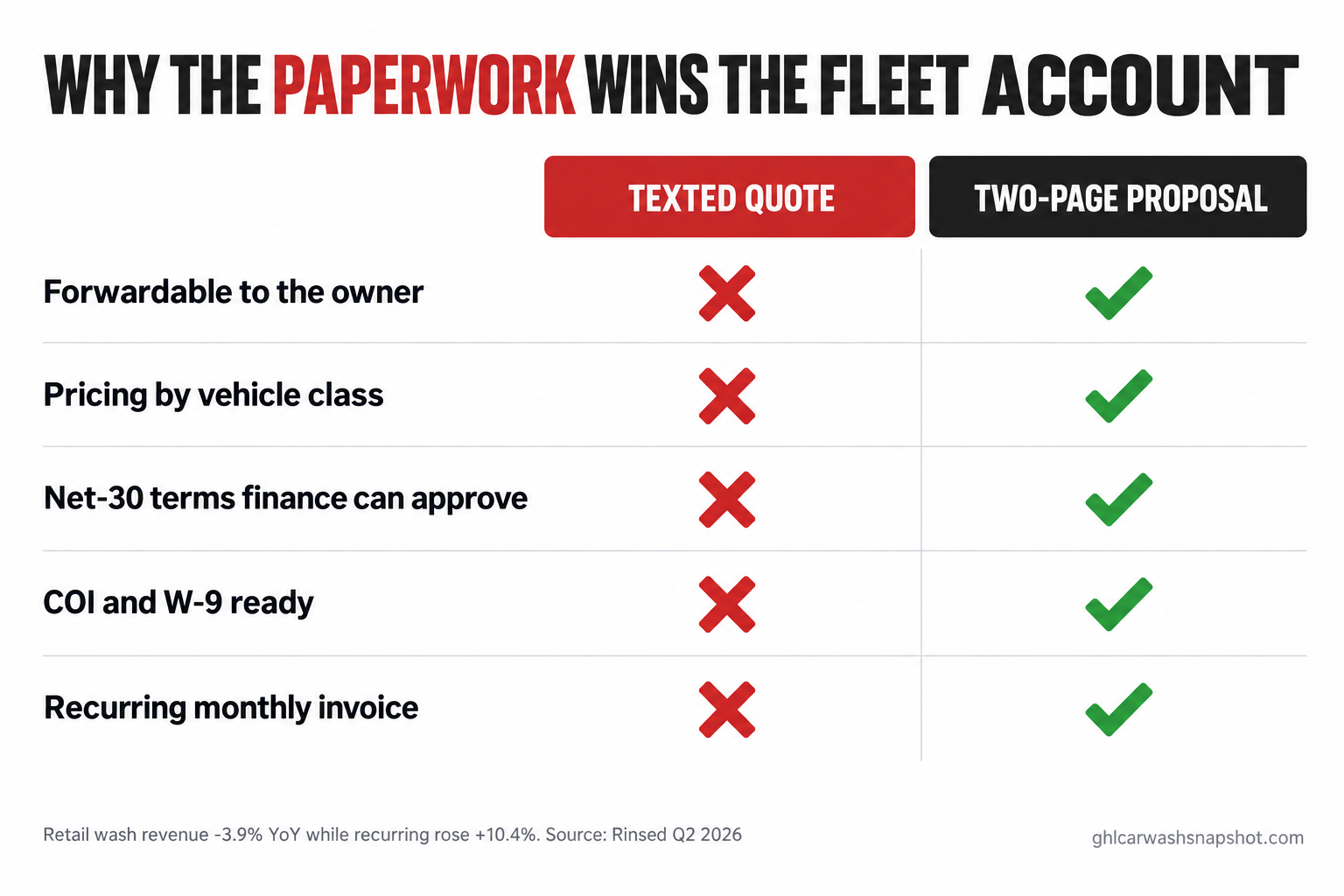
That is how most operators lose fleet work. Not on price, on the paperwork. A fleet buyer is not a retail customer who decides in the lane. She is spending company money, she has to justify it to someone above her, and she needs a document she can forward. Hand her a texted number and she goes with the mobile guy who sends a real proposal, even if he costs more.
This is that document: the full fleet wash proposal, the net-30 pricing sheet, and the account agreement, written so you can paste them into your own files, change the numbers, and send a proposal the same afternoon the dispatcher calls.
Table of contents
- Why the paperwork wins the account
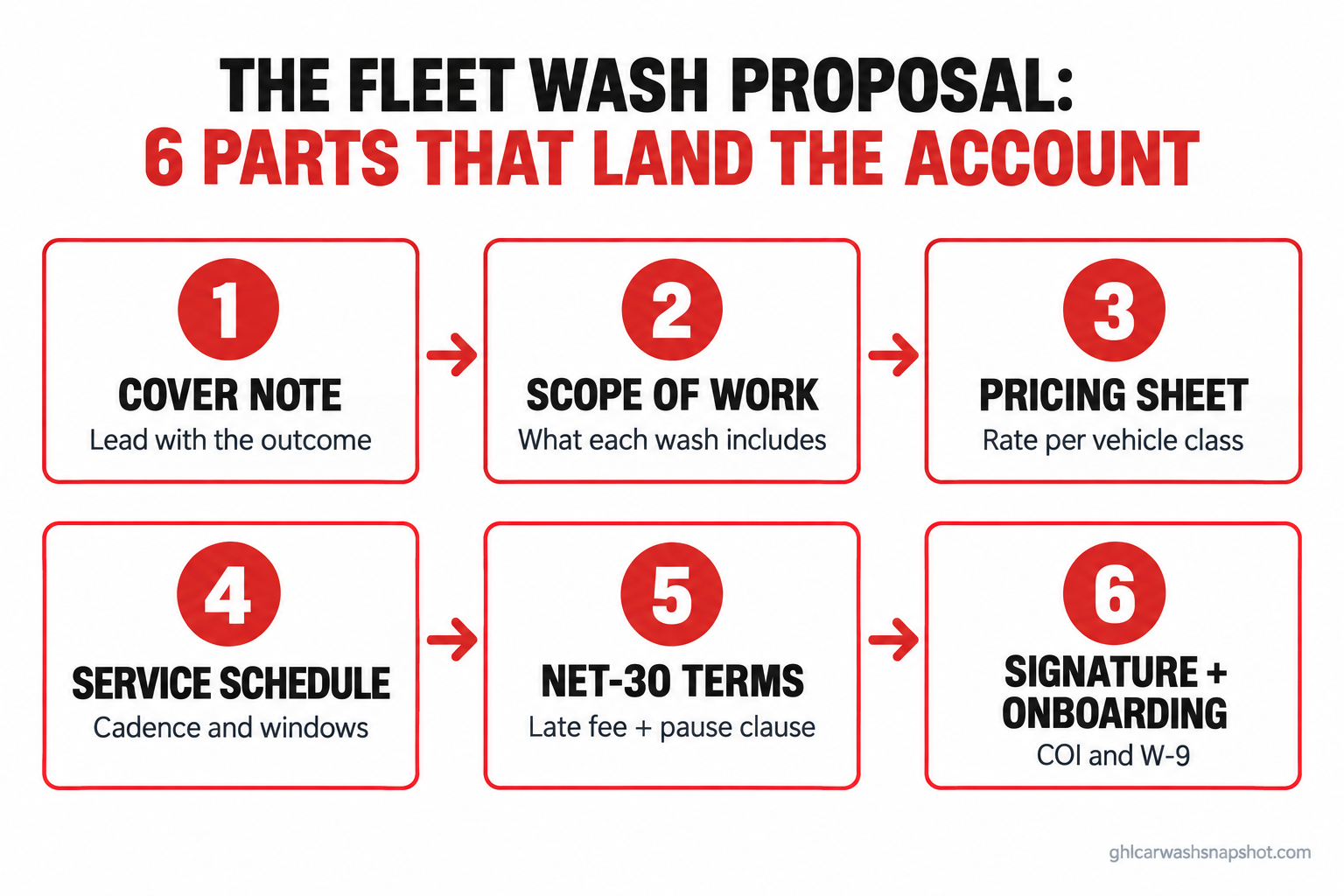
- The six parts of a fleet wash proposal
- Part 1: the cover note that gets forwarded
- Part 2 and 3: scope and the per-vehicle pricing sheet
- Part 4 and 5: the service schedule and net-30 terms
- Part 6: the signature and onboarding block
- Three real scenarios: small, regional, municipal
- How each part breaks, and what to do
- Steal these: the follow-up messages
- Objections, answered
- FAQ
Why the paperwork wins the account
Retail is getting harder. Rinsed’s Q2 2026 industry report, built on data from more than 3,000 locations, found retail wash revenue down 3.9% year over year while membership revenue rose 10.4%. By the Q3 2026 report retail had fallen 9.6%, the steepest drop in five quarters. Single-wash retail is a saw blade; the money is in revenue that repeats.
Fleet is that revenue with a signature on it: a standing weekly or biweekly visit, a predictable invoice, and a contact who stays put for years. Of the roughly 16,900 car wash and detailing businesses competing in the U.S. in 2026, per IBISWorld, almost none have a fleet proposal ready to send. That gap is your opening.
Year-over-year revenue change, U.S. car wash locations, Q2 2026. Source: Rinsed Q2 2026 quarterly report, aggregated from 3,000+ locations.
The person you sell to does not own the money. She needs a yes from an owner or finance person who will never visit your wash, and the only thing that travels up the chain is your document. A text dies in her inbox. A clean two-page proposal gets forwarded, gets approved, and wins the account.
The six parts of a fleet wash proposal
Every proposal that lands commercial work has the same six parts, and all six fit on two pages. Skip one and you create a question the buyer has to come back and ask, and every round trip risks stalling the deal.
Part 1: the cover note that gets forwarded
The cover note is three short paragraphs whose only job is to make a busy fleet manager comfortable forwarding the document to her boss. Lead with the outcome, name the scope in one line, point to the pricing sheet, and do not open with your company history.
Part 2 and 3: scope and the per-vehicle pricing sheet
Scope is one paragraph that says exactly what each wash includes and what it does not. Fleet disputes almost always come from a fuzzy “detail” the buyer assumed and you never priced. Spell it out: exterior wash, wheels and tires, bug and road-film removal, a windshield. Then name the add-ons: interior vacuum, undercarriage, anything that costs you real labor.
The pricing sheet is the heart of the proposal, and the biggest mistake is quoting one flat rate for a mixed fleet. A compact sedan, a cargo van, and a box truck are three different jobs with different costs. Price by vehicle class and it reads as defensible. Fill in your own numbers.
| Vehicle class | Examples | Exterior wash | Wash + interior vacuum |
|---|---|---|---|
| Class A, compact | Sedans, small SUVs, compact EVs | $ your rate | $ your rate |
| Class B, van | Cargo vans, minivans, crew cabs | $ your rate | $ your rate |
| Class C, large van | Sprinter / high-roof, 15-passenger | $ your rate | $ your rate |
| Class D, box / truck | Box trucks, flatbeds, service bodies | $ your rate | $ your rate |
| Add-on | Undercarriage, bug treatment, mats | $ your add-on | n/a |
Under the table, state the volume logic in one line so the account gets cheaper per vehicle as it grows: “rates assume 10 or more vehicles per visit; 20-plus earns a 10% reduction.” Never publish a rate you have not costed. Do not know your cost per vehicle by class yet? Build it first with the cost-per-car margin calculator.
Part 4 and 5: the service schedule and net-30 terms
The schedule proves you can deliver. Name the cadence (weekly, biweekly, monthly), the day and window, where the wash happens, and who confirms each visit. A fleet manager’s real fear is that you will be unreliable and her vehicles will look bad in front of customers, and a written schedule answers that in advance.
Then come the terms. Net-30 is the price of entry for commercial accounts, because corporate accounting runs on purchase orders and monthly invoices, not cards swiped in a lane. It is also where your money gets stuck: in the 2025 Atradius Payment Practices Barometer for the U.S., overdue invoices affected about 43% of the value of credit-based B2B sales, with most firms writing off no more than 5% as bad debt. Plan for a share to land late.
U.S. B2B invoices by value, 2025. Source: Atradius 2025 Payment Practices Barometer, United States.
Here is the clause that keeps you from becoming a free lender. Paste it into the terms section:
The pause clause matters most. Without it, a slow payer gets free washes for 90 days while you chase them. With it, the incentive flips: they keep you current because they need the vehicles washed. Enforce it the first time or it means nothing.
Part 6: the signature and onboarding block
The last part makes signing feel routine and gets the two documents a fleet buyer always needs out of the way. A clean onboarding block signals you have done this before, the exact signal that beats a sloppier competitor. Put four things here: signature and date lines for both parties, a request for their COI requirements, your W-9 offer, and the billing contact.
The COI and W-9 are proof, not red tape. A detailer who shows up with a bucket and no paperwork cannot touch a 40-van municipal account. You can.
Three real scenarios: small, regional, municipal
The same six-part proposal works for every fleet, but the emphasis shifts with the size and type of the account.
The small local fleet, 5 to 15 vehicles. The plumber, the HVAC company, the local courier. The buyer is usually the owner or office manager, the decision is fast, and the pricing sheet does most of the selling. Offer biweekly service so the invoice stays small and easy to approve. Your real risk is under-pricing to win a friendly local name, so hold your by-class rates.
The regional fleet, 40 to 80 vehicles. Now the buyer is a dedicated fleet or operations manager, and finance is involved. The schedule and the terms carry the weight, because reliability and clean invoicing are what they are buying. Break the fleet into classes, show the 20-plus-per-visit reduction, and expect a request for a COI naming them as additional insured. The late-payment math is real at this size, and running the account in a single fleet pipeline instead of a spreadsheet stops a missed invoice from costing you a month of revenue.
The municipal or government fleet. City vehicles, transit vans, a utility’s service trucks. The money is excellent and slow, and the process is procurement, not a handshake: expect a formal bid, a vendor-registration portal, and insurance requirements well beyond a COI. Net-30 often drifts to net-45 or net-60, so price with that float in mind and never let a government account become the majority of your book.
How each part breaks, and what to do
A proposal is a system, and every part has a failure mode.
The cover note gets ignored. Usually because it opened with your story, or you attached a PDF she had to download on her phone. Fix: put the note in the email body, attach the pricing sheet, and lead with the vehicle count and net-30 convenience.
The pricing sheet triggers a renegotiation. You quoted one flat rate, she pushed back on the box trucks, and now you are negotiating from scratch. Fix: the by-class sheet pre-empts this. Every vehicle type has its own line, so there is nothing to argue, only a total to approve.
The schedule slips and you lose the account quietly. You missed two visits during a busy stretch, nobody complained, and the renewal just did not happen. Fix: a confirmation message before every visit and a named person responsible for the route. Fleets churn in silence, the same way members go quiet before they cancel.
Net-30 becomes net-70. The most dangerous failure. You kept washing while the invoice aged, afraid of losing the account. Fix: the pause clause, enforced the first time. A fleet that will not pay after a pause was going to stiff you anyway, so find out at 45 days, not 120.
The single-contact risk. Your whole relationship lived with one fleet manager, she left, and her replacement put the account out to bid. Fix: get a second contact in onboarding and send a short quarterly summary to both, so the account belongs to the company, not one person.
Scope creep on “detail.” They start asking for interior shampoos at the wash price. Fix: the scope paragraph and the add-on lines. Anything not listed is a quoted extra, in writing.
Steal these: the follow-up messages
The proposal is half the job. The follow-up is the other half, because a good proposal still dies without a nudge. Keep texts inside business hours and get consent to text a business contact first, the same TCPA basics that govern your car wash SMS.
Half the fleet accounts I have seen signed came back weeks after that day-10 message, once the vans got bad enough to matter.
Objections, answered
“Won’t net-30 wreck my cash flow?” It strains it, which is why the terms block exists. You are floating 30 days of washes, so price the account to clear your cost comfortably, keep faster-paying work as ballast, and enforce the pause clause so net-30 never becomes net-90.
“Fleets just want the cheapest price.” Some do, and you do not want those. The ones worth having are buying reliability and clean invoicing. A fleet manager who gets yelled at for dirty vehicles cares far more about never worrying about it than about a dollar a van, and your proposal sells exactly that.
“I don’t have a sales team. Who does the follow-up?” Nobody, by hand, which is why fleet work slips through. The sequence above is five messages. Run it out of one fleet pipeline that reminds you, or automate it entirely.
“What if they churn after a few months?” Fleet churn is almost always a reliability problem or a lost contact, not a price problem, and both are fixable: the visit-confirmation message keeps service visible, the second contact survives a staff change, and the quarterly summary reminds the company what they are paying for.
FAQ
What should a fleet wash proposal include?
Six parts: a cover note that leads with the outcome, a scope paragraph listing what each wash includes and excludes, a per-vehicle pricing sheet broken out by vehicle class, a service schedule with cadence and windows, net-30 billing terms with a late fee and a pause clause, and a signature and onboarding block requesting the client's COI needs and offering your W-9. All six fit on two pages.
How do I price a fleet wash account?
Price per vehicle class, not one flat rate. A compact sedan, a cargo van, a high-roof Sprinter, and a box truck are different jobs with different water, time, and labor costs. Cost each class on its own, set a fleet rate below retail but above your cost per class, and show a volume reduction for larger per-visit counts. Never quote a fleet off your retail menu.
Should I offer net-30 terms to fleet customers?
Yes. Commercial accounting runs on purchase orders and monthly invoices rather than cards, so net-30 is the price of entry. But protect yourself: add a 1.5% monthly late fee, a clause that pauses service on accounts 45 days past due, and keep faster-paying work as ballast. Around 43% of U.S. B2B invoice value is paid late, so plan for it.
What is a COI and why do fleet accounts ask for it?
A certificate of insurance (COI) is proof you carry liability coverage, often naming the client as an additional insured. Fleet and municipal buyers require it because you are handling their vehicles. Offer it up front in your onboarding block. Having a COI and a W-9 ready beats a competitor who has to scramble when asked.
How is a fleet account different from a retail customer?
A retail customer decides in the lane and pays on the spot. A fleet buyer spends company money, has to justify it above her, and needs a forwardable document and net-30 terms. That is why a texted number loses and a clean proposal wins: the proposal is the business case she forwards up the chain for approval.
Related posts
- How Independent Car Washes Close Their First Fleet Account in 60 Days: the prospecting playbook that fills your pipeline before the proposal goes out.
- The Car Wash Cost-Per-Car Calculator: build your real cost by vehicle class before you set a single fleet rate.
- Car Wash SMS Marketing: The Text-Message Playbook: the TCPA and consent rules behind the follow-up and confirmation texts above.
- Your Members Go Quiet Before They Cancel: the same silent-churn pattern that kills fleet accounts.