

It is a Tuesday in March, the tunnel is quiet, and you are raising your unlimited plan by three dollars because the chain across town just did. Your gut says it is pure profit. Your gut has no idea what it costs to send one car through that tunnel. Most express operators quote their plan price to the penny and go blank when I ask what a single wash costs to deliver. That blank spot is where margin quietly dies.
Here is the fix: calculate your true cost per car, the sum of every variable dollar it takes to run one vehicle through the tunnel, then subtract it from what that wash earns to get your contribution margin. Five buckets make up the cost: chemicals, water, power, labor, and equipment wear. For a typical 2026 express site it lands between $2 and $5 a car. Once you know that number, the membership math makes sense: a $34 member who washes three times a month is gold, and the same member washing twelve times can put you underwater.
Table of contents
- What not knowing your cost per car costs you
- The two numbers that run a tunnel
- The five buckets inside your cost per car
- The membership twist: cost per car when a member washes
- The calculator: your inputs, your answer
- Three operators, one formula
- The price-increase rule everyone forgets
- Objections, answered
- FAQ
What not knowing your cost per car costs you
Start with the number that should scare you into doing this math. Rinsed, which pulls data from more than 3,000 car wash locations, reported in its Q2 2026 industry report that same-store sales grew 5.4% year over year, carried entirely by membership. Membership revenue rose 10.4% while retail revenue fell 3.9%. Good news, until the footnote: Rinsed estimates as much as half of that membership lift came from price increases on existing members, not new signups.
The industry is propping up revenue by charging current members more. If your cost per car is $2.50 you have margin to protect; if it is $4.50 and your heavy members wash eight times a month, another hike will not save an account that is already losing money. The only way to know which you are is to know what each wash costs to deliver.
There are roughly 62,750 car wash and detailing outlets in the US, per the International Carwash Association. The ones that survive will be the ones who know their cost per car and price above it on purpose.
The two numbers that run a tunnel
Two figures tell you whether a wash makes money.
Cost per car. Every variable dollar it takes to run one vehicle through the tunnel, once. Not your mortgage or lease or the manager’s salary: those are fixed costs you pay whether you wash zero cars or a thousand. Cost per car is only the money that leaves the building because that car went through: chemicals, the water and power the cycle burned, the labor to load it, and the slice of equipment wear it caused.
Contribution margin per wash. What is left after you subtract cost per car from what the wash earned. For a retail car it is simple:
Contribution margin per wash = retail price minus cost per car.
Sell a $20 top wash that costs $3 to deliver and you kept $17. That $17 covers fixed costs first, and once they are covered, it is profit, which is why throughput matters so much. The trap is that membership breaks the clean version of this formula, because a member does not pay per wash. We will fix that in a minute.
The five buckets inside your cost per car
Five buckets, each with a 2026 benchmark range and the way it quietly inflates while you are not looking.
Bucket 1: Chemicals
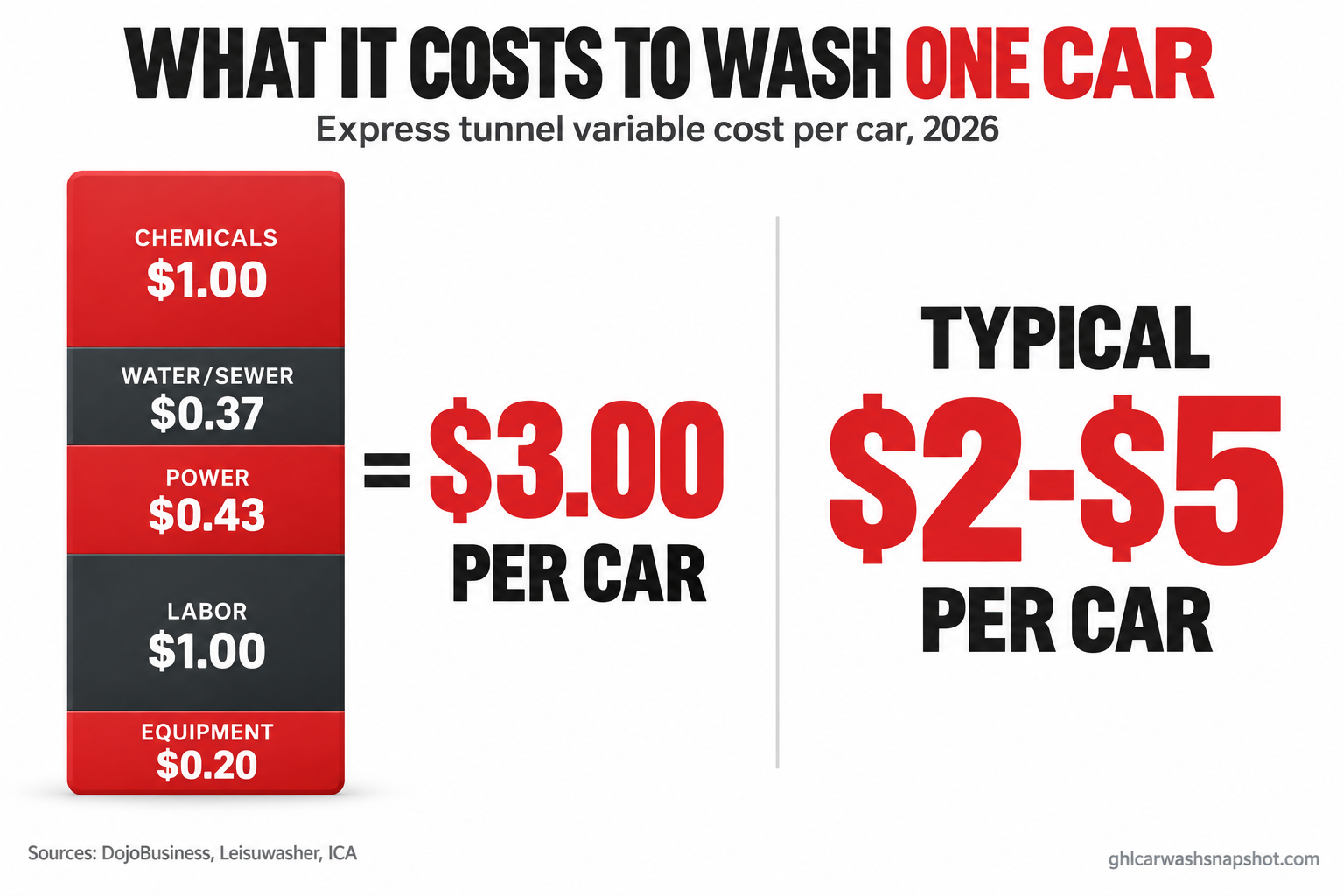
The soaps, presoaks, drying agents, and tire shine your tunnel sprays on every car. Estimates cluster around $0.50 to $1.50 per car for a standard express menu, climbing toward $2.00 once you add premium tiers like ceramic sealant, per operating-cost breakdowns from DojoBusiness and Leisuwasher.
How it breaks: dilution drift. The ratios on your injectors wander: a worn metering tip, a new hire who cranks a pump, a supplier who reformulates, and suddenly you are using more product per car than your spreadsheet says. Check actual gallons against cars washed monthly, not the label.
Bucket 2: Water
A typical express tunnel uses around 30 gallons of fresh water per car, roughly $0.37 in water and sewer at common municipal rates, per the cleaning cost calculators model. Sites with reclaim recycle a large share and push that figure well down.
How it breaks: the sewer side. Most municipalities bill sewer as a multiple of metered water, so a rate increase hits you twice. And a neglected reclaim system silently stops reclaiming while the pump still runs and the bill still climbs. If you have reclaim, meter the fresh-water make-up line.
Bucket 3: Power
Pumps, blowers, conveyor motors, and vacuums draw electricity on every cycle. The same model assumes about 2 kWh per wash, near $0.43 per car. Blowers are the hogs.
How it breaks: demand charges. Commercial electric bills often include a charge based on your single highest 15-minute spike, so a Saturday rush when every blower runs at once can inflate your per-car power cost all month. Equipment left running through dead mid-week hours burns power with no cars to spread it across.
Bucket 4: Labor
The biggest and most variable bucket. Breakdowns put direct tunnel labor around $0.50 to $1.50 per car, and a common rule keeps total labor at 15% to 25% of wash sales, per DojoBusiness and Leisuwasher. With 2026 attendant wages commonly $16 to $20 an hour, your labor cost per car comes down to how many cars you push per labor hour.
How it breaks: overstaffing the slow hours. Three attendants on a dead Tuesday triple your labor cost per car versus the same three on a busy Saturday. The fix is not firing people, it is matching the schedule to your real hourly volume curve, which almost nobody staffs against.
Bucket 5: Equipment wear
Every car wears out brushes, cloth, bearings, and belts a tiny bit. Spread your annual maintenance and parts spend across your annual car count and you get a real per-car number, usually a few cents to a couple of dimes.
How it breaks: deferred maintenance is not deferred, just delayed and compounded. Skipping a brush replacement moves the cost to a motor that fails under the extra load and takes the tunnel down on a Saturday. The true per-car cost includes the capital you spend by not spending it.
Illustrative mid-point cost per car by bucket, express tunnel, 2026. Chemicals and labor $0.50–$1.50 (DojoBusiness, Leisuwasher); water ~$0.37 and power ~$0.43 (Cleaning Cost Calculators).
Add the mid-points and you are near $3.00 per car, right in the middle of the $2 to $5 benchmark. Yours could run lower with reclaim and tight staffing, or higher with a premium menu and soft mid-week volume.
The membership twist: cost per car when a member washes
A member pays a flat monthly price and washes as often as they like, so your margin per member is not price minus cost per car. It is:
Monthly margin per member = plan price minus (cost per car x washes taken this month).
The whole game is wash frequency. The average unlimited member washes between 2.6 and 3.2 times a month: DRB’s data puts the typical member near 3.2 washes (DRB), and ICA Pulse data runs a little lower. On a $34 plan with a $3 cost per car, three washes costs $9 to serve and nets $25 a month: a beautiful account.
But members are a distribution, not an average. A commuter who treats the tunnel like a shower for their car can wash twelve times a month. At $3 a car, that member costs $36 to serve and pays you $34: you are losing money on your most loyal customer.
This is the operator breakeven, and it sits much higher than the consumer one. Consumers break even at two to three washes a month, which is why the pitch works. The operator, on a premium plan around $39 with a $6 fully loaded cost per wash, breaks even near 6.5 washes a month, per the worked example at True Margin North.
Monthly margin on a $34 member at a $3 cost per car, by washes taken. It turns negative once a member washes about twelve times a month.
The takeaway is not “memberships are bad.” Memberships are the whole business, and the Rinsed Q2 2026 data proves it: membership carried the industry while retail shrank. The point is that your average member subsidizes your heavy ones, and you need your cost per car to see whether the average still wins across your base. For the companion math on how long a member stays and what they are worth, the car wash churn and LTV calculator picks up where this leaves off.
The calculator: your inputs, your answer
You do not need software. You need six numbers and five minutes, from your point-of-sale, chemical invoices, utility bills, and payroll.
Run step three for your lightest, average, and heaviest members to see the shape of your base. Then pull the actual wash-frequency distribution and find what share of members sit above your operator breakeven. That percentage is the real health of your club.
Three operators, one formula
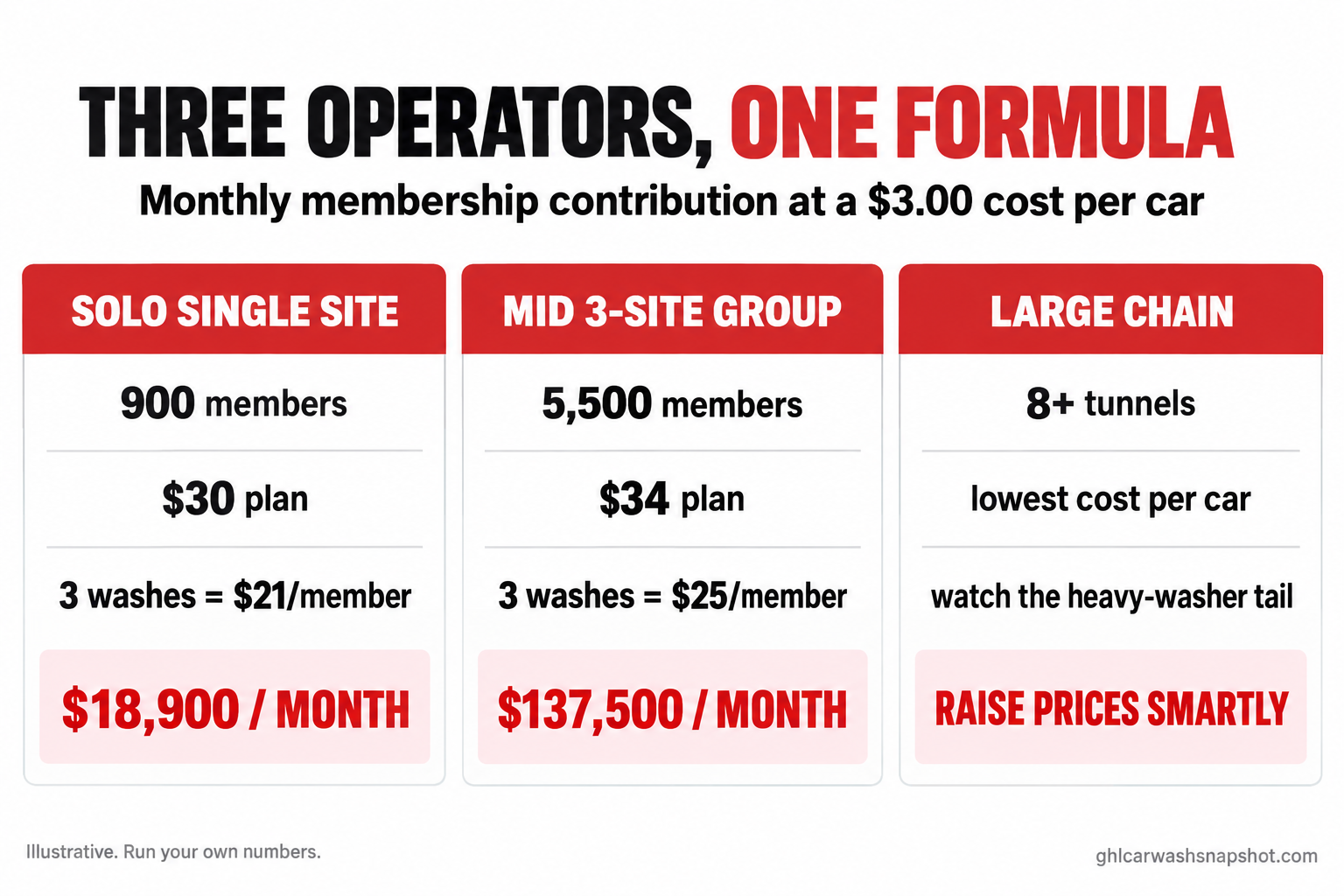
The formula is the same for everyone; the answer is not. Here it is across three real-shaped businesses, all at a $3.00 cost per car.
The solo single-site express
One tunnel, 6,000 cars a month, 900 members at a $30 average plan. A member washing the average 3 times costs $9 to serve and nets $21 a month, roughly $18,900 in monthly membership contribution before fixed costs. The solo risk is concentration: a block of fifty heavy washers above breakeven is a visible dent. The move is to tier the plan so heavy washers self-select into a higher price that covers their frequency.
The mid-size three-site group
Three tunnels, 5,500 members at a $34 average plan. Cost per car is still roughly $3, but it varies by site: the newest tunnel with reclaim runs $2.40, the oldest $3.80 on soft mid-week labor. A member washing 3 times nets $25, about $137,500 a month in contribution at the average. The risk is that the blended number hides the loser site. The move is to calculate cost per car per site and fix the $3.80 location’s labor schedule before it drags the whole book.
The large multi-site chain
Eight or more tunnels, tens of thousands of members, a central ops team. At scale the chain negotiates chemical pricing down and runs reclaim everywhere, pushing cost per car toward the low end. But the heavy-washer tail is large in absolute terms, and a plan priced for the average can bleed real money across thousands of above-breakeven members. The move is frequency-based plan design and, increasingly, raising prices, which the Rinsed data shows the industry already doing. The chain can do that intelligently because it knows its cost per car; the danger is doing it blindly and training members to cancel.
The price-increase rule everyone forgets
Here is the compliance piece operators get wrong. Many think the federal FTC “click-to-cancel” rule governs how they change auto-renewing memberships. It does not. That negative-option rule was vacated by the Eighth Circuit in July 2025 and is not in force. For the full background, see the car wash membership auto-renewal laws breakdown.
What actually governs you is state automatic-renewal law, like the California Automatic Renewal Law, plus Section 5 of the FTC Act. Several require clear advance notice before a material change to a recurring charge, which a price increase is. You can raise prices, and the margin math says many of you should, but you generally must give members notice first and an easy way to cancel. Raising a price quietly turns a routine increase into a chargeback and regulatory problem. Confirm your state’s rules with a local attorney first.
Objections, answered
“I already know my costs.” You know your total costs. Cost per car strips out fixed costs and isolates only the variable dollars one car causes. Most operators who say this quote a number that includes their mortgage, which makes it useless for pricing a wash or a plan.
“Chemicals are a rounding error.” At a dollar a car and 6,000 cars a month, chemicals are $6,000 a month, and a 30% dilution drift is $1,800 walking out the door unnoticed. Rounding errors do not compound; this one does.
“I am not going to nickel-and-dime the heavy washers.” Nobody is saying charge per wash. The point is to price your tiers so heavy washers land on a plan that covers their frequency, and to know which members are below water. Loving your customers and losing money on them are not the same thing.
“My POS or Rinsed should do this for me.” Your point-of-sale has every input: cars washed, member frequency, ticket data. The tools hold the data; the thinking is still on you. To see how the platforms compare, the car wash membership software cost teardown lays them out.
FAQ
What is a typical cost per car for an express tunnel in 2026?
Benchmarks land between $2 and $5 per car in variable costs: chemicals, water and sewer, power, labor, and equipment wear. A common mid-point is around $3.00 per car. Sites with water reclaim and tight labor scheduling run lower; sites with a premium chemical menu and soft mid-week volume run higher. The only number that matters is the one you calculate from your own invoices.
How do I calculate contribution margin per wash?
Contribution margin per wash equals your retail ticket minus your cost per car. A $20 wash at a $3 cost per car gives $17. That $17 covers fixed costs first, then becomes profit, which is why throughput and volume matter so much in a tunnel business.
Why does cost per car matter for a flat-rate membership?
Because a member does not pay per wash. Your monthly margin on a member is the plan price minus your cost per car multiplied by how many times they washed. A $34 member washing three times at a $3 cost per car nets you $25; the same member washing twelve times costs more than they pay.
How many times does the average unlimited member wash per month?
Industry data puts it between about 2.6 and 3.2 washes a month. DRB cites roughly 3.2, while ICA Pulse data runs a little lower. Members are a distribution, so the figure that matters most is what share of your base washes above your operator breakeven of roughly six to seven washes a month.
Should I include my mortgage and fixed costs in cost per car?
No. Cost per car is variable cost only, the money that leaves the building because one specific car went through. Fixed costs like mortgage, lease, insurance, and salaried management are covered by total contribution margin across all your cars, not loaded into the per-car number.
How often should I recalculate my cost per car?
Every quarter. Chemical dilution drifts as injectors wear, wages rise, and utilities raise rates, and none of those send you a memo. A cost per car you calculated a year ago is almost certainly wrong today, so any pricing decision built on it is wrong too.
Back to that Tuesday and your three-dollar hike. Run the five buckets, land on your real cost per car, pull your frequency distribution, and the decision stops being a gut call. Maybe the market will bear five dollars; maybe a chunk of your base is already below water and the smarter move is a frequency-based tier, not an across-the-board bump. Either way you are pricing on a number instead of a hunch. In an industry propping up revenue on price hikes, the operator who knows the number keeps the margin. Run it this week.