
It is the second week of November in Chicago, the first real salt truck just rolled down your street, and by noon your lane is slammed. Every car in the metro is wearing white crust along the rockers, and the drivers all had the same thought at once: get this off before it eats my truck. This is the best demand you will see all year, and here is the quiet tragedy of it. Most Chicago washes take the money and do nothing to turn the rush into anything that lasts. By April the salt is gone and the lane is empty.
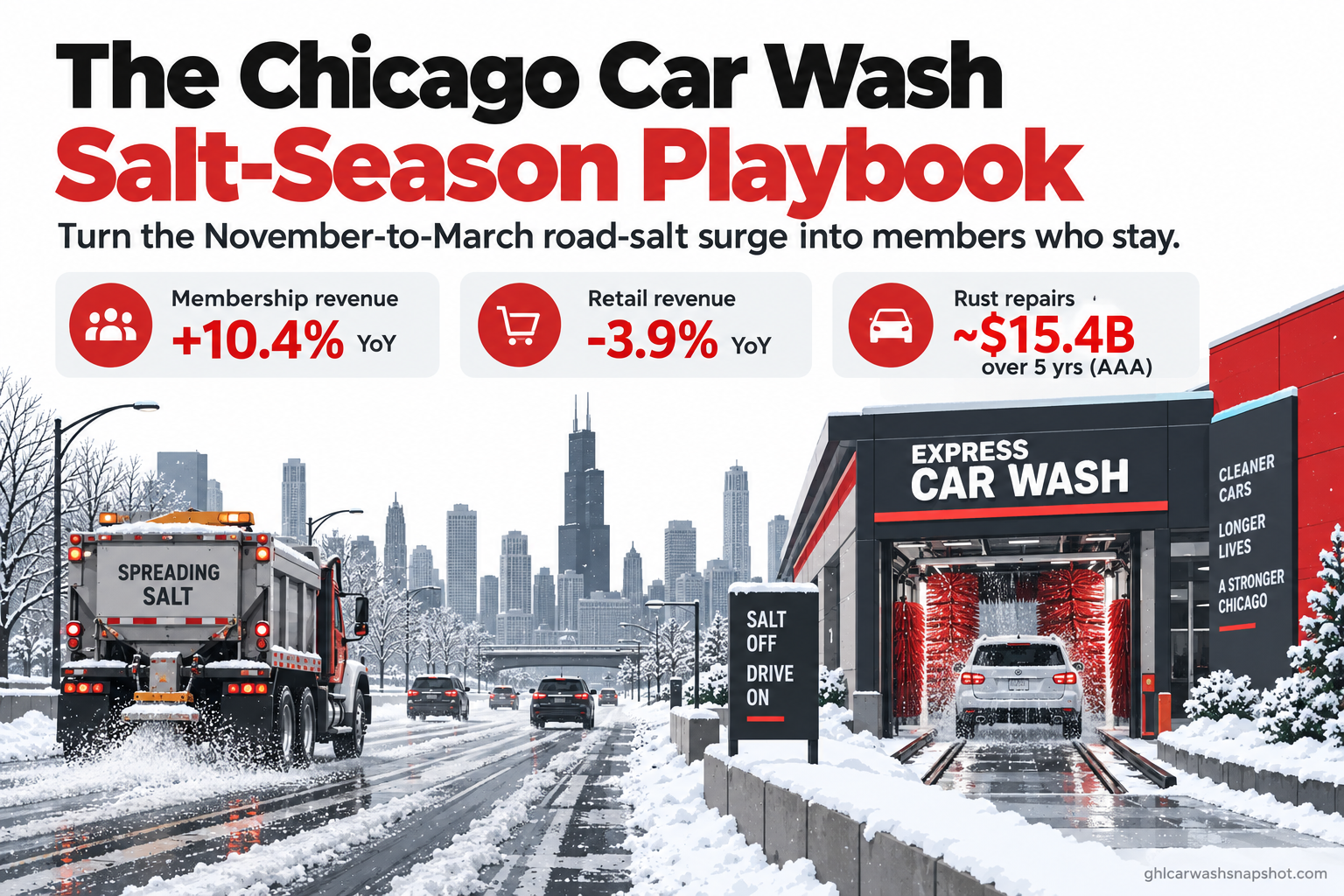
Here is the short answer. Chicago road salt creates a five-month demand surge from November through March, and it is the best window you get to convert one-time washers into unlimited members. The rush is not the win. The win is capturing those cars into a plan that still charges in July, when nobody in Chicago is thinking about their car. Membership is the line that holds when retail wobbles: across 3,000-plus US washes, membership revenue grew 10.4% year over year in Q2 2026 while retail fell 3.9% (Rinsed Q2 2026 via ICA). Here is the month-by-month plan to fill the club.
Table of contents
- What salt season is worth to a Chicago wash
- The one sentence that sells the membership
- The Chicago salt-season calendar
- October: prep before the first truck rolls
- November: the first salt and the surge
- December and January: peak, where the club gets filled
- February: the grind, where you hold what you won
- March and April: the thaw and the slowdown
- The same playbook at three sizes
- The compliance line Chicago operators forget
- Steal these: the salt-season message copy
- Objections, answered
- FAQ
What salt season is worth to a Chicago wash
Chicago salts hard. The city stockpiles north of 400,000 tons of road salt most years and can burn through it fast: about 322,000 tons in the 2020-21 season, then only 119,500 tons in the milder 2023-24 season (CBS Chicago). A normal Chicago winter drops about 36 inches of snow (NWS Chicago), and every plowable event ends in a salt run that sends cars to you.
Here is where operators lose the plot. A busy lane in January evaporates the second the roads dry out, while recurring revenue does not care about the weather. The appetite is there, too, with nearly 90% of unlimited members saying they plan to renew (ICA Car Wash Pulse Q1 2026). Your winter rush is the cheapest member-acquisition window you will ever run, and it shows up on its own every November.
The one sentence that sells the membership
You need the reason a Chicago driver already feels: road salt eats your car from underneath, and the only defense is washing it off, often, all winter. AAA pins salt-related rust repairs at an estimated $15.4 billion over five years in hard-hit regions, roughly $500 a repair, and the fix they recommend is frequent washing with attention to the undercarriage (AAA).
That is the whole sale. One rust repair costs more than a year of unlimited washing, and a retail wash now and then does not protect a car from five months of salt. A membership does. So make the undercarriage flush your hero feature from November to March: put it on the marquee and price your top tier around it, anchored against the cost of a rust repair.
The Chicago salt-season calendar
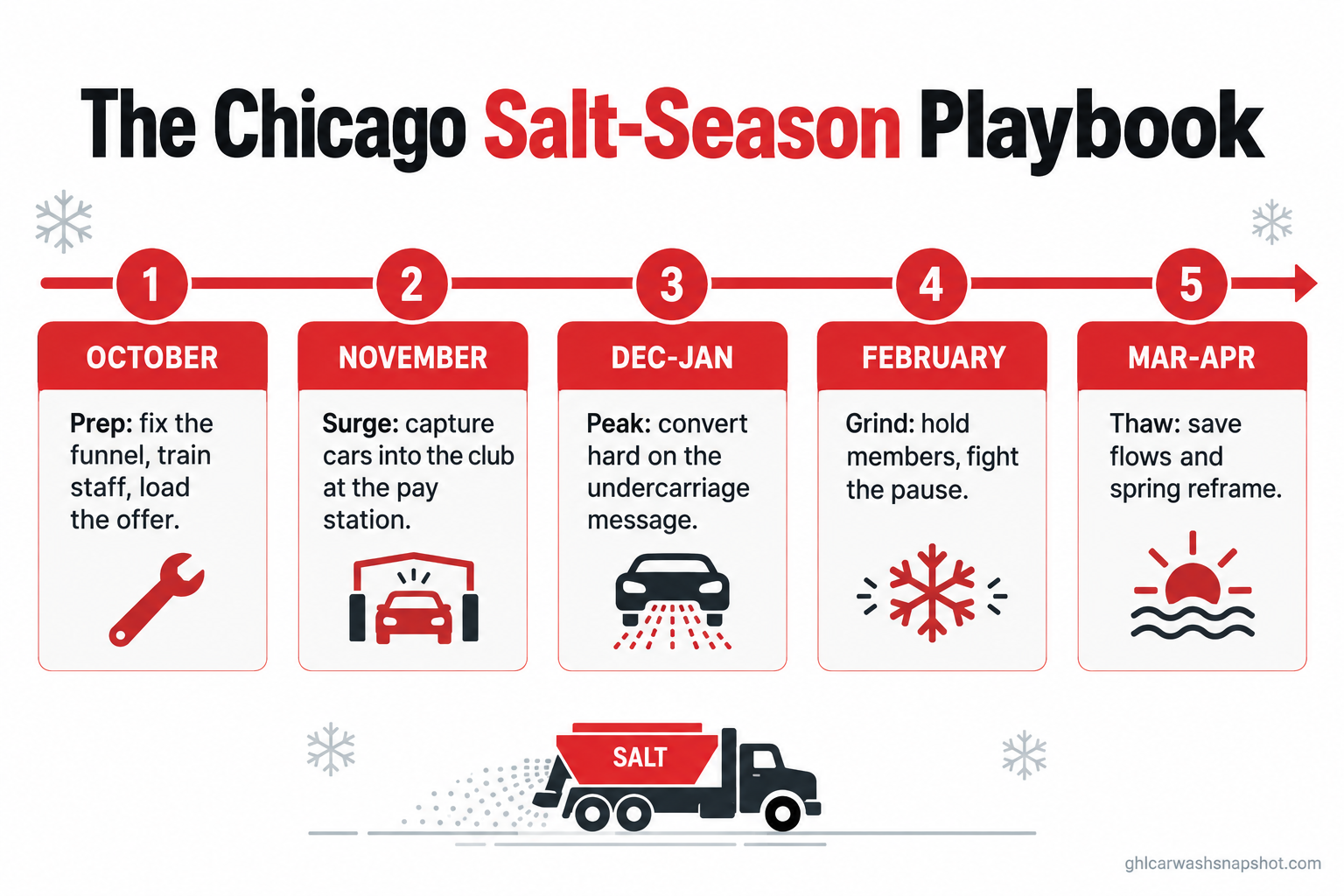
The surge is not one event. It is a season with distinct phases, each needing its own move.
| Phase | Window | What is happening | Your move |
|---|---|---|---|
| Prep | October | Dry roads, no salt, quiet lane | Fix the funnel, train staff, load the offer |
| Surge | November | First salt, demand spikes overnight | Capture cars into the club at the pay station |
| Peak | December to January | Repeated salt events, heaviest volume | Convert hard on the undercarriage message |
| Grind | February | Cold, tired drivers, washes feel pointless | Hold members, prove value, fight the pause |
| Thaw | March to April | Roads clear, winter joiners reconsider | Save flows, card recovery, spring reframe |
An operating calendar, not a forecast. Salt timing shifts year to year with the snow, so build the system to fire on the weather, not a fixed date.
October: prep before the first truck rolls
October is the stage everybody wastes, because nothing is forcing them to act. That is exactly why it matters: you cannot build the machine while the cars are stacked up in January.
The play. Get the funnel ready. Build a dead-simple pay-station signup an attendant can close in under 30 seconds without slowing the lane (our unlimited wash club launch guide has the steps). Set your winter offer, a first-month discount or free undercarriage upgrade. And write every message in this playbook now, so the first salt event fires a prepared sequence instead of texts typed between rush hours.
How it breaks. You wait until the surge to think about signup, so the busiest week of your year becomes the week you improvise, and the rush walks through as pure retail.
November: the first salt and the surge
The first salt event flips demand like a switch. One day the lane is normal, the next it is backed to the street, and drivers who ignored their car since September suddenly need it clean now. Your only job is capture.
The play. Every car in that line is already paying you. Train the pay station on one line: “The undercarriage wash is included if you join the club, for about the price of two single washes a month.” Then fire your weather trigger the morning after the first plowable snow, a text to your retail and lapsed lists saying the roads are a mess, we are open, come get the salt off. This is the highest-ROI move a wash makes all year, and the whole idea behind weather-triggered promotions.
How it breaks. You let the surge run as cash-and-go because stopping to pitch feels like it slows the line. It does not, when the pitch is one sentence and signup is one tap. Treat November as “just a busy month” and you convert almost nobody while the salt is selling for free.
December and January: peak, where the club gets filled
This is the heart of it: short days, dirty cars, and the heaviest volume you will see. The club fills now or it does not. In a heavy winter Chicago burns through more than 300,000 tons of salt (CBS Chicago), and every ton of it is on a car headed to a wash.
City of Chicago road salt used, by season, in tons. Salt is a proxy for how hard your lane gets hit. Source: CBS Chicago.
The play. Convert like it is the only thing that matters. Make the undercarriage tier the default recommendation on every ticket, and run a simple math line on the receipt: the club costs less than three single washes, and you will wash more than three times this month anyway. Capture contact info on every retail sale, because that driver is the easiest member you will sign next month. The full system is in how to convert one-time customers into members.
How it breaks. You discount retail so hard nobody has a reason to join, which trains drivers to wait for your next sale, or you convert members but capture nothing about the cars you did not close. Peak volume with a leaky funnel is the most expensive mistake in the season.
February: the grind, where you hold what you won
February in Chicago is a slog, and the members you signed in November start to wonder what they are paying for. This is where quiet churn creeps in: a member who feels the wash is pointless in a snowstorm reads the next bank alert and cancels.
The play. Prove the value before they question it. Send members a mid-winter message that reframes the grind: the reason the car gets dirty again is the reason the plan is worth it, because salt is on the road every day and your flush runs against it every wash. Nudge the quiet ones; a member who has not scanned in three weeks is the one most likely to cancel. And watch failed payments, because February is when cards expire quietly and a silent decline looks exactly like a churn. The fix is an automated dunning sequence, in silent card churn.
Monthly car wash membership churn components, Q2 2026, across 3,000+ US locations. Voluntary cancels and failed cards are separate leaks, and the grind feeds both. Source: Rinsed Q2 2026 via ICA.
How it breaks. You go silent because you are tired too. Members fill that silence with buyer’s remorse, cards fail without a retry, and you lose the members you worked all November to sign. The grind punishes silence.
March and April: the thaw and the slowdown
Then it ends. The roads clear and a driver looks at a clean car and a recurring charge they forgot about. This is the most dangerous moment in your membership year, because every winter joiner is now asking whether they still need the plan. Handle it well and you keep most of them into summer; handle it badly and your club deflates in six weeks.
The play. Get ahead of the cancel. Early March, send a reframe: salt does not vanish overnight, spring brings pollen, sap, and construction dust, and the undercarriage still holds winter grime until it is flushed. Then build a real cancellation save flow so a member who clicks cancel gets an offer, a pause option, and a human-sounding message before they are gone. A graceful pause beats a hard cancel: a paused member comes back. Lean on your broader retention program here too.
How it breaks. You assume winter members are locked in and do nothing. They joined for salt, the salt is gone, and silence reads as permission to cancel. The washes that keep winter joiners into summer gave them a spring reason first.
The same playbook at three sizes
Salt hits every Chicago wash the same. The right response depends on your size.
Solo express site. One tunnel, a lean crew. Automation is the whole game, because you cannot hand-sell every surge car. Build the one-tap signup, set one weather trigger for the storm text, and one mid-winter member message. Your edge over the chains is speed: you can fire “the roads are a mess, we are open” the morning after a plow run.
Two to three locations. Consistency is the risk. Every site needs the same undercarriage pitch, offer, and follow-up, or a member who joined on the north side gets a different story on the west side. Centralize it in one GoHighLevel workflow so one storm trigger texts every list at once, and track conversion rate by site.
Large multi-site club. With thousands of members, a one-point swing in your March save rate is real money, so the thaw program pays for itself on cancellations alone. Segment it: all-winter scanners get a loyalty thank-you, quiet ones get a win-back, and winter-only joiners get the spring reframe. Pair it with a member portal so self-service pauses do not clog the counter in April.
The compliance line Chicago operators forget
The same salt that fills your lane is a regulatory problem the minute it comes off the cars. Illinois sets a general chloride water quality standard of 500 mg/L, and the Chicago Area Waterway System carries its own winter chloride limits (Friends of the Chicago River). If your wash water or lot runoff reaches a storm drain, it reaches a creek. A fixed Chicago wash is expected to send wash water to the sanitary sewer through an oil-water separator, not the storm drain, so keep your reclaim system and separator serviced and know where every drain on your property goes. If you also run mobile detailing off-site, the rules are stricter; we cover that in the mobile detailing wastewater rules guide.
One more line. Many operators think the FTC “click to cancel” rule governs cancels. It does not: that negative-option rule was vacated by the Eighth Circuit in 2025 and is not in force. What governs you is state auto-renewal law and the FTC Act, with the full breakdown in our guide to car wash membership auto-renewal laws. When the thaw brings a wave of cancels, honor them cleanly and in line with your posted terms.
Steal these: the salt-season message copy
You do not need a copywriter. You need these sent on time, firing on the weather. Adjust the voice and drop in your real numbers and offer.
First-storm weather trigger (fire the morning after the first plowable snow):
The salt trucks were out last night and your car is wearing it. We’re open and the lines are short this morning. Come get the salt off before it does damage. Not a member yet? Join today and the undercarriage wash is included.
Pay-station signup line (train every attendant):
“For about the price of two single washes a month, the club gets you unlimited washes all winter plus the undercarriage flush, the one that actually protects against the salt. Want me to set it up? Takes 20 seconds.”
Spring reframe text (send winter joiners in early March):
Roads are clearing, but the salt under your car hasn’t gone anywhere yet, and spring brings pollen, sap, and construction dust. Your membership still earns its keep through April. Come flush the winter out.
Pause-save line (when a winter joiner tries to cancel in the thaw):
“Totally get it, the salt’s gone and you’re rethinking the plan. Here’s the thing: the undercarriage still holds winter grime until it’s flushed, and spring is messy in its own way. If you’d rather step back, I can pause you for a month and lock your rate instead of canceling. Want that?”
For more templates across the member lifecycle, see the car wash SMS marketing playbook.
Objections, answered
“Isn’t the winter rush going to happen whether I pitch membership or not?” The rush happens. The members do not. A car that drives through as retail in January is gone by February; a car you convert to a plan is still paying you in July, mild winter or brutal one.
“I already run a POS and a membership tool. Why add anything?” Those bill cards and track plates well, but very few fire a storm text the morning after a plow run, message a member who has gone quiet, retry a failed card, or run a spring save flow when a joiner clicks cancel. That timed-messaging layer is the gap the membership engine fills in your GoHighLevel account.
FAQ
When does car wash demand peak in Chicago?
It surges with the first plowable snow and salt run, usually in November, and stays high through December and January before dropping sharply in March once the roads clear. The timing shifts with the snow, so trigger promotions off the weather, not a fixed date.
Why is road salt so damaging to cars in Chicago?
Salt accelerates corrosion, especially on the undercarriage where it holds moisture against metal. AAA estimates salt-related rust repairs cost US drivers in hard-hit regions about $15.4 billion over five years, roughly $500 per repair, so over a five-month season a weekly wash is far cheaper than one rust repair.
How do I turn the winter rush into members, not one-time washes?
Lead with the undercarriage and the salt-damage message, make your top tier the obvious value against a rust repair, and make joining faster than not joining at the pay station. Capture contact info on every retail sale and fire a weather-triggered text the morning after each storm.
How do I stop winter members from canceling in the spring?
Get ahead of the thaw. In early March, send winter joiners a reframe that gives the plan a spring reason: lingering undercarriage salt, pollen, sap, and construction dust. Build a save flow that offers a pause and rate lock before a member is gone, and keep failed-card recovery tight.
Does a fixed Chicago car wash have chloride discharge obligations?
Yes. Illinois sets a 500 mg/L general chloride standard, and Chicago-area waterways carry their own winter limits. A fixed wash is expected to route wash water to the sanitary sewer through an oil-water separator, not the storm drain, so keep your reclaim system serviced and know where every lot drain leads.
Salt season is not leaving Chicago. The plows, the 400,000-ton stockpile, and the white crust on every rocker panel are the conditions you operate in from November to March. The washes that shrink take the surge as cash and watch it evaporate in April; the ones that grow convert the rush into a club that keeps charging through the summer. Start with the October prep this week, before the first truck rolls. For the national picture this sits inside, read the car wash operator’s season-by-season demand playbook, and for the opposite-weather version, see how Phoenix washes handle a drought instead of a freeze.
Related reading