

It is 7:12pm, you are wiping down the last panel of a black Tahoe, and your phone buzzes. “Hey how much to detail my truck?” Tired, wet hands, you fire back a number off the cuff. Twenty minutes later a second truck texts and you quote a different number, because you forgot the first one. One books. One ghosts. You will never know which number did it.
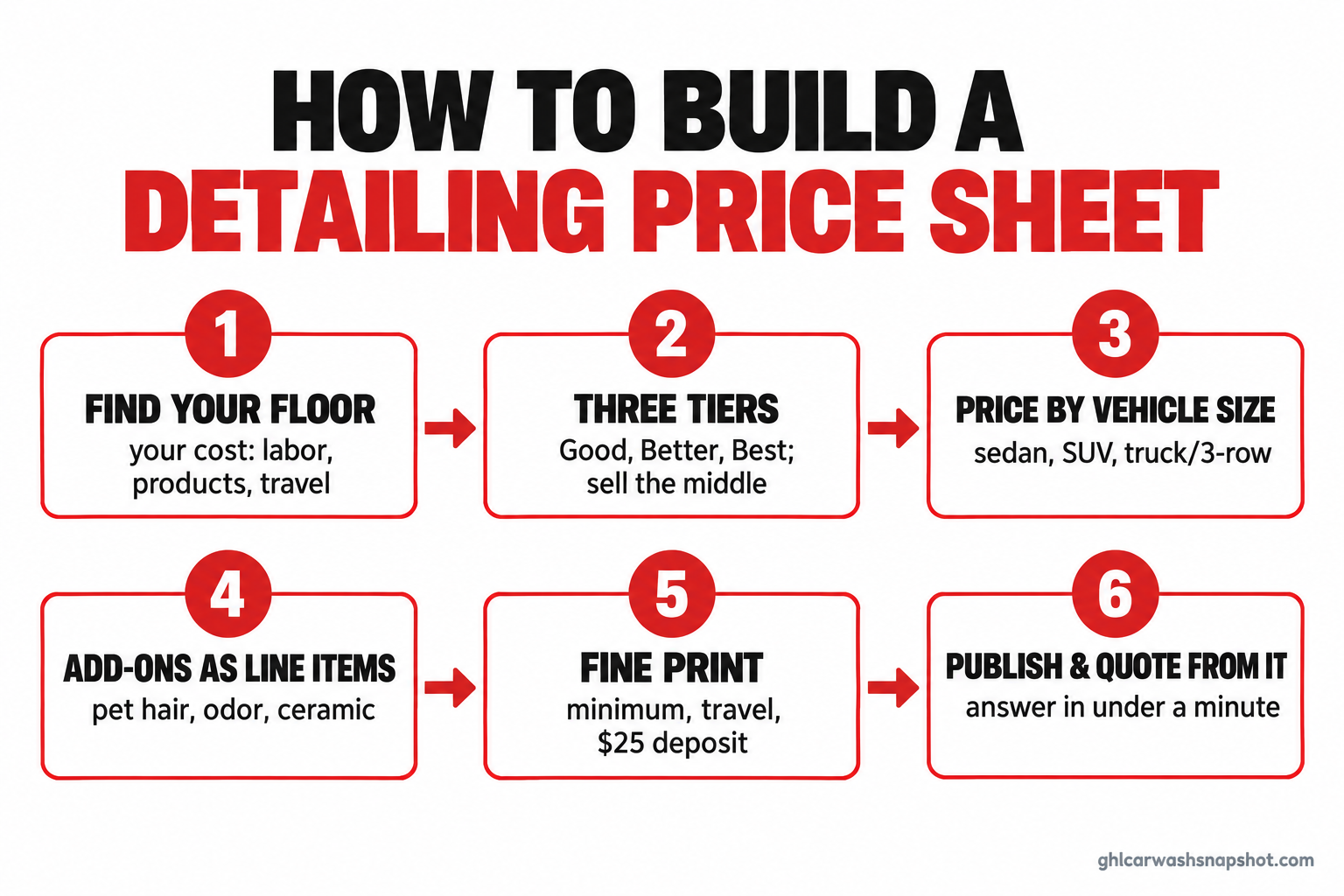
Here is the fix: build one written price sheet with three packages, priced by vehicle size, with add-ons as line items and a short block of fine print that protects you. Then quote from it the same way, every time, in under a minute. A real price sheet does three jobs at once. It lets you answer “how much?” instantly, while the job is still warm. It anchors the customer on your middle tier instead of your cheapest. And it stops you from quoting a number you lose money on. This post hands you the template, the 2026 ranges to set it against, and the texts that turn a price question into a deposit.
Table of contents
- What “it depends” quoting costs you
- The anatomy of a price sheet that books jobs
- Stage 1: Find your floor
- Stage 2: Three tiers, not twelve options
- Stage 3: Price by vehicle size
- Stage 4: Add-ons as a line-item menu
- Stage 5: The fine print that protects you
- Stage 6: Publish it and quote from it
- Steal this: the full template
- Three detailers, one sheet
- Objections, answered
- FAQ
What “it depends” quoting costs you
Every detailer has answered a price question with “it depends on the condition.” It is true, and it is also the line that loses you the job. The customer wanted a number so they could decide, and the longer you make them wait, the colder the job gets.
The old Harvard Business Review study on lead response, The Short Life of Online Sales Leads, found most businesses answer new inquiries far too slowly, and the ones who reach a lead fast are much more likely to win the work. The person texting you at 7pm is texting two other detailers. Whoever answers first with a clear price usually gets the job, and you cannot answer fast if every quote means stopping, thinking, and guessing.
Those Thumbtack and four-metro figures are the numbers your next customer has already seen on three other sites before they texted you. If your answer is slow, vague, or all over the place, you look like the amateur in a market of roughly 62,750 car wash and detailing locations. The fix is not working harder on each quote. It is doing the pricing work once and never guessing again.
The anatomy of a price sheet that books jobs
A sheet that actually helps you has six parts, and most homemade ones are missing at least three: your floor (the cost under every price), three tiers (Good, Better, Best, not a buffet), vehicle-size pricing, add-ons as line items, fine print (minimum charge, travel, condition surcharge, deposit, reschedule window), and a published home you can link to in one tap. We will build each one, and show you how each breaks.
Stage 1: Find your floor
You cannot set a price until you know the number you must never go below. That floor is your cost to do the job: your labor (pay yourself a real hourly rate), products, and the stuff people forget, like drive time, setup, teardown, and the water and power you burned.
Housecall Pro publishes the formula detailers should use: break-even cost divided by (1 minus your target margin). Their pricing guide runs the example: a $120 all-in job at a 30% target margin prices at $120 divided by 0.70, which is $171. Run it once for each tier on your average vehicle and you have your floor.
How it breaks: forgetting non-billable time. The detail took two hours, but add forty minutes driving, fifteen on setup, twenty loading out, and your “30% margin” job is really at break-even. Count the whole window, from leaving home to leaving the driveway.
Stage 2: Three tiers, not twelve options
The biggest mistake on homemade sheets is too many choices. A long à la carte list looks like homework, and a confused customer stalls instead of booking.
Use three tiers, named so the value is obvious, with the middle one built to be what you actually sell, because that is what most people pick. Both Housecall Pro and Jobber recommend Good/Better/Best and tell you to define each package in writing first.
- The Refresh (Good): the maintenance wash for a regular. Exterior, wheels, glass, quick interior.
- The Full Detail (Better): your hero, the complete interior-and-exterior job. Build it to be the obvious choice.
- The Showroom (Best): for the car that was neglected or is about to be sold. Adds paint correction and a ceramic sealant. (Full contents are in the template table below.)
How it breaks: tiers that overlap. If a customer cannot tell why The Showroom costs double The Full Detail, they pick the cheaper one. Each step up must add something they can picture: “correction removes the swirl marks you see in the sun” beats “premium package.”
Stage 3: Price by vehicle size
A compact sedan and a lifted three-row Suburban are not the same job, and your sheet should never pretend they are. Size-based pricing keeps you profitable and lets the customer find their row, find their column, and have a number.
Three bands cover almost everything: Sedan / Compact (cars, coupes, small crossovers), SUV / Crossover (midsize SUVs, minivans, standard trucks), and Truck / 3-Row (full-size trucks, 3-row SUVs, large vans). The 2026 ranges back this up: one national guide puts a full detail around $220 for sedans and $310 for SUVs and trucks, and CostInsightHub’s 2026 guide lists $150 to $400 depending on size and location.
Illustrative full-detail price by vehicle size, 2026. Sedans near $220, large trucks and 3-row SUVs near $380, per national guides (CostInsightHub) and the four-metro survey.
How it breaks: guessing the size over text. “SUV” means a RAV4 to one person and a Suburban to another, so put example models on the sheet and ask for the year, make, and model before you confirm a price.
Stage 4: Add-ons as a line-item menu
Keep your three base packages clean and move everything situational into a named add-on list with its own prices (the full list is in the template below). This keeps the base price honest, so you are not padding every quote for pet hair that is not there, and it turns the upsell into the customer’s idea.
Those numbers sit inside the published 2026 ranges: Housecall Pro lists paint correction at $250 to $750+ and ceramic coating from the low hundreds past $800, into the thousands for multi-layer work. For pricing a coating by panel and prep, the ceramic coating pricing estimator walks through the variable-cost math.
How it breaks: burying add-ons in the base price “to be nice.” If every Full Detail secretly includes pet hair removal, the spotless back seat overpays and the shedding Golden underpays. Name it, price it, charge it only when it is there.
Stage 5: The fine print that protects you
Almost every homemade sheet skips this, and it is what saves your week. Five short lines that set the rules so you are not negotiating them live in a driveway.
- Minimum charge. A floor (say $90) so a tiny job still covers your drive and setup.
- Travel. Free within a set radius (say 15 miles), then a per-mile rate beyond it.
- Condition surcharge. “Heavily soiled vehicles quoted after photos, plus 25% to 50%,” so a two-hour job never gets a one-hour price.
- Deposit. A $25 deposit to hold the slot, applied to the total. Your no-show insurance.
- Reschedule window. “24 hours notice to reschedule, deposit forfeited after that.”
A cancelled Saturday slot you cannot refill is pure lost income, and a small deposit changes the mindset from “I’ll probably get it done” to “I’ve committed.” The full deposit-and-reminder flow is in how to stop last-minute detailing cancellations.
How it breaks: rules in your head but not on the sheet. A policy you have not written down is one you will cave on at 8am when the customer pushes back. Written next to the price, it is just how your business works, and almost nobody argues.
Stage 6: Publish it and quote from it
The last stage turns the sheet from a note on your phone into a booking machine: give it a home you can link to, and quote from it the same way every time.
Put the sheet on your website as a real page, not a PDF in your camera roll. A link opens on any phone, it is easy to text, and search engines can read it, so a published price page shows up when someone searches “mobile detailing prices near me” and a hidden one does not. The mobile detailing service page shows the structure, and losing leads after hours shows why fast quoting matters.
When a lead asks “how much?”, you send the same clean reply with the link and a next step. Here is the copy to steal.
Three messages cover almost every pricing conversation, sent in seconds because they are written down. For the full set of nudges that reel in a quote gone cold, the detailing quote follow-up system picks it up from here.
How it breaks: sending the link and stopping there. A price with no next step is forgotten. Every quote text must end with an ask: hold a slot, send photos, pick a time. The sheet answers “how much,” your message answers “what now.”
Steal this: the full template
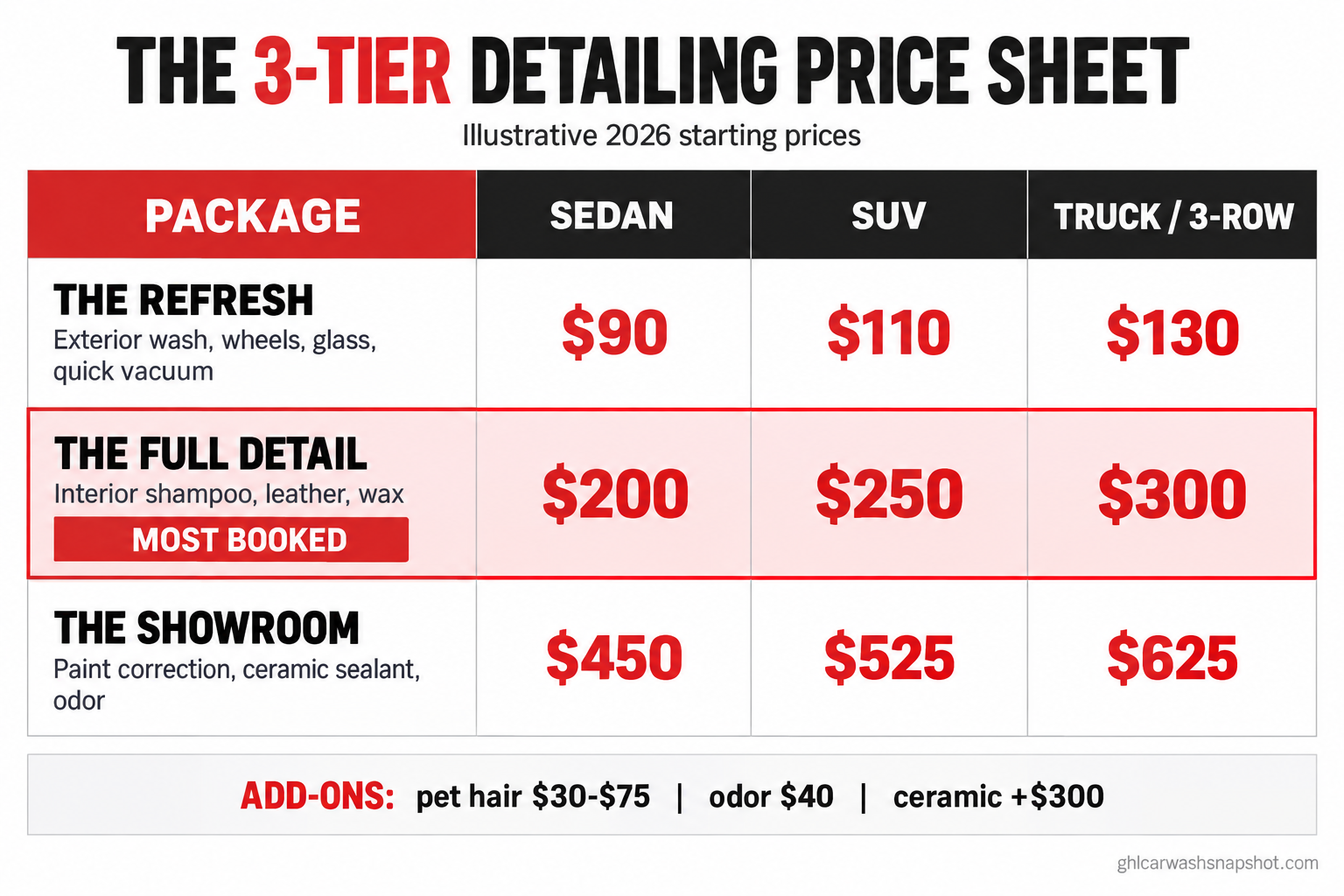
Here is the whole sheet in one place. These are illustrative starting numbers inside the 2026 ranges above. Run the Stage 1 formula on your own costs, replace them, then publish.
| Package | Sedan / Compact | SUV / Crossover | Truck / 3-Row |
|---|---|---|---|
| The Refresh (exterior wash, wheels, tires, glass, quick vacuum and wipe) | $90 | $110 | $130 |
| The Full Detail (Refresh + interior shampoo and extraction, leather care, door jambs, wax or sealant) | $200 | $250 | $300 |
| The Showroom (Full Detail + one-step paint correction, ceramic sealant, engine bay, odor treatment) | $450 | $525 | $625 |
Add-ons (any package): Pet hair $30 to $75 · Stain extraction $40 to $80 · Odor treatment $40 · Headlight restoration $60/pair · Clay bar $50 · Ceramic coating upgrade +$300 (2-yr) / +$700 (multi-year)
The rules: Minimum charge $90 · Free travel within 15 miles, then $1.50/mile · Heavily soiled vehicles quoted after photos (+25% to 50%) · $25 deposit holds your slot and comes off the total · 24-hour reschedule notice, deposit forfeited after.
Midsize-SUV mobile package averages from a 2026 four-metro analysis reported by Housecall Pro: basic $158, standard $278, premium $443. Your tiers should spread across a similar shape.
Three detailers, one sheet
The structure is the same for everyone; the numbers and emphasis change with where you are.
The brand-new solo detailer
First season, maybe part-time, chasing your first twenty regulars. Keep all three tiers but price toward the lower-middle of your market, competitive without being cheapest, because cheapest attracts the customers who cancel. Lead every quote with The Full Detail to build a portfolio. Use the deposit from day one: it feels aggressive when you are hungry for work, but it is what separates you from the hobbyist. For tools, the best mobile detailing software breakdown compares your options.
The established solo, booked four to five days a week
More demand than calendar, so your sheet’s job shifts from “win the quote” to “raise the floor.” Nudge prices toward the premium end, lean on the condition surcharge, and push The Showroom and the ceramic upgrade, because at capacity your money is in higher-value jobs, not more jobs. Turn your best repeats into a maintenance plan so their slot is booked before they ask, which recurring detailing maintenance plans lays out in full.
The mobile team with two or three vans
Now the sheet is a management tool. Any tech quotes the exact same price from the exact same sheet, so you are not undercut by your own crew and the brand stays consistent across the city. Standardize the add-on list and track your attach rate, because add-ons are where a team’s margin lives. When every van runs one sheet, you can finally see which tech sells, which service lands, and where the week leaks.
Objections, answered
“Publishing my prices lets competitors undercut me.” Your competitors already know roughly what you charge, because the customer tells them. Hiding prices only costs you the fast, warm leads. A published price filters out bargain hunters and books the people ready to pay.
“Every car is different, I can’t lock in fixed prices.” You are not locking in a final invoice, you are publishing a clear starting point. That is what the vehicle-size bands and the condition surcharge are for: an instant number for the normal car, and the written right to re-quote the disaster after photos.
“I already quote fast by text, why formalize it?” Because “fast” and “consistent” are not the same thing. Quoting off the top of your head is fast until you give two numbers for the same truck or lowball at 9pm because you were tired. A sheet makes you fast and right at once.
FAQ
How do I price a detailing job if every car is different?
Publish a starting price for each package by vehicle size, then use a condition surcharge for the ones that need more work. A normal car gets an instant number, which is what wins fast leads. A heavily soiled vehicle you quote after photos, plus 25% to 50%. Fixed where you can be, flexible where you have to be, both written down.
Should I publish my detailing prices on my website?
Yes. A published price page lets you answer 'how much?' in one tap, shows up when someone searches for detailing prices nearby, and filters out bargain hunters before they waste your time. Detailers who hide prices lose the warm, ready-to-book leads who will not wait for a callback. Use a real web page, not a PDF in your camera roll.
What is a good profit margin for car detailing?
Many detailers target 30% to 40% once you count labor at a real hourly rate, products, and non-billable time like travel and setup. Housecall Pro's formula is break-even cost divided by one minus your target margin, so a $120 job at 30% prices at about $171. The trap is forgetting travel and setup, which quietly turns a profitable price into break-even.
How do I stop no-shows and last-minute cancellations?
A small deposit, around $25, that comes off the final total. It shifts the mindset from 'I'll probably get it done' to 'I've committed,' and it protects the slots you cannot refill on short notice. Pair it with a clear reschedule window, like 24 hours notice or the deposit is forfeited, written right on your price sheet.
Should I use fixed packages or à la carte pricing?
Lead with three fixed packages, Good, Better, Best, and keep à la carte items as a short add-on list. Too many standalone options overwhelms people and stalls the booking. Three clear tiers let most customers pick the middle, which should be the one you most want to sell. Add-ons then become an easy upsell instead of clutter.
How often should I update my detailing price sheet?
At least twice a year, and any time your product costs or wages jump. Compare the time you estimated for each package against what the jobs actually take, and check your product spend against recent invoices. A sheet you set last year was built on last year's costs, so a quote off it today may be leaving margin on the table.
Back to that black Tahoe and the two trucks that texted twenty minutes apart. With a sheet, both get the same instant answer, the same clean link, and the same ask to lock a slot with a deposit. The pricing work happens once, at a kitchen table with a calculator. After that, the sheet books the jobs and you do the detail. Build it this week.