

You have done the math on your current platform and you do not like it. Maybe it is the 4% Rinsed takes on every membership it signs, maybe it is a Washify or DRB bill that climbs with every lane, maybe it was built for a chain and you run three sites. So you call around, a competitor quotes a lower monthly, and the number looks great. Then a quiet voice asks the real question: what does it cost to actually move? Not the new monthly, the move itself, the part no quote shows.
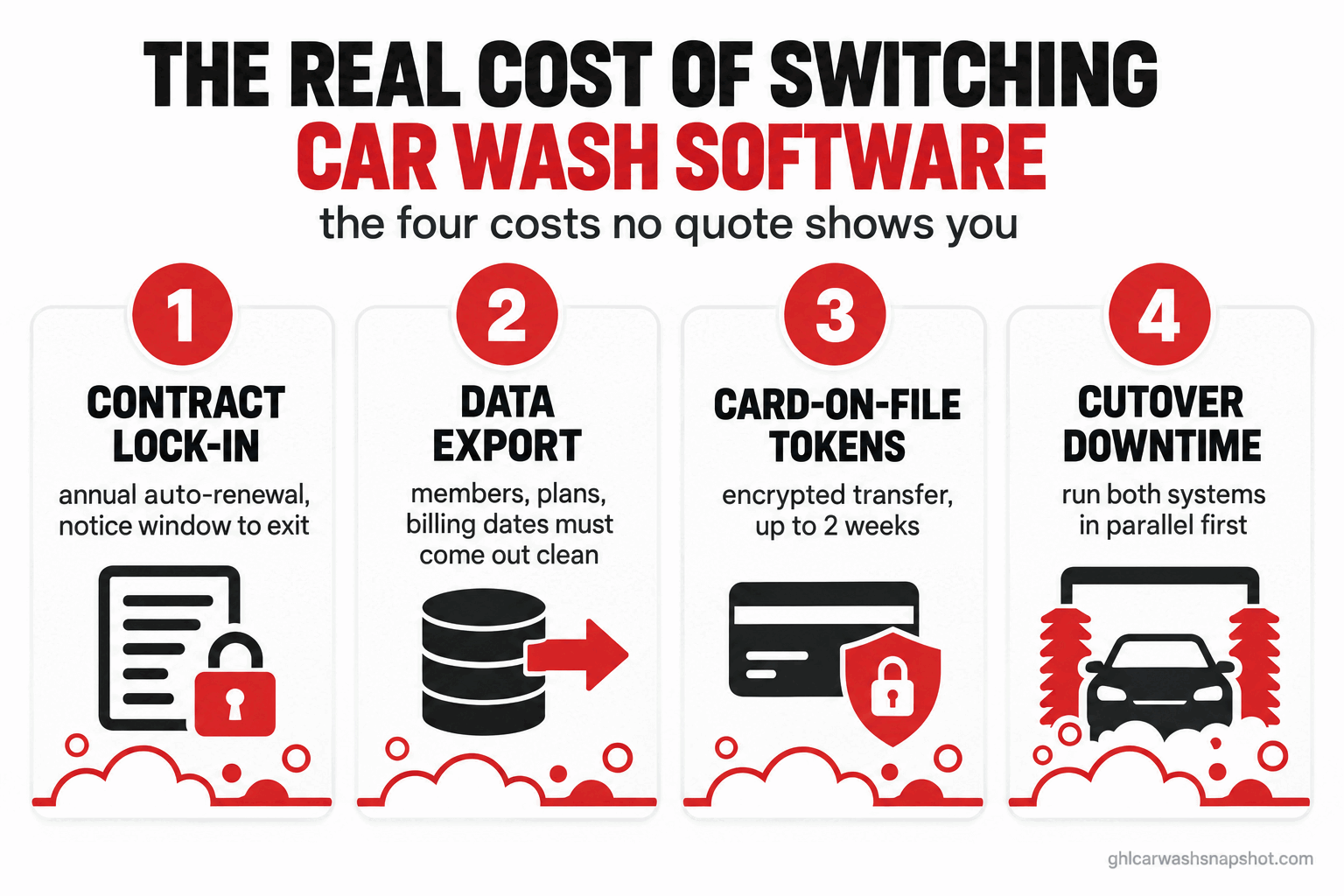
Here is the honest answer before the detail. The sticker price of the new software is almost never what stops an operator from switching. The switching cost is, and it has four parts nobody puts on a quote: the contract you are still inside, the friction to get your member data out, the card-on-file tokens that cannot simply be emailed to you, and the cutover days where billing is fragile. Price those four before you sign, because a platform $300 a month cheaper can still cost you five figures and a month of risk to reach. This teardown gives you the real reported numbers, three scenarios by wash size, and the checklist so the move does not cost you members.
Table of contents
- Why switching costs more than the quote says
- Cost 1: the contract you are still inside
- Cost 2: getting your member data out
- Cost 3: the card-on-file tokens (the expensive one)
- Cost 4: cutover downtime and staff retraining
- What each platform’s exit actually looks like
- Three scenarios by wash size
- Steal these: the switch checklist and the questions
- The auto-renewal law trap people miss
- Objections, answered
- FAQ
Why switching costs more than the quote says
Switching software feels like swapping a phone plan. It is not. You are moving the machine that bills thousands of cars a month and holds your members’ payment details. The new vendor sells you the destination; nobody sells you the trip, and the trip is four costs: a contract you may still owe months on, a data export that has to come out clean, the card tokens that keep billing alive, and the cutover days where billing is fragile. A diligence checklist estimates a full point-of-sale swap at $40,000 to $120,000 per site plus four to eight weeks of disruption (Acquidex), hardware included. An independent swapping only a membership CRM pays far less, but never zero, and a vendor quoting a lower monthly has no reason to mention it.
Cost 1: the contract you are still inside
The first question is not what the new thing costs, but what the old thing costs you to leave. Most enterprise car wash software is sold on an annual agreement that renews automatically. DRB even publishes a page about the subscription-cancellation features in its SiteWatch and Website Connect products (DRB). What no public page reliably states for Rinsed, Washify or DRB is your specific term, renewal date, and notice window. Those live in the contract you signed. If it renews annually and requires advance written notice, missing that window by a day can lock you in for another full year. Pull the agreement before you shop and write down your contract end date, the notice window to cancel, and the early-termination cost mid-term.
How this breaks. You sign with the new vendor in month nine, then find your old contract auto-renewed because you missed a 60-day notice window. Now you pay both platforms until the old term runs out. The fix: confirm your exit date in writing, then back-schedule the migration so cutover lands after the old billing stops.
Cost 2: getting your member data out
Your member data is the asset: names, emails, phones, vehicles, plate records for plate-on-file, which plan each member is on, and the billing anniversary that decides when each one is charged. If any of that comes out garbled, you do not have a clean member base on the other side. You have a reconciliation project.
Reputable platforms give you an export. The trade press flags that several car wash vendors do not disclose export terms publicly at all (Trade Tech Guide), which is why you ask in writing: what format (a real CSV or a locked PDF report), which fields, any fee, and how long it takes. The field operators forget is the billing anniversary. A list with no billing dates means you cannot reproduce each member’s charge schedule, so you either guess or re-anchor everyone to one date, and a member charged on the 3rd who suddenly gets billed on the 1st notices and disputes it.
How this breaks. The export looks complete, then three weeks after cutover you find the plan-tier field did not map cleanly, so a batch of top-tier members are now on the base plan paying less. Nobody complains about paying less, so you find it in the revenue report, not the inbox. The fix: reconcile the export against your active-member count and revenue before importing, and test a small batch.
Cost 3: the card-on-file tokens (the expensive one)
This is the cost that stops most switches, and the one almost no comparison article explains. Your recurring billing works because each member’s card is stored as a token held by your processor. To keep billing after a switch, those tokens have to move, and you cannot do it yourself or fast. Under card-industry rules you as the merchant generally never hold raw card numbers in readable form. A vault vendor puts it plainly: merchants should never receive raw card numbers, and the transfer should stay between compliant systems (Gr4vy). Moving tokens is a processor-to-processor transfer of an encrypted file, not an email with a spreadsheet.
The specifics are concrete. Square will send stored card data only to a receiving processor that is PCI DSS Level 1-compliant, as an encrypted CSV, and the export can take up to about two weeks, with the clock starting only after it verifies you own the account (Square). The receiving side then quotes five to ten business days once it has the file (Payabli). Stack those and a token migration is a multi-week affair, with two vendors who do not work for you coordinating an encrypted handoff.
And if a member updates their card with your old processor between export and import, that change is not in the file you moved, so you need a second import to catch it (Stripe). In a wash with thousands of members, that window is never clean.
Two ways to move card tokens, one of them loses members
The wrong way: cancel the old platform, then collect new card details from every member yourself. Most never re-enter a card, your active base craters, and you have manufactured mass churn out of a software change.
The right way: arrange an encrypted processor-to-processor token transfer while the old system still bills, verify the tokens charge on a test batch, then cut over. Members never notice, because the card on file never left a compliant vault.
How this breaks. The catastrophic version is the operator who treats tokens like a contact list, cancels the old system, and plans to have members re-enter cards on the new portal. Only a fraction ever do, so because nearly 90% of unlimited members would have renewed (ICA Q1 2026), you just turned a loyal, renewing base into a re-acquisition project. The fix is non-negotiable: never cut off the old billing until tokens are proven to charge on the new one. A vendor that cannot support a compliant token transfer is a reason to keep shopping.
Cost 4: cutover downtime and staff retraining
The last cost is the human one: two systems that both think they are in charge of billing, and lane staff learning new screens. The downtime risk is real but manageable if you run both systems in parallel first. Keep the old platform billing while the new one is loaded, reconciled, and tested on a small batch, and only when it charges correctly do you turn the old one off. That parallel week costs a few weeks of overlapping fees, and it is the cheapest insurance you will buy against a failed-billing cliff. Retraining is slower: budget for a dip in signup conversion and post the new signup script at the kiosk.
How this breaks. The flip-the-switch cutover, done on a Friday to be ready for the weekend surge, is where washes get hurt: a billing bug nobody caught without a parallel run, Saturday volume hits, and you are debugging billing during your busiest shift. The fix: cut over on your slowest day, after a parallel week, with the old system available to fall back to for one more cycle.
What each platform’s exit actually looks like
No public page gives a clean exit sheet for these vendors, so this table combines reported pricing with the migration realities above. Confirm your own in writing.
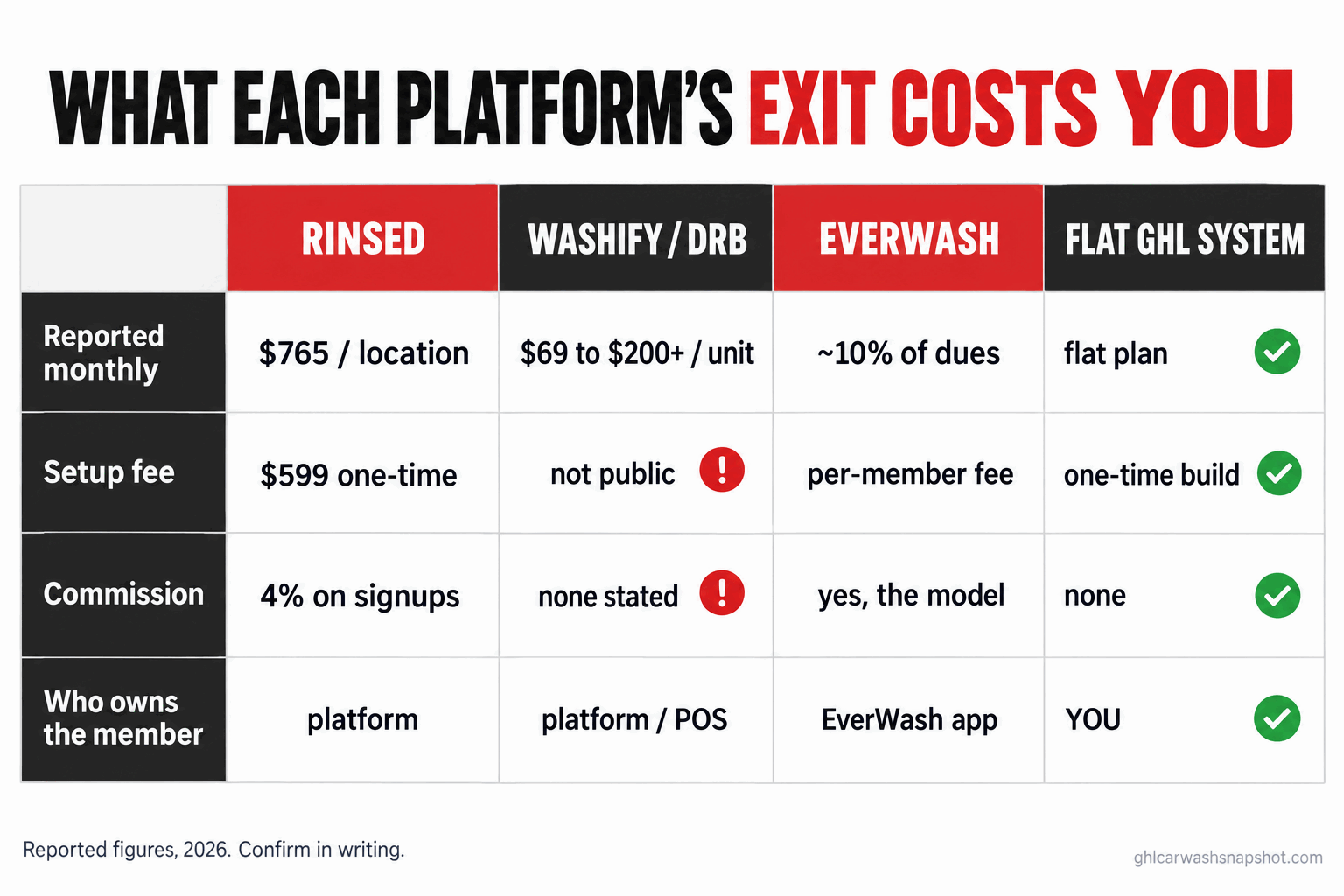
| What to check | Rinsed | Washify / DRB | EverWash | Flat GoHighLevel system |
|---|---|---|---|---|
| Reported monthly | ~$765/location (src) | ~$69-$200+/unit (src) | ~10% of dues (src) | Flat GHL plan, member-count independent |
| Setup / ongoing | ~$599 setup + 4% on Rinsed signups | Not public | Per-member fee + revenue share | One-time build, no commission |
| Who holds the member | The platform | The platform/POS | EverWash app | You |
| Card tokens on exit | Confirm transfer terms | Confirm transfer terms | Confirm portability | Yours, in your processor |
For the full monthly-cost breakdown, see what car wash membership software actually costs in 2026, and for the closest head-to-heads, Rinsed vs GoHighLevel and DRB and Patheon alternatives for small tunnels.
Three scenarios by wash size
The switching math changes with size, because the fixed costs of a move spread over very different member counts.
Single-site express, 400 members. Switching cost is mostly your time and a couple weeks of overlapping fees; 400 tokens move the same way 4,000 do. The move is worth it when the new platform removes a recurring tax, like a percentage commission, bigger than a flat fee.
Three-location operator, 2,800 members. The data complexity is real now: three sites, maybe three billing-day conventions, and a token file per processor. The switch is a month-long project with a parallel week per site, but your savings are three times larger too, and a flat, member-count-independent system pulls ahead here because your current bill scales with sites and members while a flat one does not. Do the sites one at a time.
Eight-location group, 11,000 members. A full POS swap can run into tens of thousands with hardware (Acquidex); move only the membership and marketing layer and you avoid most of that. You do not cut over eight sites in a weekend: pilot one, prove the token transfer, document the runbook, then roll the rest over a quarter. At your scale, 4% of dues is a seven-figure line over a few years, which is why groups this size most want out of a commission model.
Steal these: the switch checklist and the questions
Work them in order. This is the difference between a clean move and a churn event.
The questions to ask your current vendor, in writing:
- My exact contract end date, and does it auto-renew?
- The notice period to cancel, and in what form (email, letter, portal)?
- The early-termination cost if I leave mid-term?
- A full member export as CSV, including each member’s plan tier and next billing date, and is there a fee?
- Will you do a processor-to-processor transfer of the card-on-file tokens, and how long does it take?
The switch checklist, in order:
- Confirm your exit date and notice window, then back-schedule everything to land after old billing stops.
- Request the export, reconcile it against your active-member count and revenue, and map plan tiers one to one.
- Arrange the compliant token transfer while the old system is still billing. Never cancel first.
- Test-import a small batch and run a real charge to prove tokens work.
- Run both systems in parallel for at least one billing cycle, then cut over on your slowest day with the old one as a fallback.
If you would rather hand the project to someone who has done it, that is what a GoHighLevel developer or a trained wash-savvy VA is for, and the full step-by-step lives in how to migrate a wash to GoHighLevel without losing a member.
The auto-renewal law trap people miss
One compliance point. When you move members, you re-create their auto-renewing subscriptions, and the notices your new system sends have to satisfy the same rules your old one did. A clarification that saves operators a scare: the FTC “click-to-cancel” negative-option rule everyone cited in 2025 was vacated by the Eighth Circuit in July 2025 and is not in force. That does not mean no rules. State auto-renewal laws, like California’s, still apply, along with Section 5 of the FTC Act (more here). The practical angle: if your old platform sent the required renewal reminders and a clear cancellation path, your new one must too from day one of cutover, or a member who cannot easily cancel becomes both a compliance risk and a chargeback.
Objections, answered
“My platform says switching is easy, they will export everything.” Get that in writing, especially the token transfer. “Easy export” often means a CSV of names and emails, not a compliant transfer of the card tokens that keep billing alive.
“Can’t members just re-enter their cards on the new system?” You can ask, but most will not, because their unlimited plan is on autopilot. Forcing a re-entry turns a renewing base into a churned one, and membership is the growing half of the industry, up 10.4% while retail fell 3.9% in Rinsed’s Q2 2026 report (Rinsed Q2 2026).
“The new platform is cheaper monthly, so it pays for itself fast.” Sometimes, which is why you price the trip. Put the one-time switching cost against the monthly savings: save $400 a month on a $1,600 move and you break even in four months. Skip the parallel week and there is no payback at all.
The honest verdict
Back to that lower monthly quote. It might be the right move. Plenty of washes overpay a platform that scales with their success or taxes every membership it touches, and moving to a flat, member-count-independent system can save real money and put the member relationship back in your account.
But the quote is the destination, not the trip. Before you sign, price all four switching costs: the contract exit, the clean export, the multi-week token transfer, and the parallel week that keeps billing from breaking. Run the questions and move on your slow season with the old system still billing until the new one is proven. Do that, and switching is a project with a payback date. Skip it, and it is how a software decision becomes a churn event. The members, and the cards that keep them paying, are not as replaceable as the platform.
FAQ
How much does it cost to switch car wash membership software?
Most of the cost is not on the quote. A full point-of-sale swap can run $40,000 to $120,000 per site at the enterprise end including hardware, but an independent moving just the membership and billing layer pays far less: a few weeks of overlapping fees, their own time, and any export fee. The real risk cost is churn from a botched token migration, which is avoidable with a parallel run.
Can I export my members' credit card numbers when I switch?
No. Card-industry rules mean you as the merchant generally cannot hold raw card numbers. Stored cards move as a processor-to-processor transfer of an encrypted file. Square, for example, will send card data only to a PCI DSS Level 1-compliant receiving processor and the transfer can take up to about two weeks. Never cancel the old system before the tokens charge on the new one.
Will I lose members when I switch platforms?
Only if you mishandle the card tokens. Transfer the stored cards compliantly while the old system still bills and members never notice. Cancel first and ask members to re-enter cards, and most will not, converting a renewing base, nearly 90% of whom planned to renew, into a re-acquisition project. The move does not lose members; skipping the token transfer does.
How long does it take to switch car wash software?
Plan for a few weeks for a single small site and up to a quarter for a multi-location group rolled out site by site. The card-token transfer alone can take two weeks on the sending side plus five to ten business days on the receiving side, and you want one full billing cycle running both systems in parallel before you cut over.
What is the biggest mistake operators make when switching?
Cutting off the old billing before the new system is proven. The card tokens take weeks to move compliantly, so cancelling first creates a billing gap and forces members to re-enter cards, which most will not do. Run both systems in parallel for a cycle and cut over only after a test batch charges correctly.
Related posts
- What Car Wash Membership Software Actually Costs in 2026: Rinsed vs Washify vs EverWash
- Rinsed vs GoHighLevel for Car Washes: Which CRM Should Run Your Wash Club?
- DRB and Patheon Alternatives for Small Tunnel Car Washes
- How to Migrate Your Car Wash to GoHighLevel Without Losing a Member
- Silent Card Churn: The Hidden Killer of Every Unlimited Wash Club
- Car Wash Membership Auto-Renewal Laws in 2026: What Actually Applies