

It is the third of the month and you are looking at two statements side by side. The first is your merchant deposit for the unlimited wash club: a good month, membership revenue up again. The second is the invoice from the software that runs it, and it went up too, by almost exactly as much, because the number it charges is a slice of the first statement. The better your club does, the more the software takes, and nobody put that on a pricing page.
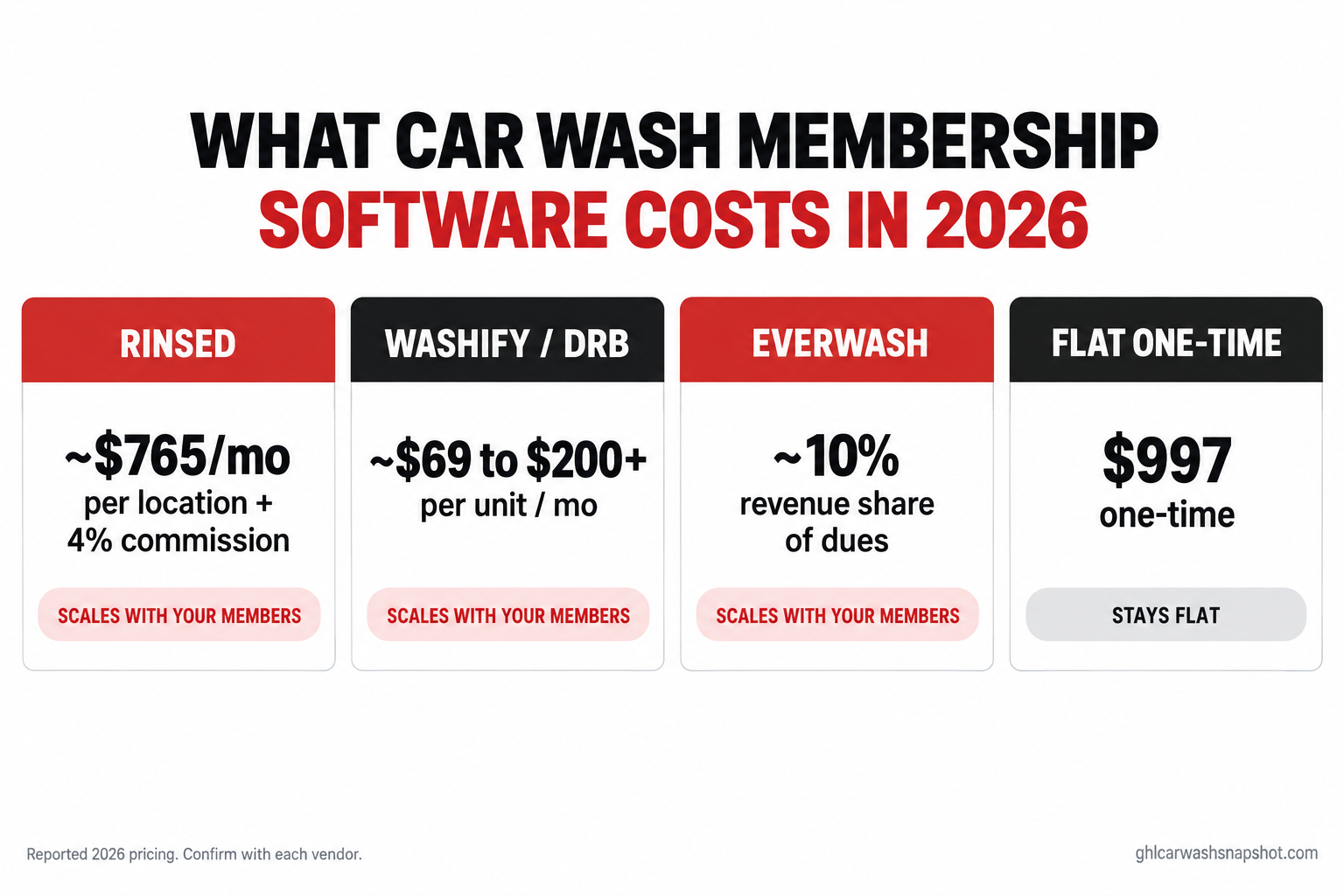
Here is the honest answer up front. Rinsed, Washify/DRB and EverWash all hide their real numbers behind a demo, and they price three different ways: Rinsed on a per-location fee plus a recurring commission on the memberships it signs, Washify/DRB on a per-unit fee, and EverWash on a revenue share of your dues. The sticker you are quoted is never the number that bites. The number that bites is the one that grows every month your club grows, forever, and for a three or eight-location chain it can pass what a full membership build would cost outright. This teardown shows the reported figures and the model behind each, so you can compare them without a sales call.
Table of contents
- How I priced these (and why it is hard)
- The three pricing models behind every quote
- Rinsed: per-location fee plus commission
- Washify / DRB: per-unit monthly fee
- EverWash: revenue share on your dues
- The reported numbers, side by side
- The buried cost: three real scenarios
- The compliance line item nobody quotes
- How each pricing model breaks
- Steal these: the demo-call script and switch checklist
- Objections, answered
- FAQ
How I priced these (and why it is hard)
Two things make this pricing hard to pin down, both against the buyer.
First, none of the three publishes a live rate card. Rinsed, Washify/DRB and EverWash all route you to a demo before naming a number (Capterra lists Rinsed as quote-based). When the price is a slice of your revenue or a stack of add-ons, a single sticker would scare people, so the cost gets assembled on a call. Every figure here is labeled reported: it comes from operators, review sites and vendor statements, not a page you can bookmark.
Second, the sticker and the total are different animals. A $69 base with add-ons and processing is not a $69 tool, and a 4% commission sounds tiny until you multiply it across a year of net-new members. The only number that matters is all-in cost per month at your real member count, and that is the one the demo is designed not to hand you cleanly. The US has roughly 62,750 car wash outlets (ICA), and few have worked out what the pricing model, not the sticker, costs them in two years.
The three pricing models behind every quote
Forget brand names for a second. There are only three ways these tools charge you, and the model matters more than the logo:
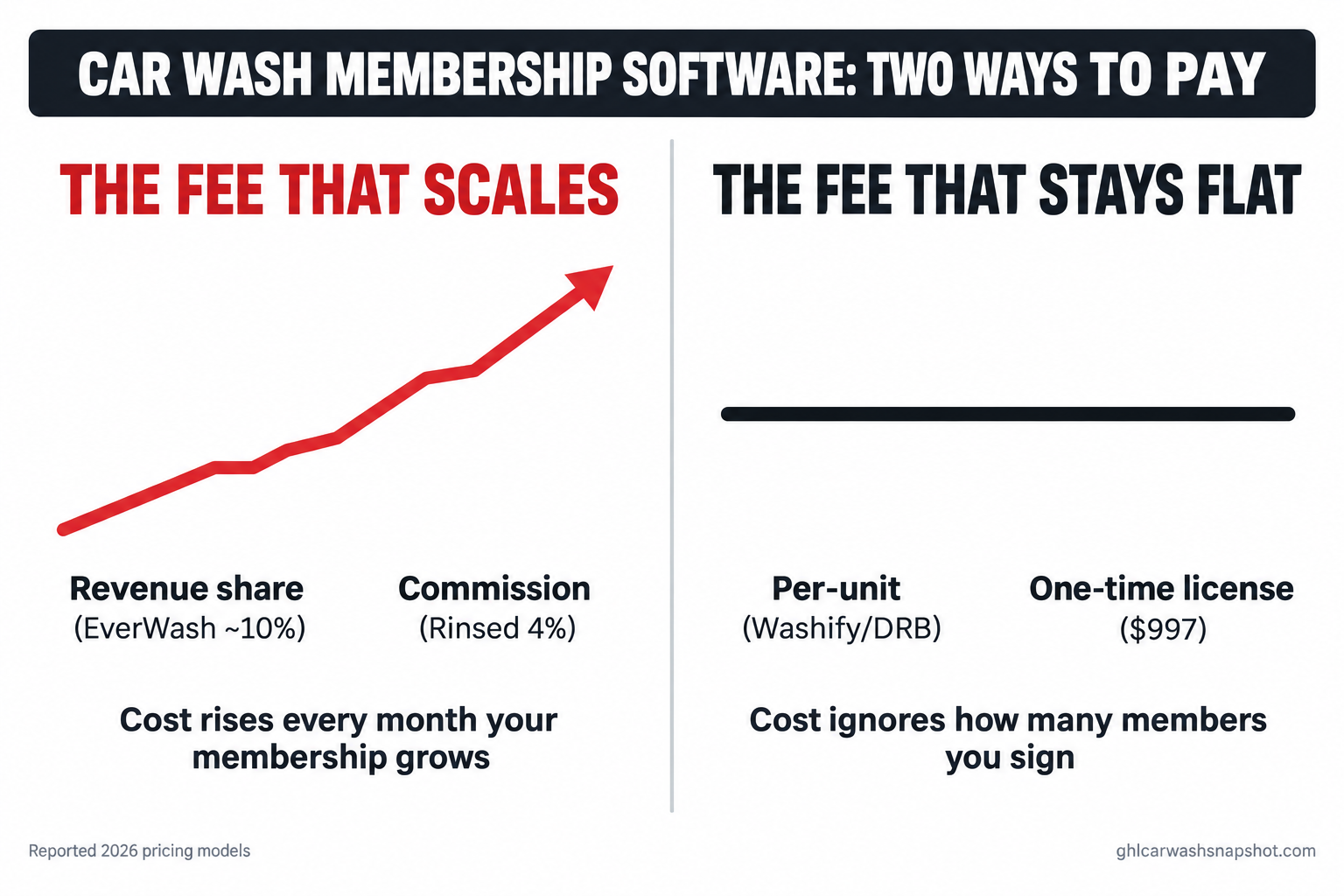
The fee that stays flat vs the fee that grows with you
Scales with success: a commission on new members (Rinsed) or a revenue share on dues (EverWash). No ceiling. The better you do, the more you pay.
Stays roughly flat: a per-unit or per-location fee (Washify/DRB, Rinsed's base), or a one-time build. Predictable, and decoupled from how many members you sign.
- Revenue share / commission. The vendor takes a percentage. EverWash takes a share of dues; Rinsed takes 4% of net-new memberships its forms sign up. Cheapest to start, most expensive to succeed with.
- Per-unit or per-location subscription. A flat monthly fee per pay station, tunnel or site. Washify/DRB and Rinsed’s base fee work this way. Predictable, but it climbs as you add locations and stacks add-ons.
- One-time or flat platform cost. You license the system once, then run it on a fixed subscription that ignores your member count. This is where a GoHighLevel-based system like the Car Wash Snapshot sits.
The trap is choosing on the first number you hear: the share model shows the smallest sticker and the largest lifetime bill.
Rinsed: per-location fee plus commission
Rinsed is the category leader and, for a large operator, a strong product: a car-wash-only CRM that bolts onto your tunnel POS and squeezes retention and analytics out of it, managing more than 4 million active memberships across 1,300+ washes on a $20M Series B (PR Newswire). If you are a multi-site express chain that lives on churn analytics, it earns its place.
The cost has two parts. The base is a reported ~$765 per month per location with a ~$599 setup fee, plus a 4% recurring commission on net-new memberships signed through Rinsed’s forms (Rinsed pricing). The base is predictable. The commission is the part that scales: it is charged on the members the tool signs, month after month, for as long as they stay. The pitch calls that fair alignment with your growth. It is also the line that never stops climbing.
For the full head-to-head on where Rinsed wins and where an all-in-one system does, see Rinsed vs GoHighLevel for car washes.
Washify / DRB: per-unit monthly fee
Washify, now part of DRB, is a point-of-sale and payments platform with membership tooling attached. It prices per unit and does not publish the numbers. Operator reports put the base license around $69 per unit per month, add-ons like gas-station code integration near $49 per unit on top, and total fees from about $119 to $200+ per unit depending on the modules (Washify reviews, PaymentPop). Card processing is reported separately near $12.95/mo plus 3.2% and $0.25 a transaction.
The good news with a per-unit model is that it does not tax membership growth directly. A thousand new members do not raise a per-unit fee. The catch is threefold: it stacks with add-ons until the “base” is a fiction, it climbs every time you add a lane or location, and bundled processing makes the true all-in cost hard to separate. The bill grows with your footprint, not your revenue.
EverWash: revenue share on your dues
EverWash is the purest example of the model that scales with you. It runs a membership program, often marketing its own network, and takes a cut of the dues. Operator reports put the take around 10% of membership revenue plus card fees plus a one-time fee per new member, closer to 15 to 18% per month all-in, negotiated per wash (Car Wash Forum operator thread; EverWash for wash owners).
Run that against a real club. A wash doing $30,000 a month in dues at a 10% share pays $3,000 a month, or $36,000 a year, and that rises every time you add a member. The fair argument for it: EverWash markets its own network, so you share revenue you might not have had. But if you sign most members yourself at the kiosk, you pay a growing percentage on customers you brought in. That is the buried cost at its clearest.
The reported numbers, side by side
Here is the reported 2026 picture, a map, not a quote.
| Vendor | Pricing model | Reported base | Setup | The fee that scales |
|---|---|---|---|---|
| Rinsed | Per-location + commission | ~$765/mo per location | ~$599 | 4% on net-new memberships |
| Washify / DRB | Per-unit subscription | ~$69 to $200+/unit/mo | quote | none direct (climbs per unit/location) |
| EverWash | Revenue share | negotiated | per-member fee | ~10% of dues (~15-18% all-in) |
| GHL Car Wash Snapshot | One-time + flat sub | $997 one-time | included | none (flat, member-count-independent) |
Sources: Rinsed pricing, Washify reviews, EverWash operator reports, GoHighLevel pricing. Numbers vary; treat them as ranges.
The shape is the point. At one location the spread is already wide, and three of the four bars grow every month your club grows. Only the flat one holds.
The buried cost: three real scenarios
The right answer differs by size. Run the same question three ways.
Scenario one: the single express tunnel, 1,200 members at $30/mo ($36k dues/mo). Any model is survivable here. Rinsed’s ~$765 base plus commission is bounded; Washify’s per-unit fee is a few hundred dollars; EverWash’s 10% is roughly $3,600 a month, the outlier to scrutinize hardest. Score on fit first, but do the EverWash math before signing a share deal.
Scenario two: the three-location chain, ~4,000 members total. Now the model dominates. A per-location fee triples (three sites at ~$765 with Rinsed is ~$2,295/mo before commission). A revenue share on ~$120k of monthly dues at 10% is ~$12,000 a month, ~$144,000 a year. A flat cost barely moves. This is where operators price out a build, and where failed-card recovery matters more than the dashboard.
Scenario three: the eight-site regional operator, 12,000+ members. Here a percentage model is a seven-figure conversation and the commission or share is your single largest software expense. Best-in-class churn analytics can justify a premium at this tier, so Rinsed’s pitch lands, but this is where a chain most needs to model the fee five years out, not one.
Sources: ICA CAR WASH Pulse Q2 2026; EverWash figure is illustrative math from reported revenue-share rates.
Across all three: the more successful your club, the more a percentage model costs, and the gap versus a flat model widens every month.
The compliance line item nobody quotes
One cost never shows up on the demo, and it is not a fee. It is cancellation risk. Your unlimited club is an auto-renewing subscription, regulated whether or not your software helps you comply. Many operators think the FTC “click-to-cancel” rule sets the standard. It does not right now: the Eighth Circuit vacated the FTC’s revised Negative Option Rule in July 2025 on procedural grounds, days before it took effect (Mayer Brown; Sidley). What still governs your club is state auto-renewal laws, the ROSCA statute and Section 5 of the FTC Act.
It belongs in a pricing post because a tool that makes cancellation deliberately hard lowers churn on paper and raises legal exposure, and a revenue-share vendor has every incentive to keep members on the books. Price the compliance posture, not just the fee. Full breakdown: car wash membership auto-renewal laws in 2026.
How each pricing model breaks
Every model has a failure mode:
- Rinsed: the commission compounds. It stacks cohort on cohort, so year three costs more than year one for the same effort. Guard: get a written all-in projection at your 24-month forecast.
- Washify/DRB: the base is a fiction until add-ons land. The $69 headline climbs with every module, lane and site. Guard: get the fully-loaded per-unit number, processing included.
- EverWash: you pay a growing tax on members you signed yourself. Guard: ask what share of members it actually sources.
- The flat model: it is not a POS. Guard: keep your POS, layer the recovery workflows on top, and confirm the integration.
- All four: the demo hides the total. Guard: do not sign without the all-in cost at 2,000 and 5,000 members.
Steal these: the demo-call script and switch checklist
The vendors control the demo. These pull the real number into the open.
The five questions that surface the buried cost:
- “What is my all-in monthly cost today at my current member count, every fee, add-on and processing rate included, in writing?”
- “What is that same all-in number at 2,000 members? At 5,000? Show me the line that changes.”
- “Is any part of this a percentage or commission? On what, and for how long does it recur per member?”
- “What is the setup fee, the contract length, and the early-termination cost?”
- “If I leave, do I get a full export of my member and card-on-file data, and is there a fee?”
The cancellation clause to keep clean (plain-English, for your own club terms):
Members can cancel anytime from the same account portal they signed up in, with no phone-call requirement and no retention gate. Cancellation takes effect at the end of the current paid cycle, with written confirmation. We do not bill after a valid cancellation.
The switch checklist (before you move off any vendor):
- Export members, plans, billing dates and card-on-file tokens (confirm token portability, this is where switches die).
- Reconcile active vs failed-payment members so you do not import a churn problem.
- Rebuild the failed-card dunning sequence before go-live, not after.
- Run a parallel week: old and new billing side by side, compare deposits, then cut over.
Wire the dunning and win-back flows first, whichever platform you land on. The fastest ROI in any wash is not signing new members, it is not losing the ones whose cards quietly failed (the retention playbook makes the full case).
Objections, answered
“Rinsed is the market leader. Doesn’t that make it safe?” For a large chain that needs deep, wash-specific churn analytics, it is a strong pick. But price the commission out over your real growth first, because “leader” and “cheapest for you at 5,000 members” are not the same sentence.
“A revenue share feels fair, since they only win when I win.” It feels fair and is the most expensive model at scale. The question is who sources the member. If the vendor’s channels bring you members you would not have had, sharing revenue is reasonable. If you convert them at the kiosk, you pay a growing percentage on your own work.
“I already run Washify or Rinsed and it works. Why change?” Then do not switch for its own sake. Keep the POS you trust, and check whether the marketing, failed-card recovery and win-back are as good as the pricing implies. Often the cheapest win is layering the lifecycle workflows it does thinly, not replacing the platform.
“Do I need to be technical to run a flat, GoHighLevel-based system?” No. It ships prebuilt and installed for washes, and a GoHighLevel VA can run it for you. The point is fewer invoice surprises, not more work.
The honest verdict
There is no single cheapest car wash membership software, because the three leaders do not charge the same way. Rinsed is an analytics-heavy CRM whose commission scales with you. Washify/DRB is a per-unit platform whose base climbs with add-ons and footprint. EverWash is a revenue share, cheapest to start and most expensive to grow into. A flat model like the Car Wash Snapshot trades a rate card for a fixed cost that ignores member count.
Score them on fit, then on the one number none of them prints: your all-in cost at the member count you are chasing. Membership is the growing part of the wash (up 10.4% while retail fell). Make sure the software running it is not quietly taking a bigger slice every month you succeed.
FAQ
How much does Rinsed cost for a car wash in 2026?
Rinsed does not publish live pricing. Operators and review sites report a base around $765 per month per location plus a roughly $599 setup fee, and a 4% recurring commission on net-new memberships signed up through its forms. Confirm the all-in number at your member count directly with Rinsed before signing.
What does Washify or DRB cost per month?
Washify (part of DRB) prices per unit behind a quote. Reported figures put the base near $69 per unit per month, with add-ons pushing the total to roughly $119 to $200+ per unit, plus separate card processing. Get the fully-loaded per-unit number in writing.
Is EverWash's revenue share worth it?
It depends who sources the member. EverWash reportedly takes around 10% of dues plus card fees and a per-member fee, near 15-18% all-in. If its channels bring you net-new members, sharing revenue can pay off. If you convert most members yourself at the kiosk, you pay a growing percentage on customers you brought in.
Why do these vendors hide pricing behind a demo?
Because the real cost is assembled from a percentage of your revenue, per-unit add-ons and processing, not a single sticker. A published rate card would expose how much the fee grows with your member base, so the total gets tuned to your wash on a sales call instead.
What is the cheapest way to run a car wash membership program?
For a single tunnel, a low per-unit tool can be cheapest to start. As your base grows, a flat or one-time model beats any percentage or revenue-share model, because it does not climb with member count. The GHL Car Wash Snapshot runs the full membership machine for $997 one-time plus your GoHighLevel plan.
Related posts
- Rinsed vs GoHighLevel for Car Washes: Which CRM Should Run Your Wash Club?
- Car Wash CRM Software: The 2026 Buyer’s Guide
- Silent Card Churn: The Hidden Killer of Every Unlimited Wash Club
- Car Wash Membership Auto-Renewal Laws in 2026: What Actually Applies
- Car Wash Customer Retention: The 2026 Playbook to Cut Churn and Grow LTV