

A guy calls Tuesday about a full interior and a two-stage paint correction on his truck. You pull over, talk him through it, and text a clean number: $540, Saturday or the following Tuesday. He replies “sounds good, let me check with my wife.” Then nothing. You text once more Thursday. Still nothing. By next week you’ve written him off as a tire-kicker.
He wasn’t a tire-kicker. He booked the detailer who texted him Friday: “still holding your Saturday slot, want me to lock it?” You did the hard part. You answered, you quoted, you were ready to work. You lost the job in the four days of silence after the price went out.
Detailing quotes don’t die on the number. They die in the follow-up gap. A customer who asks for a price is a hot lead who went quiet, not a buyer who said no, and the detailer who sends a short, friendly, scheduled sequence of texts over the next week books a big share of the estimates everyone else deletes. The fix is a seven-touch quote follow-up system that fires on its own, from the written quote through a day-7 last call and a slow monthly nurture for the ones that still go cold. Here’s the full system, with the copy you can steal.
Table of contents
- What a ghosted quote actually costs you
- Why detailing quotes go quiet (it is almost never the price)
- The quote follow-up system, start to finish
- Stage 1: Confirm the quote the second you send it
- Stage 2: The same-day nudge
- Stage 3: Day 2, give a real reason to act now
- Stage 4: Day 4, handle the objection they didn’t say out loud
- Stage 5: Day 7, the last-call text
- Stage 6: Don’t delete a dead quote, nurture it
- Run it for your size
- Is it legal to text someone who asked for a quote?
- Objections
- FAQ
What a ghosted quote actually costs you
Run the math on your month. Say you send 20 quotes at an average detail of $350. Book 5 and that’s $1,750. The other 15, worth more than $5,000 you already priced, walk away. Most didn’t hire someone else because your number was wrong. They drifted: life got busy, the text got buried, nobody reminded them.
Those four numbers are the whole problem. People open texts (up to 98% of the time, per Sender) and 69% of them would rather you text than call, yet more than half who text a business get silence back, and 44% of reps (per Invesp) quit after one try. The money sits in the gap between “I sent a quote” and “I followed up like I meant it.”
And a booked detail isn’t worth $350. It’s the front door to a repeat customer. One-time service is shrinking while recurring revenue climbs: the Rinsed Q2 2026 report found membership revenue up 10.4% year over year while one-time retail sales fell 3.9%. Every quote you let die is a customer you never got to put on a recurring plan, and the lead was the cheapest money in your business because you already paid to make the phone ring.
Why detailing quotes go quiet (it is almost never the price)
Detailers hear silence and assume “too expensive.” It’s usually one of these.
They got busy. Your text came in while they were at work, they meant to reply after dinner, and it slid up the thread behind their kid’s soccer schedule. Most common reason, and it has nothing to do with you.
They’re price-shopping and you were first. They asked three detailers. You answered fast, but now they’re waiting on the other two. Go quiet after one text and you taught them it’s fine to wait.
They have one unanswered question. “Will this get the dog hair out?” “Does the ceramic come with a warranty?” “Can you come to my office?” They won’t send that unprompted. They’ll stall until someone makes it easy.
They need a push on timing. “Sounds good” is a real yes with no deadline. Without a reason to book this week, “later” becomes never.
Notice what none of these are: a hard no. The ones who say “let me check” and go quiet are the ones you win back with a system. (For brand-new leads where speed is everything, that’s a different play, covered in how mobile detailers lose leads after hours.) This piece is about what happens after the number is out and the thread goes cold.
The quote follow-up system, start to finish
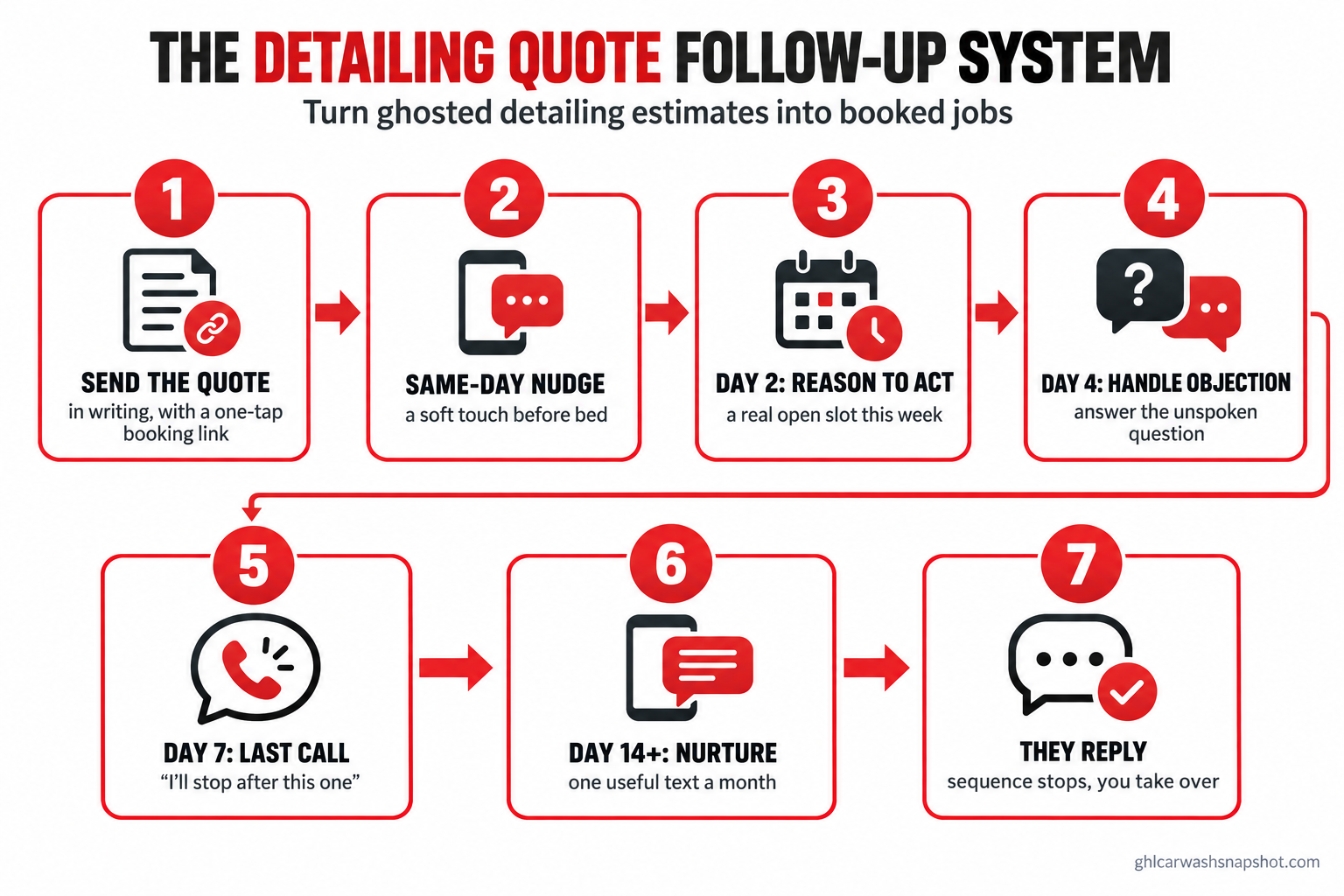
The system is seven touches over about two weeks, then a slow drip. Each touch does one job and runs on autopilot the moment you save a quote. A card-on-file booking tool fires the sequence and stops it the instant the customer replies. Here’s the shape of it:
- Minute 0: Confirm the quote in writing with a one-tap booking link.
- Same day: A soft nudge that keeps the thread warm.
- Day 2: A reason to act now (a slot, a season, a small incentive).
- Day 4: Surface the objection they never said out loud.
- Day 7: The honest last-call text.
- Day 14+: Move the dead quote into a monthly nurture.
- Anytime they reply: The sequence stops, you take over.
Open rate by channel, as a percentage. SMS up to 98%, email typically 20 to 30% (midpoint shown). Source: Sender, 2025.
Every touch below is a text, the channel that gets read, so quote follow-up belongs in a text thread, not an email nobody opens. Keep each under about 300 characters, write like a person, and never send more than one a day.
Stage 1: Confirm the quote the second you send it
The quote itself is a follow-up touch. Most detailers just read a price over the phone. Put it in writing, make it skimmable, and attach a one-tap way to book.
Why it works, how it breaks. It confirms you listened (you named the truck and the problem), it’s easy to forward to a spouse, and it gives two specific slots instead of “whenever works.” The booking link matters most: one that takes a deposit or holds a card removes the back-and-forth that kills momentum. A broken link or a forced account signup, though, and they bounce. Test it on your own phone monthly, and lead with the number, don’t bury it.
Stage 2: The same-day nudge
Three to five hours later, before bed, send one light touch. Not a pitch, a door left open.
Why it works, how it breaks. “Let me know either way” gives them permission to say no, which oddly makes more say yes, and it catches the person who meant to reply and forgot. Send it 20 minutes after the quote, though, and you look desperate; wait a full day and you’ve lost the same-evening decision. Same-day after work is the window, one message only.
Stage 3: Day 2, give a real reason to act now
“Sounds good” has no deadline. Day 2 is where you supply one, using real scarcity (your actual calendar), not a fake countdown.
Why this works. It’s true: your weekends really do fill up, and “easy to move later” lowers the stakes. You’re reporting urgency, not inventing it. A small honest incentive can live here too (“book by Friday and I’ll throw in the engine bay”), used sparingly so you don’t train people to wait.
How it breaks. Manufactured urgency (“50% off, today only!!”) on a $540 job reads as a used-car move. Detailing buyers want a pro, not a closeout sale. To price an incentive without eating your margin, our ceramic coating pricing guide covers the math.
Stage 4: Day 4, handle the objection they didn’t say out loud
By now the quiet ones have a reason they haven’t booked, and they haven’t told you. Day 4 flushes it out by naming the most common blockers.
Why it works, how it breaks. You’re doing their thinking for them. People won’t type out “does this get dog hair out,” but they’ll reply “perfect, yes, let’s do Saturday” once you’ve answered it. Photos, guarantees, and “I come to you” move detailing jobs most. Pull the three bullets from the real conversation; generic ones (“we offer competitive pricing!”) waste the touch.
Stage 5: Day 7, the last-call text
A week in, you send one clean, honest close. Most detailers never send this touch, and it books more jobs than any other because the field has cleared out. The other two quit days ago.
Why it works, how it breaks. “I’ll stop bugging you after this one” is the most effective line in the sequence. It removes the pressure, it’s respectful, and it creates a soft deadline because you’re reclaiming the slot. A lot of “sounds good” people come alive right here. But if you say “last text” and keep sending the same offer, you’ve trained them to ignore you. After this, the active sequence is done.
Stage 6: Don’t delete a dead quote, nurture it
A quote that didn’t book in two weeks is not worth zero. The guy who said no in November, when money was tight, often says yes in April when his truck is filthy and the tax refund hit. Move every unbooked quote into a monthly nurture list. Once a month, one useful, non-pushy text:
Why it works, how it breaks. You stay in their phone as the detailer who gives value, so when the itch comes back you’re the first text they scroll to. It’s also where a dead quote becomes a recurring maintenance plan instead of a one-time job. But monthly means monthly: weekly “just checking in” texts to a cold quote are spam. Give before you ask, and always include an easy out.
Run it for your size
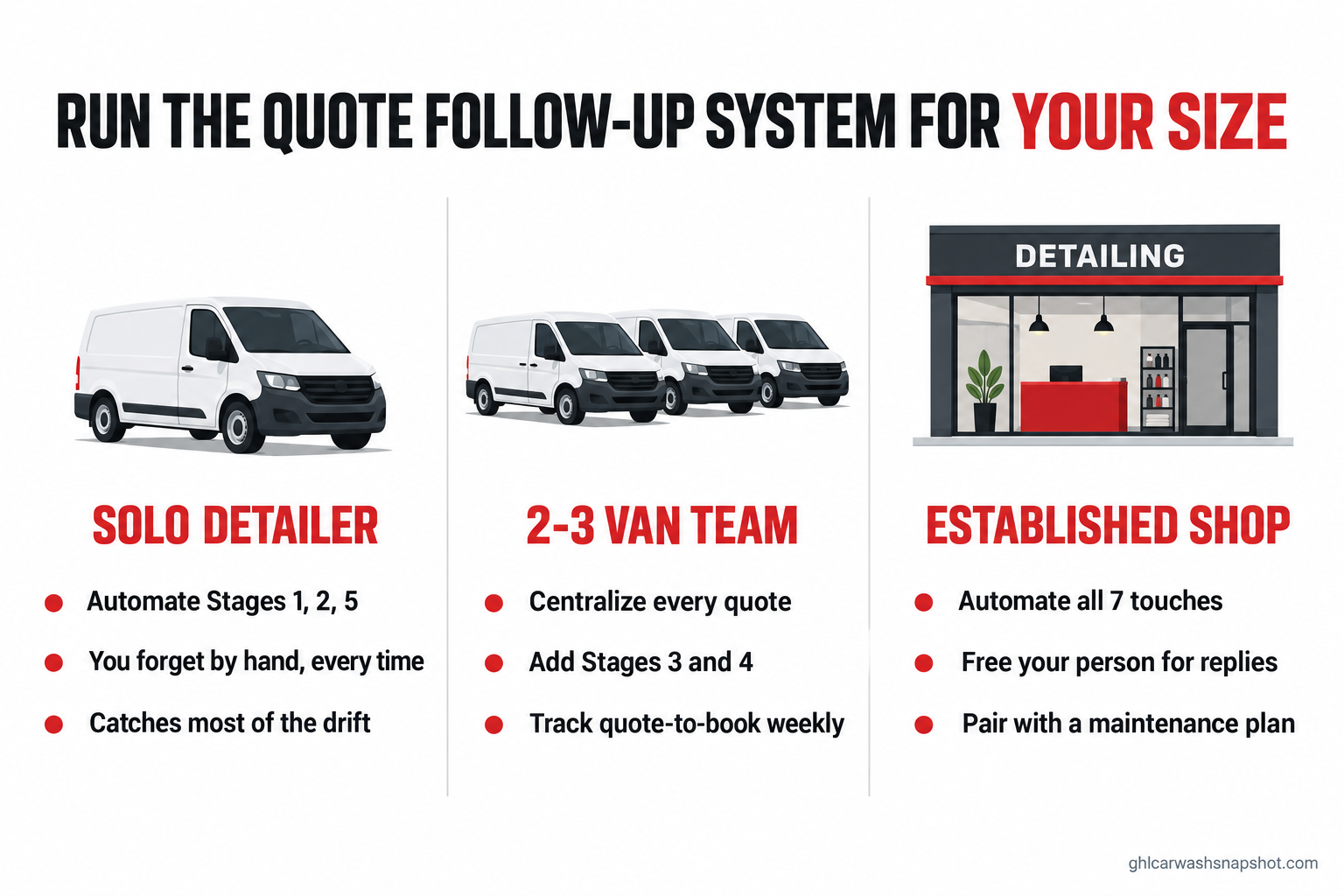
The seven touches are the same. What changes is how much runs by hand versus on autopilot.
Solo, weekend warrior (you’re the detailer, scheduler, and phone). You cannot do this by memory. You’ll forget Stage 4 every time, because on day 4 you’re elbow-deep in someone’s back seat. Set the sequence up once and let it run. Start with Stages 1, 2, and 5, which catch most of the drift. Right now you do zero of it.
Small team (2 to 3 vans). The risk is a quote falling between people: one of you quoted it, nobody owns the follow-up. Centralize every quote in one system so the sequence fires no matter who took the call. Add Stages 3 and 4 with the incentive on. Track quote-to-book weekly; under 30% means a hole in your follow-up.
Established shop (a receptionist, steady lead flow). Your person is good, but they’re also answering the phone, checking in cars, and chasing parts. Follow-up is the first thing that slips when they get slammed, and it slips silently. Automate the full seven touches so the system never has a busy day, and free your person for the replies, where the human touch pays. Pair booked jobs with a maintenance plan offer and you compound it.
The theme across all three: the detailer who follows up loses the “who’s the cheapest” game less often, because persistence reads as competence. The one who answers on day 7 looks like the one who’ll show up on time and do the job right.
Is it legal to text someone who asked for a quote?
Short version: yes, when they contacted you first and you keep it about their request. Someone who texts or calls you for a quote started the conversation, which gives you a reasonable basis to reply about it. A few rules keep you clean:
- Honor opt-outs instantly. Reply STOP means you stop. The FCC’s guidance on unwanted texts treats ignoring an opt-out as a real violation.
- Keep it tied to their request. The seven touches are about the job they asked you to quote: sales follow-up, not a campaign to a bought list.
- Get consent before monthly marketing. Stage 6 crosses toward marketing, so add an opt-in line to your quote (“ok if I check in with a tip once a month? reply STOP anytime”).
- Identify yourself in every message, with an easy way out.
None of this is a reason to skip follow-up, just to do it like a professional.
Objections
“Won’t I annoy people and look desperate?” Only if you do it badly. Seven short, spaced, useful texts over two weeks is professional. Five texts in one afternoon is desperate. One text and silence is lazy. 53% of people who text a business get no reply at all (Sender), so a well-timed sequence makes you the exception.
“My customers prefer a phone call.” Some do, and when they reply you can call. But for the first touch the data runs the other way: 69% of people would rather a new business text them than call (Avochato). Lead with text and let the customer pull you to the phone.
“I don’t have time to send all these.” That’s the point of automating it. You set it up once, it runs while you’re working, and it gets out of the way the second someone replies. Our best mobile detailing software rundown compares tools that can fire a sequence like this.
“I already use Jobber or Housecall Pro.” Good, use what you have. Most field-service tools send a confirmation and a reminder. The part they do weakly is the multi-touch nurture above and the monthly drip for dead quotes. If your tool stops at one reminder, you’re leaving the day-4 and day-7 jobs on the table. We covered the gaps in Jobber vs Housecall Pro for mobile detailing.
FAQ
How many times should I follow up on a detailing quote?
About seven touches over two weeks, then a slow monthly nurture. Most jobs that look dead book on the day-4 or day-7 touch, which is exactly where 44% of people quit (per Invesp). The sequence stops the instant the customer replies or books.
Should I follow up by text, call, or email?
Text, for the first touches. SMS open rates run up to 98% versus 20 to 30% for email (Sender, 2025), and 69% of people prefer a text from a new business over a call (Avochato). Once they reply, call if the job is complex.
How long should I wait before the first follow-up?
The written quote goes out in the first few minutes while the conversation is hot, then the same evening, day 2, day 4, and day 7. For a brand-new inbound lead, speed in the first five minutes matters most (MIT / InsideSales).
Is it legal to text a customer who asked me for a quote?
Yes, when they contacted you first and you keep the messages about their request. Honor STOP replies immediately, identify yourself, and get a simple opt-in before adding them to monthly marketing. See the FCC guidance on business texts.
What do I say if they reply that the price is too high?
That's a real conversation, not a ghost. Ask what budget they had in mind, then offer a scaled-down package (interior only, one-stage instead of two) rather than slashing the full quote. Our pricing guide covers how to build tiered options.
Can I automate all of this without sounding like a robot?
Yes, if you write the templates in your own voice and personalize the merge fields (name, vehicle, the slot). The examples above read human because they name the truck and the real problem. A good booking tool fills those in and sends on schedule.
Related reading
- How mobile detailers lose leads after hours: the speed-to-lead play for brand-new inbound leads.
- The done-for-you mobile detailing system: quote, booking, and follow-up on autopilot.