

It is the first week of the month and your calendar is stacked. Three full details, two ceramic maintenance washes, a fleet pickup. Good week. Then the second week lands and the phone goes quiet. You post on Instagram, chase a tire-kicker who ghosts you, and drop your price to fill Thursday. You worked hard and still cannot say what you will make next month. That is the real problem with a one-off detailing business. The work is fine. It just resets to zero every 30 days.
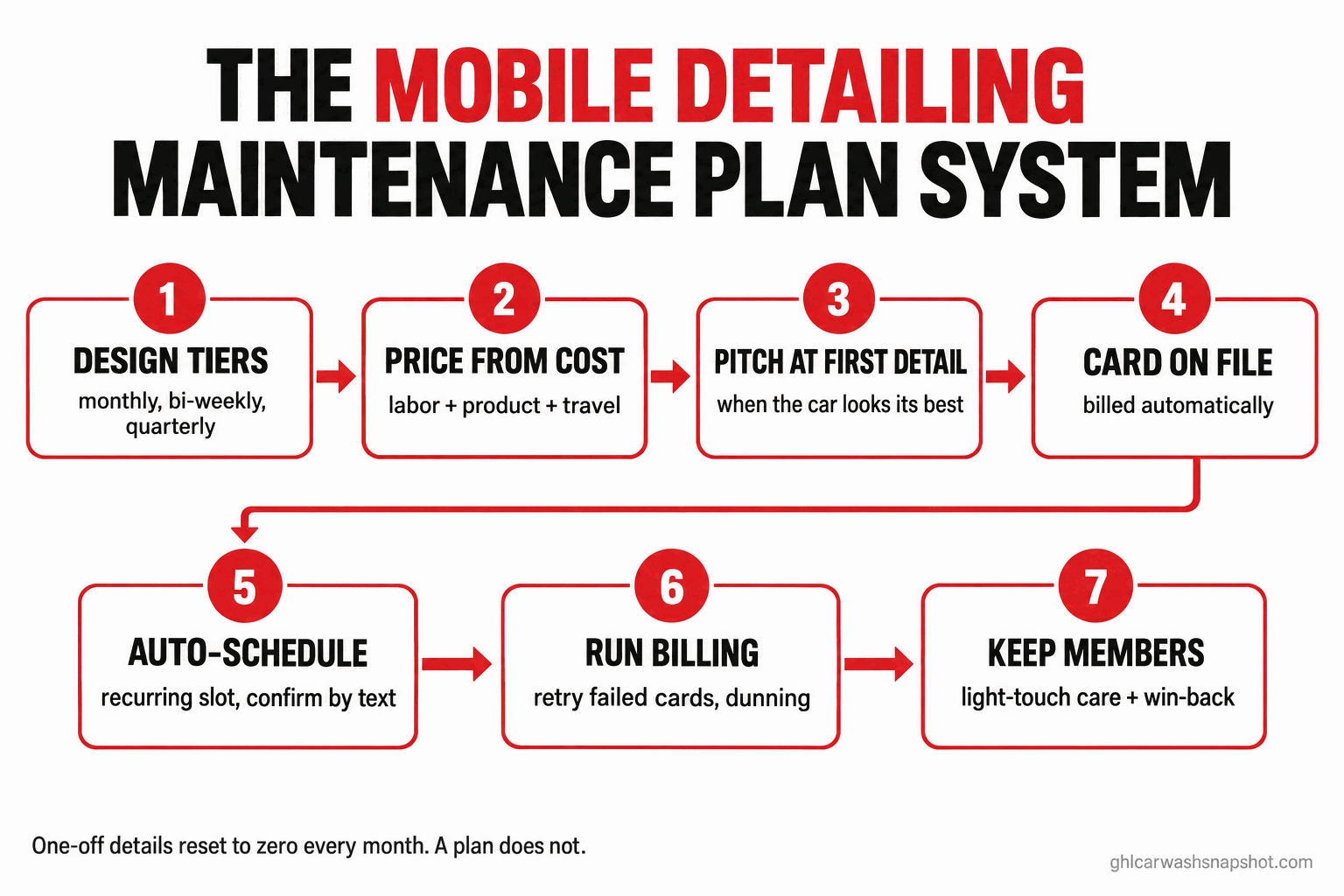
Here is the fix: stop selling one detail at a time and start selling a maintenance plan a customer pays for every month, automatically, whether they think to book or not. Design two or three tiers tied to a visit cadence, price them from your real cost, pitch them when the first detail is done and the car looks its best, put the card on file, and let software rebook and bill on autopilot. Then a slow week stops meaning a broke week, because the money shows up before the calendar does. This is the recurring-revenue system for mobile detailers, your single biggest lever.
Table of contents
- What a one-off-only business costs you
- The seven-stage maintenance plan system (design, price, pitch, card on file, schedule, bill, keep)
- Three plans, three business sizes
- Steal these: the plan messages
- The legal part you cannot skip
- Objections, answered
- FAQ
What a one-off-only detailing business actually costs you
Run the numbers on one customer. A $200 full detail twice a year is $400, and you won both bookings. The same customer on a $60-a-month plan is $720 a year, hitting your account whether or not they think about it. Nearly double the revenue, a fraction of the hassle.
This is not a hunch. The Rinsed Q2 2026 report found membership revenue up 10.4% year over year while one-time retail sales dropped 3.9%: the recurring side is growing and the pay-as-you-go side is shrinking. Bain & Company puts the economics plainly, a 5% increase in retention yields more than a 25% increase in profit, and in a market worth about $18.7 billion across roughly 16,879 businesses, per IBISWorld, the operators pulling ahead are the ones with predictable monthly income.
The chart shows the gap on one customer over a year: two unpredictable visits you have to earn versus twelve scheduled visits you already got paid for.
Annual revenue per customer: a $200 one-off detail twice a year versus two plan cadences. Your prices will differ; the shape does not.
The seven-stage maintenance plan system
A maintenance plan is not a discount card. It is a system with seven parts, each with a job and a way it breaks, built in order: design the tiers, price from cost, pitch at the first detail, capture the card on file, auto-schedule the visits, run the billing, and keep the members.
Stage 1: Design the plan tiers
Keep it to two or three tiers; more than that and buyers freeze. Each tier is a visit cadence paired with a scope of work, named so a customer instantly gets what they are buying. Adjust this structure to your market.
| Tier | Cadence | What it includes | Who it is for |
|---|---|---|---|
| Maintenance Wash | Monthly | Exterior wash, wheels, quick interior wipe-down, vacuum | Daily drivers who want it to stay clean |
| Full Care | Every 2 weeks | Everything above plus interior detail, spray sealant top-up | Family cars, pets, commuters who eat in the car |
| Protect & Maintain | Quarterly correction + monthly washes | Monthly maintenance wash plus a quarterly polish and ceramic top-up | Ceramic clients and enthusiasts protecting an investment |
How to set it up. Write each tier’s scope down to the task list, so you and any helper know exactly what a “Maintenance Wash” is. Tie each tier to one cadence, and make the middle tier the obvious value so most people land there.
How it breaks: scope creep. A member asks for “just a quick clay bar while you’re here” and you give it away because they are a regular. Fix it with a scope-change message that re-prices the extra before you touch it, the discipline that protects a ceramic coating quote. The plan price covers the plan scope; everything else is an upsell.
Stage 2: Price the plan from your cost
A recurring price that loses money loses it twelve times a year instead of once. Price each tier from the cost of one visit, then multiply by the cadence. One visit costs loaded labor hours times your real hourly rate, plus product and travel. Your labor floor is not zero even when the hands are yours: federal wage data for vehicle cleaners puts the median near $17.24 an hour (Bureau of Labor Statistics), and a skilled detailer is worth more. If a monthly wash takes 75 minutes door to door at a loaded $60 an hour, it costs about $75 before product and drive time. Price the monthly plan at $90 to $110 and you clear a real margin on every charge.
Plan members should pay a little less per visit than a one-off buyer, because they give you guaranteed volume. A 15% to 20% discount versus your walk-up rate is plenty; any deeper and you are paying customers to let you serve them.
How it breaks: you price against a competitor’s subscription instead of your cost. A shop advertising a $49 monthly plan is either running a stripped wash or buying market share at a loss. You cannot copy a price without seeing the cost structure behind it. Build your number from your route, product, and time.
Stage 3: Pitch the plan at the first detail
The best moment to sell a maintenance plan is when the first full detail is done and the customer is looking at a car that looks better than the day they bought it. That feeling is the pitch. Miss the window and you are selling a subscription cold a week later, which is far harder.
How to set it up. Build the offer into your close-out routine. When you hand the keys back, say one line: “This is the best it’ll look all year. Want me to keep it like this? My plan brings me back every few weeks, cheaper per visit than one-offs.” Then send a same-day follow-up text with the tiers and a one-tap signup link.
How it breaks: you forget to ask, because you are tired and loading the van. Take the decision out of your hands: an automated post-service message fires the moment you mark a job complete, asks for the review and offers the plan in one breath. That is the same speed-to-offer logic behind catching leads after hours.
Stage 4: Capture the card on file
A plan without a card on file is a loyalty punch card with extra steps. The whole point is that money moves on a schedule without you invoicing or chasing it. If the customer has to approve each charge, you have rebuilt the one-off problem.
How to set it up. At signup the customer enters a card that is vaulted with your payment processor and billed automatically on the cadence. Your phone sends a one-tap signup link, they tap, enter the card, done. The card lives with the processor, never in a notes app or a group text.
How it breaks: you run it on cash and Venmo. Informal payment feels friendly and quietly kills the plan, because every month the customer has to decide to pay you again, and some months they forget. Card on file removes that decision, which is why recurring works. One honest limit: the software stores the card and triggers the charge, but the money runs through your own merchant account.
Stage 5: Auto-schedule the recurring visits
Billing monthly for a wash you never delivered earns a chargeback and a one-star review. The plan has to schedule itself, or it falls apart the first busy week.
How to set it up. When a customer enrolls, the system books their recurring slot on the cadence they bought, confirms each visit by text, and lets them reschedule with a tap. For a mobile operation, cluster visits by zone and day so your route stays tight.
How it breaks: no-shows and lockouts. The customer is not home, the gate is locked, and you drove 30 minutes for nothing. Use the same reminder-and-confirm discipline that stops last-minute cancellations: confirm 24 hours out, require a tap to confirm access, and roll a missed visit forward. The visit is already paid for, so deliver it, do not refund it.
Stage 6: Run the billing and failed-card recovery
This is the stage most detailers never build, and it is where the money leaks. Cards expire, banks decline, a customer gets a new card and forgets you. Across the industry, credit-card-related churn runs around 3% a month, per the Rinsed Q2 2026 report. On a book of 40 members, that is more than one silently falling off every month because a card number changed.
How to set it up. When a charge fails, the system retries on a smart schedule (a couple of days later, then again) and texts the customer a one-tap link to update the card. This is dunning, and it is the difference between recovering a lapsed member and losing one.
How it breaks: silent failure. The charge bounces, nobody notices, and months later you find a member getting washes they did not pay for, or gone entirely. The fix is automation that acts the same day, every time, without you watching a dashboard.
Stage 7: Keep the members
Recurring revenue is only as strong as your retention. A well-run plan is sticky by design, because the customer gets a clean car on a schedule and never thinks about it. Your job is to not give them a reason to leave.
How to set it up. A quick “your car’s looking great, see you on the 14th” text keeps it warm, and a quarterly perk reminds them the plan is worth it. Watch the at-risk signals: a member who reschedules twice in a row or goes quiet is drifting, and a personal check-in saves the account. For the ones who cancel, a win-back 30 days later (“first month back 20% off”) recovers a real slice.
How it breaks: you treat members like a set-and-forget asset and go silent. Silence plus one bad visit equals a cancellation. Members who feel seen stay for years; the ones who feel like a line item leave the first month money gets tight.
Three plans, three business sizes
The same seven-stage system runs at any size. Only the scale and tooling change.
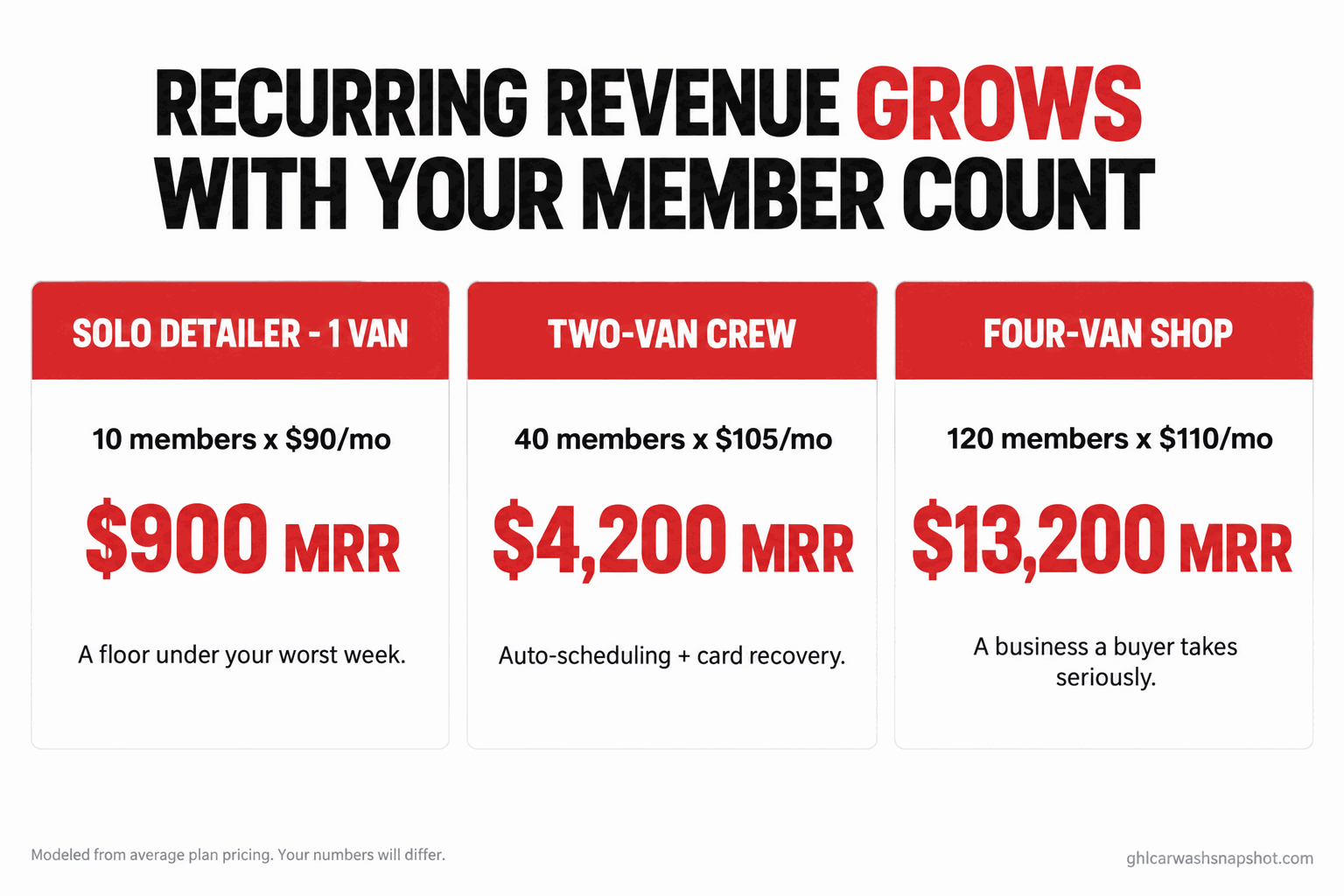
Scenario 1: solo detailer, one van. Enroll 10 members at an average $90 a month and that is $900 of guaranteed MRR before you book a single one-off. It covers your rig payment and insurance, so every walk-up job after that is profit, not survival. Run it on a simple booking tool plus a card-on-file processor. The win is a floor under your worst week.
Scenario 2: two-van crew. At 40 members averaging $105, $4,200 a month lands on the 1st. Now the admin matters: 40 recurring visits to schedule, route, and bill cannot run from memory. This is where auto-scheduling and failed-card recovery stop being nice-to-have. One bounced card a month is real money.
Scenario 3: four-van shop. At 120 members averaging $110, you have $13,000+ in recurring MRR and a business a bank or a buyer takes seriously, because it runs on predictable revenue instead of a founder hustling bookings. The plan is the business, and the engine has to run without you in it.
The floor grows with the member count, which is the whole point.
Steal these: the messages that sell and hold a plan
Copy these, swap in your details, and save them as canned replies and automations.
Post-detail plan offer (sent the moment you mark the job complete):
Your [vehicle] is done and honestly it looks incredible. Want to keep it like this without thinking about it? My maintenance plan brings me back on a schedule, cheaper per visit than one-offs. Here are the tiers, 30 seconds to start: [link]
Pre-visit confirmation (24 hours out):
Hey [name], I’ve got you on the schedule tomorrow between [window] for your [tier] visit. Just reply YES so I know the car’s there and I can get in. See you then!
Failed-card recovery (same day the charge bounces):
Quick heads up, [name]: the card on file for your detailing plan didn’t go through this month, probably just expired. Tap here to update it so your next visit stays on track: [link]. No rush, I’ve got you.
Win-back (30 days after a cancel):
Hey [name], your car’s probably missing me by now. Want back on the schedule? I’ll knock 20% off your first month back. [link]
These messages are 90% of the system’s customer-facing work, and the faster they go out, the more members you enroll and keep. If you lose signups because you cannot reply with your hands in a bucket, that is the gap an automated text-back and offer layer closes.
The legal part you cannot skip
A maintenance plan is a recurring charge on a saved card, which puts you under auto-renewal rules. This is not legal advice, but here is what to get right.
Disclose the recurring terms before you charge. State the price, cadence, and how to cancel plainly at signup, and get the customer’s agreement. Many operators think the FTC’s “click-to-cancel” rule governs this. It does not: that negative-option rule was vacated by the Eighth Circuit in July 2025. What governs your plan is state auto-renewal laws, like California’s, plus the FTC Act’s ban on deceptive practices. We break down the real rules in car wash membership auto-renewal laws.
Make canceling genuinely easy. A hard-to-cancel plan generates chargebacks and complaints that cost more than the saved member. A one-tap cancel link keeps you clean and, ironically, keeps more members, because people trust a plan they can leave.
Keep SMS consent clean. The plan runs on text, so get opt-in consent at signup and honor STOP instantly, or you have a TCPA problem.
Objections, answered
“My customers won’t commit to a subscription.” Some will not, and they stay one-off buyers, which is fine. But many of your best customers already want their car to always look good and would happily stop thinking about booking. The ones who say yes were coming back anyway, now locked in and paid up front.
“I’m solo. I can’t handle recurring billing and scheduling too.” That is the reason to automate it, not avoid it. With a system that schedules, reminds, bills, and recovers failed cards on its own, 40 members is less admin than 40 one-off bookings, because you are not re-selling anyone. The software built for mobile detailing lets a solo operator run a recurring book without a back office.
“Won’t the per-visit discount eat my margin?” Only if you discount too deep. A 15% to 20% cut still leaves a healthy margin when you priced from cost in Stage 2, and it is paid back by the volume, the up-front cash, and the marketing you no longer spend. A member who stays a year beats a full-price one-off you chase twice.
FAQ
What is a detailing maintenance plan?
A recurring subscription where a customer pays a set monthly price for detailing on a fixed cadence, such as a monthly maintenance wash or a bi-weekly full detail, billed automatically to a card on file. It turns one-off customers into predictable monthly revenue.
How much should I charge for a mobile detailing maintenance plan?
Price each tier from your real cost: loaded labor hours times your hourly rate, plus product and travel, times the cadence. Give members a 15% to 20% per-visit discount versus your walk-up rate, never deeper. Monthly plans often land around $90 to $120, but build your number from your costs, not a competitor's flyer.
Why are recurring plans better than one-off detailing jobs?
Recurring revenue is predictable, arrives whether or not the customer books, and costs far less to serve because you stop re-winning the same people. Membership revenue grew 10.4% year over year in Q2 2026 while retail fell 3.9% (Rinsed), and a 5% lift in retention produces more than a 25% increase in profit (Bain).
How do I get customers to sign up for a maintenance plan?
Pitch it the moment you finish the first full detail, when the car looks its best, then send a same-day follow-up text with the tiers and a one-tap signup link. Build the offer into your close-out routine so it happens every time.
Are detailing maintenance plans legal?
Yes, but recurring charges fall under auto-renewal rules. Disclose price, cadence, and how to cancel before charging, get affirmative consent, and make canceling easy. The FTC's click-to-cancel rule was vacated in July 2025, so plans are governed by state auto-renewal laws and the FTC Act. Keep SMS consent TCPA-compliant. This is not legal advice; check your state's rules.
The takeaway is simple. A one-off detailing business resets to zero every month and makes you earn every dollar twice. A maintenance plan gives you a floor of money that shows up before the calendar does and turns your best customers into members who stay for years. Design two or three tiers, price them from your cost, pitch them when the car looks its best, put the card on file, and let the billing and scheduling run themselves. Build it once, and the quiet second week stops keeping you up.