

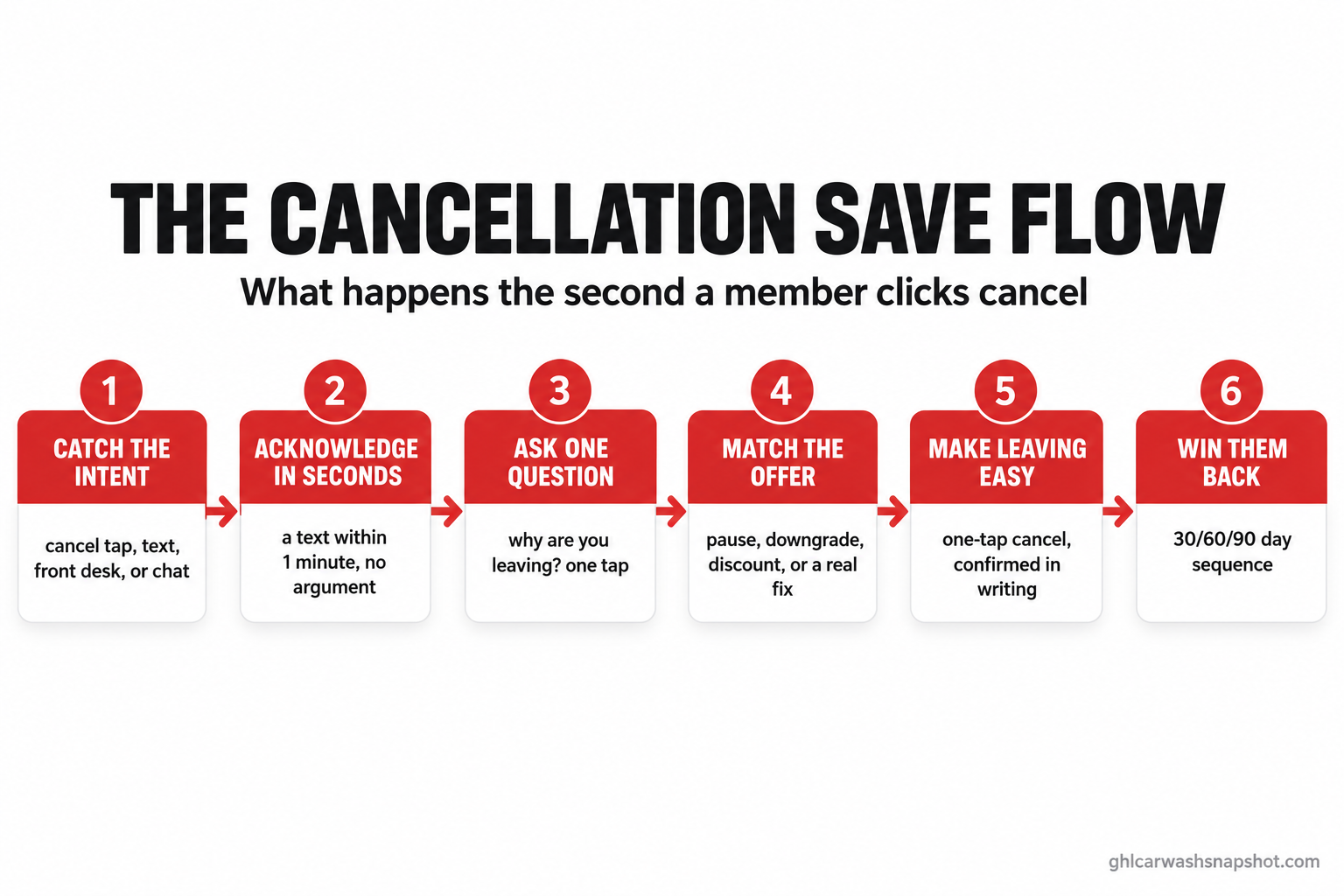
A member opens your portal at 9:12pm, finds the cancel button, and clicks it. Nobody at the wash knows. By the time you pull the churn report on the first, they are a line item in the “lost” column and you are already paying to replace them. The whole fight for that membership happened in a ninety-second window you never saw.
Here is the answer up front. A cancellation save flow is an automated sequence, usually over text, that fires the second a member signals they want to cancel. It asks one question to learn why, then makes the one offer that fits the reason: a pause before a discount, a real fix before any offer at all. Done right it saves a meaningful share of members who would otherwise walk, for near-zero labor, with no dark pattern that lands you in legal trouble. This is the build guide: the six stages, the exact messages to steal, how each stage breaks, and the math at one, three, and eight locations.
Table of contents
- What a cancellation save flow actually is
- Why voluntary churn needs its own system
- The six stages, end to end
- Steal these: the exact messages
- How each stage breaks (and the guard)
- The save flow at one, three, and eight locations
- Keeping it legal: the cancellation rules that actually apply
- Objections, answered
- FAQ
What a cancellation save flow actually is
A save flow is the automated path between “a member wants out” and “the member is gone.” Most washes have no path there at all: the member cancels in the portal or tells the attendant, and the only response is that it happens. No question, no offer, no second look.
The flow puts four things in that gap, in order: a fast human-sounding acknowledgment, one diagnostic question, an offer matched to the answer, and a clean exit if they still want out. It runs over text, where this customer already is. It is one workflow inside a bigger retention system (onboarding, engagement, failed-card recovery and win-back, all in the car wash customer retention playbook). This post is the deep build of the one that fires at the moment of highest risk: the cancel click.
Why voluntary churn needs its own system
There are two different ways a member leaves, and a save flow only handles one.
Voluntary churn is a decision: the member moved, money got tight, they feel they are not washing enough, or a competitor opened a closer lane. In Q3 2025 this ran about 4.7% of members per month industry-wide (Rinsed). You fight it with value, timing, and the save offer.
Involuntary churn is an accident: a card expired or a bank declined, and the member never meant to leave. That ran about 2.9% per month in the same data. You fight it with a dunning sequence, not a save offer. Sending “here’s 50% off” to someone whose card merely expired is pointless. The fix is the silent card churn recovery flow, a separate build.
Two kinds of churn, two different tools
Voluntary: the member chose to cancel. Fix with the save flow, a diagnostic question, a matched offer (pause, downgrade, discount, or a real fix), then a clean exit.
Involuntary: the card broke, not the relationship. Fix with a dunning sequence and card-update texts. A save offer here just gives away margin.
The save flow is for the 4.7%. The first job of any good system is to not treat an expired Visa like a breakup.
Why obsess over a few points of monthly churn? The classic Reichheld and Sasser research found that cutting the defection rate by just 5% raised profits 30% in an auto-service chain (Bain / HBR), the closest analog to a wash club. The members you keep are worth far more than the margin to keep them.
The six stages, end to end
Stage 1: Catch the intent. Wire up every trigger: a cancel tap in the portal, a “cancel” or “pause” text reply, a word to the front desk, a chat-widget request. All route into the same automation. The worst setup is a cancel button that silently flips a flag in your POS: a member leaving in total silence.
Stage 2: Acknowledge in seconds. The first message goes out within a minute and does not argue. It confirms you heard them and earns permission for one question. A reply an hour later lands after they moved on.
Stage 3: Ask the one diagnostic question. You cannot make the right offer until you know the reason. One multiple-choice question, a single tap: price, not using it enough, moving, a service problem, or just done. The answer routes the rest.
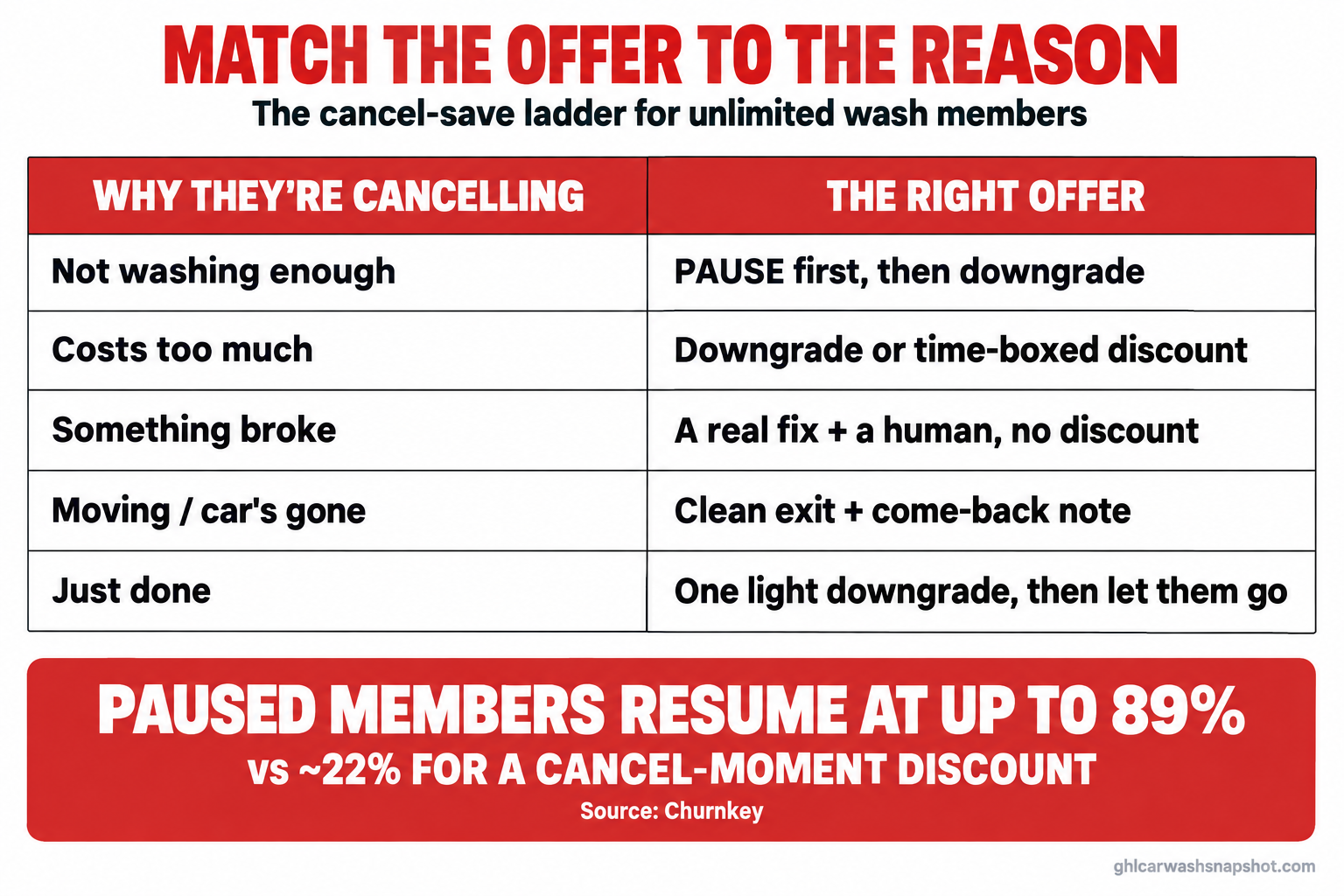
Stage 4: Make the matched offer. A ladder, not a firehose:
- Not using it enough gets a pause first (freeze 1 to 3 months, no charge, auto-resume), then a downgrade. Both keep the plate-on-file and the habit alive. This is the branch that pays: at the best-run operators, paused members resume at up to 89% versus about 22% for a cancel-moment discount (Churnkey).
- Price gets the downgrade or a time-boxed discount, never an open-ended one.
- Service problem gets a real fix and a human, not an offer. A broken dryer is not solved with 30% off.
- Moving away gets a clean exit and a “come back if you return” note.
- Just done gets one light downgrade offer, then a clean exit.
Stage 5: Make leaving easy. If none of that lands, cancel them immediately, with a confirmation. This is not surrender, it is the law (more below) and how you stay the kind of wash people rejoin. A trapped member leaves a one-star review; a cleanly released one joins your win-back pool.
Stage 6: Win them back later. A short sequence at 30, 60, and 90 days, timed to a weather surge or seasonal promo, pulls a slice back. 54% of former members still wash at the same location after cancelling (Rinsed). They left the plan, not the parking lot.
The ladder leads with pause and downgrade for a reason: the numbers.
Steal these: the exact messages
Copy these into your flow and change the brand name. Written for text: short, plain, no hype.
Stage 2, the acknowledgment (within 1 minute of the cancel signal):
Hey [First name], it’s [Wash name]. Got your request to cancel your Unlimited plan, that’s handled either way, no hoops. Quick thing first: can I ask what’s driving it? Tap one so I point you right. Thanks for being a member.
Stage 3, the diagnostic question (same message or immediate follow-up):
- Costs too much 2) Not washing enough lately 3) Moving / car’s gone 4) Something broke or went wrong 5) Just done for now
Stage 4a, “not washing enough” → pause offer:
Totally fair, some months you just don’t drive it through. Want me to freeze your plan for 2 months instead of cancelling? No charge while it’s paused, your plate stays on file, and it picks back up automatically. Reply PAUSE and you’re set, or CANCEL and I’ll close it out.
Stage 4b, “costs too much” → downgrade or time-boxed discount:
Hear you. Two options: drop to [Basic] at $[XX]/mo, or keep your current plan at $[XX]/mo for the next 3 months while things settle. Reply BASIC, KEEP, or CANCEL, whatever’s easiest.
Stage 4c, “something broke” → human + fix, no offer:
That’s on us, not you. I’m looping in [Manager name] at [location] now to make it right, you’ll hear from a real person today. Your plan stays active in the meantime and I won’t charge you for a bad experience. Want me to hold the cancel while we fix it?
Stage 4d, “moving / car’s gone” → clean exit:
Got it, and thanks for washing with us. I’ve cancelled your plan, effective at the end of this cycle, nothing else will be charged. If you land somewhere near one of our locations, text JOIN and I’ll get you set back up. Safe travels.
Stage 5, the cancel confirmation (always, the second a cancel is final):
Done, [First name]. Your Unlimited plan is cancelled effective [date], and you won’t be billed again. You’ll get an email confirmation too. The gate’ll still read your plate through [date]. Appreciate you.
Stage 6, the win-back (Day 30, then Day 60 tied to a promo):
Miss having the car clean without thinking about it? Your old plate’s still on file, [First name]. Come back this month and your first month’s [XX]% off, no setup. Reply BACK and you’ll be washing by the weekend.
Notice what is not in that block: no guilt, no “are you sure” loops, no hiding the cancel. Every message offers the exit plainly, which is what keeps it effective and legal.
How each stage breaks (and the guard)
A save flow fails quietly, running while saving nobody. The six ways it breaks, and the guard for each:
- Stage 1, the silent cancel button saves zero. Guard: route every cancel path into the same trigger, and test it monthly with a dummy account.
- Stage 2, slow or robotic gets ignored. Guard: fire within a minute, write like a person, lead with “it’s handled either way.”
- Stage 3, skipping the question pays people who would have downgraded for free. Guard: always diagnose first.
- Stage 4, one offer for every reason insults a complaint and wastes a mover. Guard: build the ladder, pause and downgrade before discount, a human before any offer for service failures.
- Stage 5, a hard exit lowers churn on paper and raises legal risk and one-star reviews. Guard: one-tap cancel, instant confirmation, no retention gate.
- Stage 6, win-back that never fires leaves 54% on the table. Guard: auto-enroll every clean cancel into a 30/60/90 win-back, tied to your weather-triggered promos.
The meta-failure across all six: nobody watches the save rate. If you cannot say what percent of cancel-intent members you kept last month, the flow runs blind.
The save flow at one, three, and eight locations
The flow is the same shape at every size, but what you optimize changes.
The single tunnel (~1,200 members, ~$36k/mo dues). Here it is about labor, not analytics. One owner cannot talk every canceller down during the Saturday rush. Automate stages 1 to 3 and 5 fully, and point stage 4’s “service problem” branch at your own cell. One point of monthly churn saved is about 12 members kept, at $30 roughly $4,320 a year, for a flow that takes an afternoon to set up.
The three-location chain (~4,000 members). Now routing matters, and your diagnostic reasons start talking: if location two throws triple the “something broke” cancels, that is an equipment problem, not a churn problem. Wire the flow into your CRM workflow automations so reason-codes roll up per site. A one-point improvement here is on the order of $14k a year in kept dues.
The eight-site regional operator (12,000+ members). The flow is now a data instrument. A/B test the offer ladder, because a point of churn is a six-figure line. You are also most exposed on compliance: more members, more states, more cancellation-law surface area. The payoff is equal parts dollars saved and a clean, auditable cancel path, with the save rate on a dashboard next to the membership pricing and LTV numbers.
Keeping it legal: the cancellation rules that actually apply
Most operators get this backwards. A save flow lives one bad decision from a dark pattern, and the line is the law. Many think the FTC “click-to-cancel” rule sets the standard. It does not right now: the Eighth Circuit vacated the FTC’s revised Negative Option Rule in July 2025, days before it took effect (Mayer Brown; Sidley). So the federal “cancel must be as easy as sign-up” rule everyone braced for is not in force.
What still governs your club: state automatic-renewal laws, ROSCA, and Section 5 of the FTC Act. California’s ARL, the strictest template, already requires that a member who joined online can cancel online, with no call and no retention maze, and several states mirror it (full breakdown). For your save flow, concretely:
A compliant save flow and an effective one are the same flow. A fast, respectful, genuinely-helpful offer is what makes members stay and what keeps you off a regulator’s radar. Washes get in trouble when they confuse “hard to leave” with “worth staying for.”
Objections, answered
“Won’t the texts just annoy people who already decided to leave?” Only if you argue. The flow is “this is handled either way,” one question, one matched offer, then out. Tap CANCEL at stage 4 and you are cancelled, not nagged. The annoyance comes from guilt loops and hidden buttons, which this flow bans. Done right, members thank you for a pause they did not know existed.
“Isn’t a save flow basically a dark pattern?” The opposite, when built to the three rules above. A dark pattern hides or blocks the exit; a save flow surfaces a better option and gets out of the way. The test: can the member leave in one tap at every stage? If no, you built the thing that gets washes sued.
“I already run Rinsed. Doesn’t it do this?” Rinsed is strong on analytics and can trigger retention messaging, so use what it has. The questions: does it diagnose the reason before it offers, does it have a real pause product, and does it auto-run the 30/60/90 win-back? Fill any gap inside your tool or with a GoHighLevel-based layer on top. The flow matters more than the logo.
“Do I need to be technical to run this?” No. It ships prebuilt for washes, and a GoHighLevel VA can set it up and watch the save rate for you.
“Won’t pausing just delay the loss by two months?” Some, yes. But a paused member keeps the plate on file and the habit warm, and a real share resume on their own at zero reacquisition cost, versus a hard cancel where you pay ad dollars to win the same person back from scratch.
The bottom line
Membership is the part of the wash still growing, up 10.4% while retail fell 3.9% in ICA’s Q2 2026 data (carwash.org). Every point of voluntary churn you stop is dues you keep without paying to replace them, and the save flow is the single best way to protect that growth: it fires at the moment the member is deciding, makes the one offer that fits the reason, and still lets them leave clean when that is right. Build the six stages, steal the messages, watch the save rate, keep the exit honest.
FAQ
What is a cancellation save flow for a car wash membership?
An automated sequence, usually over text, that fires the moment an unlimited-wash member signals they want to cancel. It asks one question to learn why, makes an offer matched to that reason (a pause, a downgrade, a time-boxed discount, or a real fix), then cancels cleanly if they still want out. The job is to save voluntary cancels without trapping anyone.
How much churn can a save flow actually stop?
It only addresses voluntary churn, about 4.7% of members per month industry-wide in Rinsed's Q3 2025 data. It does nothing for failed-card (involuntary) churn, which needs a dunning sequence. Even one point of monthly churn saved is thousands a year in kept dues at most club sizes.
Is a pause offer better than a discount?
For members who say they are not washing enough, yes. A pause freezes the plan one to three months with no charge, keeps the plate on file, and auto-resumes. At top car wash operators, paused members resume at up to 89% versus about 22% for a cancel-moment discount. Save the discount for genuine price objections.
Is a car wash cancellation save flow legal?
Yes, if it keeps the exit easy. The FTC's federal click-to-cancel rule was vacated in July 2025, but state auto-renewal laws (California's ARL is strictest), ROSCA and Section 5 of the FTC Act still apply. Let members cancel in the same channel they joined, never block the exit behind an offer they must decline twice, and confirm every cancellation in writing.
What happens to members after they cancel?
They go into a win-back sequence, not a void. About 54% of former car wash members still wash at the same location after cancelling, so a sequence at 30, 60, and 90 days, timed to a weather surge or promo, recovers a real share of them at near-zero cost.
Related posts
- Car Wash Customer Retention: The 2026 Playbook to Cut Churn and Grow LTV
- Silent Card Churn: The Hidden Killer of Every Unlimited Wash Club
- Car Wash Membership Auto-Renewal Laws in 2026: What Actually Applies
- Car Wash Membership Pricing: How to Price an Unlimited Wash Club Members Actually Keep
- What Car Wash Membership Software Actually Costs in 2026