

It is a Tuesday in Phoenix, the local news just ran a graphic that says “Stage 1 Water Alert,” and the first three texts in your wash’s inbox all ask the same thing: “Are you guys even allowed to wash cars right now? Should I pause my membership?” You have done nothing wrong. Your water is recycled and your lane is busy. But the headline did the damage, and if you do not answer it fast, a chunk of your unlimited members talk themselves into canceling over a rule that does not even apply to you.
Here is the short answer. Phoenix is in a Stage 1 Water Alert, and the Colorado River is under a Tier 1 shortage for 2026 (Phoenix Water Services; AZ Water). Stage 1 does not restrict a commercial wash. The real threat is not the ordinance, it is the member who pauses because they think washing is wasteful or banned. The fix is a membership base you defend with facts, reassurance texts, and weather triggers, so you keep washing while retail-only shops panic. Here is how, stage by stage.
Table of contents
- What the drought actually costs a Phoenix wash
- The fact that wins the argument
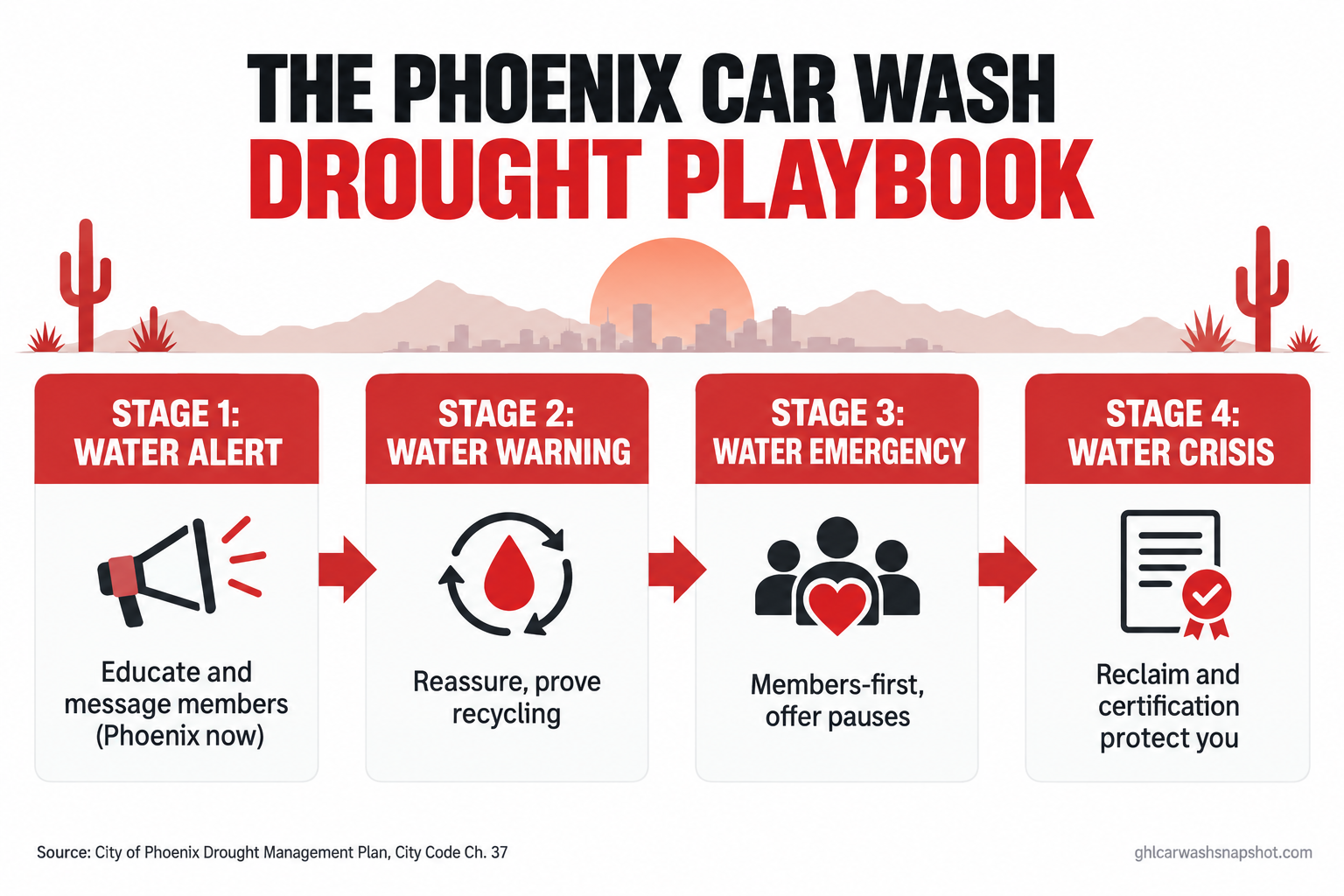
- The Phoenix water rulebook, stage by stage
- Stage 1 now: get ahead of it
- Stage 2 warning: when rules can turn mandatory
- Stage 3 and 4: the ban scenario
- The monsoon and the haboob surge
- The same plan at three sizes
- The compliance line nobody plans for
- Steal these: the drought message copy
- Objections, answered
- FAQ
What the drought actually costs a Phoenix wash
Phoenix pulls about 40% of its water from the Colorado River through the Central Arizona Project (Phoenix Water Services). That river is in trouble: for 2026 the lower basin is under a Tier 1 shortage, the mildest tier, which still forces real cuts to Arizona’s delivery, and Lake Mead sat near 1,039 feet in summer 2026 (Scottsdale Colorado River update).
None of that bans your wash. But it shapes the mood of every customer, and the cost shows up where most operators do not look: the pause and cancel rate. In Q2 2026, voluntary cancels across car wash clubs ran at 4.9% a month, up 9.2% year over year (Rinsed Q2 2026 via ICA). A drought headline is a local accelerant on that number. A price-sensitive member reads “Water Alert,” decides washing feels wrong this month, and clicks pause. A handful of those across a few hundred members is more revenue lost to a feeling than any ordinance would cost you. The retail-only shop feels it worst; the shop with a strong club barely notices.
The fact that wins the argument
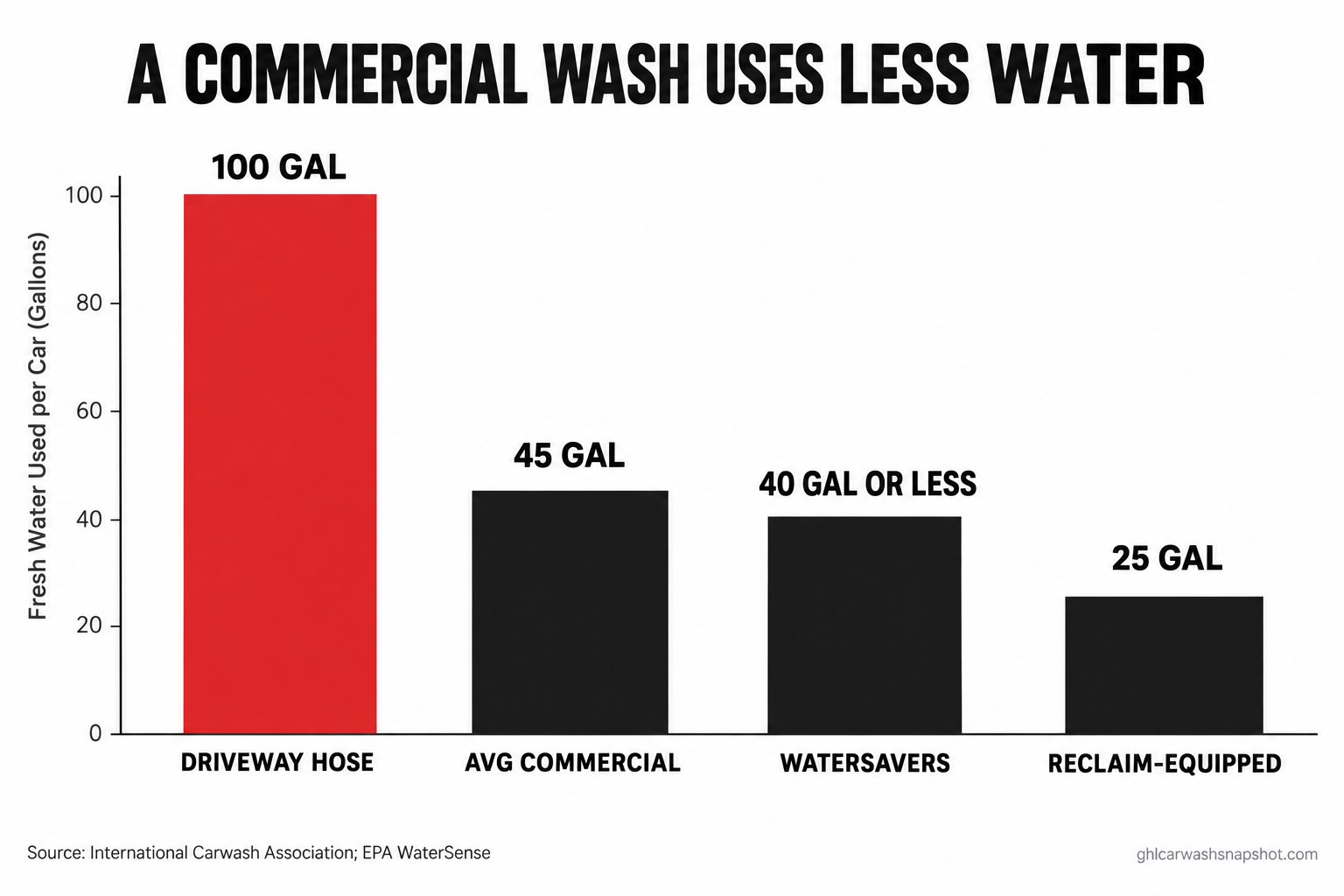
Here is the sentence to memorize: a professional car wash uses far less water than washing a car at home, and most of it is recycled. Driveway washing can run around 100 gallons per car by the International Carwash Association’s estimate (ICA via Cars.com). A typical commercial wash averages roughly 45 gallons, and a wash certified under the association’s WaterSavers program commits to 40 gallons of fresh water or less per vehicle and filters its runoff (ICA WaterSavers). Add a reclaim system and your fresh-water number drops further, because reclaim recaptures several gallons for every fresh one (EPA WaterSense).
Approximate fresh water used per car, by method. Home and commercial figures from ICA; reclaim-equipped is a mid-range estimate for a tunnel running reclaim. Sources: ICA via Cars.com, EPA WaterSense.
In Arizona this is often the law. The Town of Marana requires at least 40% of a commercial car wash’s water to be recycled, and Cochise County requires new commercial washes to recycle at least 75% (Marana, via KOLD). A drought plan goes after lawns, pools, and driveway hoses before a commercial wash because the wash is already the efficient option. Make sure every member knows it, and claim WaterSavers status only if you are certified.
The Phoenix water rulebook, stage by stage
Phoenix adopted its Drought Management Plan in 1990, and it lives in City Code Chapter 37 (Phoenix City Code Chapter 37). It has four stages. Knowing which one you are in keeps you from ignoring a real rule or panicking over one that has not come.
| Stage | Code section | What triggers it | What it means for your wash |
|---|---|---|---|
| Stage 1: Water Alert | 37-126 | Probable change in supply; the stage Phoenix is in now | Public education and enforcement of existing codes. No new limit on a commercial wash. Your job is messaging. |
| Stage 2: Water Warning | 37-127 | Supply pressure worsens | Elements of the plan “may become mandatory” at the Director’s discretion. Keep recycling proof ready. |
| Stage 3: Water Emergency | 37-128+ | A serious shortfall | More severe mandatory cuts. A broad car-washing restriction becomes a real possibility here. |
| Stage 4: Water Crisis | 37-130+ | A critical shortfall | The deepest cuts. The city lists banning car washing among the severe measures at this end of the scale. |
Stage structure and current Stage 1 status from City Code 37-126 and Phoenix Water Services. Deeper-stage section numbers are approximate; read the current ordinance before acting on Stage 3 or 4.
The key point: Phoenix lists “banning car washing” as a severe measure, not a Stage 1 rule. But members read the headline, not the code, so you plan for the mood now.
Stage 1 now: get ahead of it
Stage 1 is the stage to do the boring work before you need it. Nothing forces your hand, which is why most operators waste it.
The play. Audit your water story so you can prove it on demand. Know your fresh-water-per-car number from your meter, get your reclaim system serviced if it is off spec, and start WaterSavers certification if you qualify so your signage carries a real badge. Then publish a short “where our water goes” explainer and link it from your member texts, next to your membership pricing so the value and the water story sit together.
How it breaks. You treat Stage 1 as “nothing is happening.” Then Stage 2 arrives, a member panics, and you are building your water story live on the worst possible day. Silence during Stage 1 is the setup for a scramble.
Stage 2 warning: when rules can turn mandatory
Stage 2 is where Phoenix can make elements of the plan mandatory at the Director’s discretion (City Code 37-127). Nothing says a commercial wash gets restricted at Stage 2, but public pressure jumps, and that is what moves your cancel rate.
The play. Get in front of members the day the stage changes. A proactive text that says “we are open, we are compliant, here is why” removes the reason to pause before they think of it. Lean on your recycling numbers and your badge. Keep your failed-card recovery tight too, because a stressed month is when cards quietly expire and a silent cancel looks just like a drought cancel.
How it breaks. You wait to see if the rules change before you say anything. In that gap, pause requests pile up, and every one you lose to silence is a member you win back at full cost.
Stage 3 and 4: the ban scenario
Nobody wants to plan for this stage, which is why you should. If Phoenix ever reaches a Water Emergency or Crisis, a broad car-washing restriction moves from “severe measure on a list” to a live possibility (Phoenix Water Services). You cannot control that. You can control whether your model survives it.
The play. This is the argument for being a heavy-reclaim, WaterSavers-certified operation before you ever need to be. Emergency-level restrictions almost always carve out the most efficient commercial users and hit waste hardest, which is why Arizona cities already require commercial washes to recycle. If a restriction does hit, go members-first: tell unlimited members before anyone else, offer a fair pause on your terms, and protect the card-on-file relationship. A member you pause gracefully comes back; one who cancels in frustration is gone.
How it breaks. The operator with no reclaim, no certification, and no communication plan gets the restriction and the panic at once, then rebuilds the club from scratch. Plan the emergency while it is hypothetical.
The monsoon and the haboob surge
Phoenix drought is also a demand engine if you run it right. Monsoon season runs June 15 to September 30 and delivers roughly half of Phoenix’s annual rain in short, violent bursts (NWS via Phoenix New Times). Those bursts arrive with dust, and the valley’s haboobs coat every car in the metro. The clear morning after a storm is the best walk-up window you get all year.
The play. Treat weather as a trigger. The morning after a dust storm, fire a text to your retail and lapsed-member lists: the roads are a mess, we are open, here is a wash-today offer. This is the highest-ROI move a wash makes, and the whole point of weather-triggered promotions. For members, reframe the monsoon as the reason the plan pays off: dust, sap, and hard-water spotting are what unlimited washing is for.
How it breaks. You forget to send the storm text and the surge walks into the competitor who remembered. Weather windows last hours, so the message has to fire on a trigger. And do not discount retail into the floor during the dry stretch, which trains customers to wait for your next sale.
The same plan at three sizes
The drought is the same across Phoenix; the right response depends on your size.
Solo express site. One tunnel, a lean team. Automation is the whole game. Write the water explainer once, set one reassurance text to fire on a stage change, and one weather trigger for the monsoon surge. Your edge over the national chains is speed: you can text “we are open and compliant” the hour the stage moves.
Two-to-three locations. Consistency is the risk. Every site needs the same water story, copy, and badge, or a member at site B calls site A and nobody sounds sure. Centralize it in one GoHighLevel workflow so one stage-change update hits every member at once, and track cancel rate by site.
Large multi-site club. With thousands of members, a 1% swing in cancels is real money, so the program pays for itself on the first stage change. Add segmentation: members who have not washed in 30 days get a warmer message than weekly regulars, because the quiet member is the one most likely to read a Water Alert and pause. Pair it with a retention program and a cancellation save flow.
Year-over-year revenue change by type, Q2 2026, across 3,000+ US car wash locations. Membership is the line that holds when retail wobbles. Source: Rinsed Q2 2026 via ICA.
The compliance line nobody plans for
Two compliance notes, because getting one wrong undoes the other.
First, water. Do not claim a certification or a figure you cannot back up. “We recycle our water” is fine if you do; “WaterSavers certified” is only fine if you are. If a restriction arrives, read the ordinance or call Phoenix Water Services before you decide it applies to you.
Second, cancellations. Many operators think the FTC “click to cancel” rule governs membership cancels. It does not: that negative-option rule was vacated by the Eighth Circuit in 2025 and is not in force (Reuters). What governs you is state auto-renewal law and the FTC Act; the full breakdown is in our guide to car wash membership auto-renewal laws. If a drought scare drives a wave of cancels, honor them cleanly and in line with your stated terms. A smooth cancel keeps the door open for a win-back; a sticky one earns a complaint when regulators are watching.
Steal these: the drought message copy
You do not need a copywriter, just these sent on time. Adjust the voice and your numbers.
Stage 1 reassurance text (send when the alert is announced):
Hi [Name], you may have seen Phoenix is in a Stage 1 Water Alert. Quick note: we recycle our water and use far less per car than washing at home, so your membership is good to go and we are open as normal. Questions? Just reply here.
Stage 2 proactive text (send the day the stage changes):
[Name], Phoenix moved to a Stage 2 Water Warning. Hear it from us: our wash is fully compliant, we recycle [X]% of our water, and there is no restriction on your membership. A professional wash is the responsible choice right now. Open 7 days. Thanks for washing with us.
Monsoon surge text (fire on a storm trigger):
Dust storm last night? Your car is wearing it. We are open and the lines are short this morning. Members, come get the grit off. Not a member yet? Today’s wash is [offer] and it counts toward joining the club.
Front-counter script (train every attendant):
“Great question. We recycle our water and use about [X] gallons of fresh water per car, way less than a hose at home, which is why the city targets lawns and driveways before a wash like ours. Your membership is totally fine.”
Pause-save offer (when a member cites the drought):
“Totally get wanting to be careful with water. Here’s the thing: because we recycle, washing here uses less than skipping us and rinsing at home later. If you’d still rather pause, I can do one month and lock your rate. Want that instead of canceling?”
That line matters because the alternative to a club wash is not “no wash,” it is a less efficient wash elsewhere. For the full retention system, see how to convert and keep members.
Objections, answered
“Won’t talking about the drought just remind members to worry?” They are already worried, because the news reminded them. Silence does not calm a worried member, it leaves them to fill the gap with the scariest version. A short, confident message with a real number closes it.
“Isn’t it tone-deaf to run wash promos during a water alert?” It would be tone-deaf to brag about wasting water. It is the opposite to point out that a recycled, 40-gallon commercial wash beats 100 gallons in the driveway. Frame it around efficiency and it lands as helpful.
“I already pay for a POS and a membership tool. Why add anything?” Most wash POS and membership tools bill cards and swipe plates well. Very few fire a reassurance text the hour a stage changes, a wash-today offer the morning after a haboob, or a pause-save when someone clicks cancel. That timed-messaging layer is the gap the snapshot fills in your GoHighLevel account.
FAQ
Is it legal to run a car wash in Phoenix during the current drought?
Yes. Phoenix is in a Stage 1 Water Alert under its Drought Management Plan (City Code Chapter 37), an education and code-enforcement stage, not a restriction on commercial washes. A broad car-washing ban is listed only among the city's most severe Stage 3 and 4 measures. Always confirm the current stage with Phoenix Water Services before relying on it.
Does a commercial car wash really use less water than washing at home?
In most cases, yes. The International Carwash Association estimates a driveway hose wash can use around 100 gallons, while a typical commercial wash averages about 45 gallons and a WaterSavers-certified wash commits to 40 gallons of fresh water or less per car, plus runoff filtering. A reclaim system lowers the fresh-water number further.
Why do my members threaten to pause during a drought headline?
Because they conflate a commercial wash with wasting water, and a scary headline makes the feeling urgent. The fix is a fast, factual reassurance message that explains your recycling before the worry turns into a pause. Voluntary cancels rose 9.2% year over year in 2026, and a drought scare accelerates that if you stay silent.
Are Arizona car washes required to recycle water?
In several jurisdictions, yes. The Town of Marana requires commercial car washes to recycle at least 40% of their water, and Cochise County requires new commercial washes to recycle at least 75%. Rules vary by city, but the pattern is clear: commercial washes are regulated as efficient water users, not wasteful ones.
How should I handle monsoon season as a Phoenix wash?
Treat it as your biggest demand window. Monsoon storms and haboobs coat cars in dust, and the clear morning after a storm is prime walk-up demand. Set an automated weather-triggered text to your retail and lapsed-member lists, and reframe the season for members as the reason their unlimited plan pays off.
The drought is not leaving Phoenix. The Colorado River math, the Stage 1 alert, and the monsoon dust are the conditions you operate in now. The washes that shrink let a headline run their member base. The ones that grow answer the headline first, prove their water story, and keep the dues coming through every stage. Start with the Stage 1 work this week. For the national picture this playbook sits inside, read the car wash operator’s season-by-season demand playbook.
Related reading