

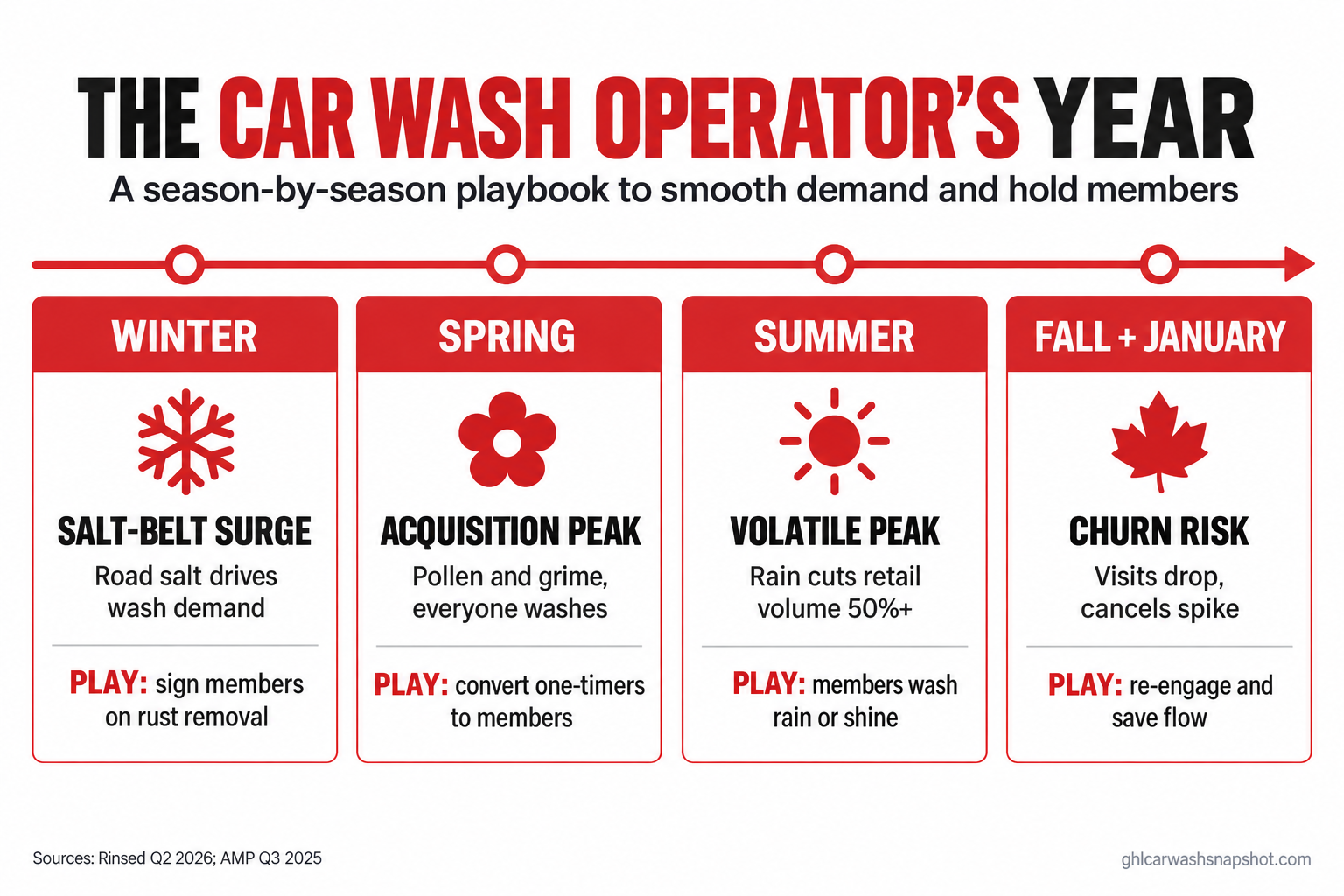
It is the second week of January and you are staring at a weekend count that would have been a slow Tuesday in May. The lot is empty, the blowers run for nobody, and the part that stings is that you saw it coming and still had no plan ready. Every car wash operator lives inside this swing. The question is whether it owns your year or you do.
Here is the short answer. Retail wash traffic is wildly seasonal and local: it surges in the salt belt in winter, peaks in the sunbelt in spring and summer, and collapses on any rainy afternoon. Membership is the one lever that flattens all of it. In the second quarter of 2026, membership revenue grew 10.4% while retail revenue fell 3.9% across more than 3,000 locations (Rinsed Q2 2026, via ICA). The operators who win the year sign members in every season and build the retention plumbing that holds them through the empty quarters. This is the season-by-season playbook to do it.
Table of contents
- Why the swing costs so much
- The one shift that changes the year
- Winter: salt belt vs sunbelt
- Spring: your acquisition window
- Summer: rain and water rules
- Fall: the quiet quarter
- January: the churn cliff
- The same plan at three sizes
- The compliance line
- Steal these: seasonal copy
- Objections, answered
- FAQ
Why the swing costs more than you think
Weather does not nudge wash traffic. It swings it. AMP’s Q3 2025 analysis of more than 7,400 sites found rain cuts retail wash volume by more than 50% on the day (AMP, 2025). Stretch that across a year and the numbers hold: Rinsed’s Q2 2025 report found retail revenue down 11.9% year over year even as the price per wash rose 3%, driven partly by a 10% rise in rainy days (Rinsed Q2 2025). The traffic did not leave because you got expensive. It left because the sky changed, and you cannot price or staff your way out of weather. Across roughly 62,750 US wash locations (an ICA-commissioned 2020 study, ICA), most competitors ride that same saw-blade curve instead of planning for it.
The one shift that changes the whole year
One thing turns a seasonal business into a predictable one: converting one-time washers into members who pay every month, rain or shine.
Year-over-year revenue change by type, Q2 2026, across 3,000+ car wash locations. Source: Rinsed Q2 2026 report, via ICA.
This is not a one-quarter fluke: a year earlier, membership rose 15.2% while retail fell 11.9% (Rinsed). When retail craters, membership holds the floor, and members are sticky: nearly 90% plan to renew heading into 2026 (ICA CAR WASH Pulse Q1 2026).
Retail year vs membership year
Retail-dependent: revenue tracks the weather. A wet month shows up in the deposit, and you start every month at zero.
Membership-led: monthly dues pay rain or shine. Weather still moves retail on top, but the floor never drops out.
The rest of this playbook assumes you are signing members year round. If not, start with how to launch an unlimited wash club and the retail-to-member conversion system.
Winter: the salt-belt surge and the sunbelt dip
Winter is two different seasons depending on your zip code, which is why a national find-and-replace playbook fails.
In the salt belt, winter is a surge. The US uses around 39 million tons of salt a year, with highway deicing roughly 37% of it (USGS Mineral Commodity Summaries 2026, Salt). That salt eats undercarriages, and drivers who never washed in July line up in January to get it off, so in the Midwest or Northeast, winter is prime acquisition season. In the sunbelt, winter is the dip, and the job is retention: keep the members you signed in spring and summer from slipping away while the lot is slow.
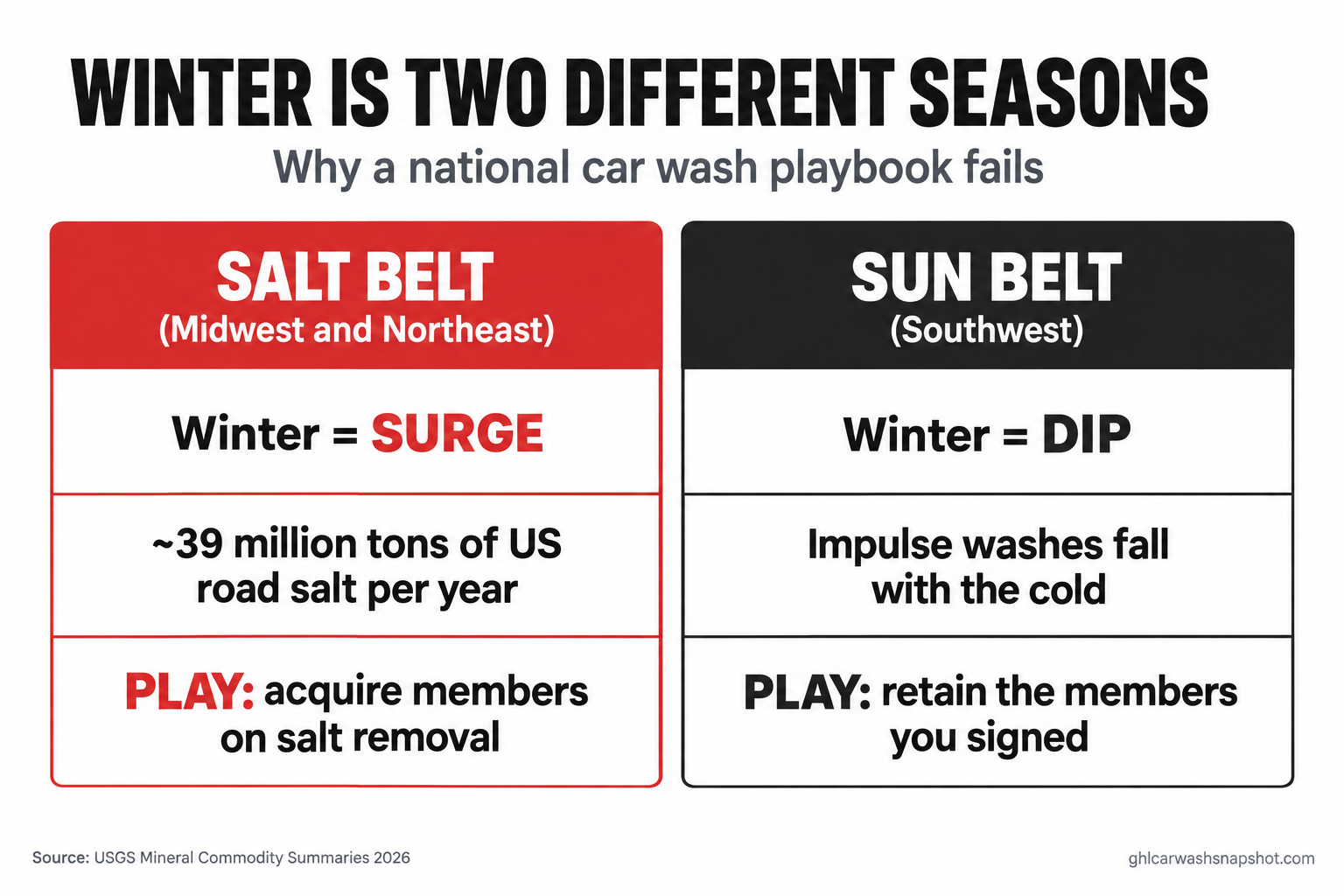
The play. Salt belt: a “salt season” membership offer, the underbody wash as hero service, and signage that frames the unlimited plan as rust insurance. Sunbelt: a December members-only touch (a free upgrade, a bonus interior service) so the member who is not visiting still feels the value.
How it breaks. Treating a frozen bay as a reason to go dark on marketing. You stop texting, the member stops visiting, and by February they cannot remember why they pay you. Silence in the off-season is the start of churn, not a pause from it.
Spring: your biggest acquisition window
Spring is where the year is won. Pollen, rain spatter, and the end of winter grime put every driver in the market at once, and unlike a rainy Saturday, that demand holds for weeks.
The mistake is treating spring as a revenue event instead of an acquisition event. A one-time spring washer is worth one wash. The same washer converted to a member at a commonly reported $20 to $40 a month is worth that every month, through the summer rain and the fall quiet and next winter (membership pricing). Spring is when your lot is full of the people most likely to say yes.
The play. Put a human or kiosk prompt on every spring transaction with one job: convert to the unlimited plan today. Script the attendant. Run a limited spring join offer (first month discounted, not free, so the card on file stays working). Capture the phone number on every retail wash to follow up the “maybe later” crowd.
How it breaks. The spring rush overwhelms the conversion motion. The line is long, the staff is slammed, and nobody asks for the membership. You end the quarter with record retail and a flat member count, which carries nothing into the lean months. Build the conversion ask into the busiest days on purpose.
Summer: surviving rain and water restrictions
Summer is the volatility season, a peak in much of the country but a jumpy one: afternoon thunderstorms gut a day’s retail in an hour, and the next clear morning brings a rebound. It most rewards a large member base, because members wash on the clear days you did not have to pay to bring back. In drought-prone regions, summer adds a second complication, water restrictions, covered below.
The play. Lean into weather as a demand trigger, not a threat. A clear-morning-after-rain text to your retail list fills the rebound window AMP measured (weather-triggered promotions). For members, reinforce value: road-trip prep, bug and sap removal, the stuff that makes the plan feel earned in July.
How it breaks. Two ways. First, operators discount retail into the ground on rainy weeks, training customers to wait for the next storm instead of joining. Second, they let summer card failures slide: travel means more expired cards, and a failed card is a silent cancel. Credit-card churn still ran at 3.0% of members a month in Q2 2026 (Rinsed), recoverable revenue the fix for which is automated dunning (silent card churn).
Fall: the quiet quarter that decides your churn
Fall is the season nobody plans for, and the one that quietly decides your winter. The rush is over, the lot settles into a slower rhythm, and the member who washed twice a week in July now washes twice a month. Nothing feels wrong, which is the danger: a member who stops visiting is about to question the charge. Voluntary churn, the member who actively decides to cancel, is the fastest-growing leak in the industry, climbing to 4.9% a month in Q2 2026, up 9.2% year over year (Rinsed). Fall is when that decision gets made, even if the click comes later.
The play. Watch for members whose visit frequency drops and hand them a reason to come back before they drift: a free upgrade, a seasonal interior reminder, a “we noticed you haven’t been in” nudge that feels like service, not a collections call. This is the whole job in the off-season (car wash customer retention).
How it breaks. Measuring the wrong number. Operators watch new signups and total member count, both of which look fine in fall because the cancels have not landed yet. The number that predicts winter is visit frequency per member. When it falls and you do nothing, churn is loading in slow motion.
The turn of the year: January is the churn cliff
January is the most dangerous month on the calendar for a wash club. It is widely the slowest month in most markets, demand is at its floor outside the salt belt, and it lands right when consumers review and cut the subscriptions that “feel optional” after holiday spending. The membership that survived a quiet fall gets its hardest test in the first two weeks of the year.
Monthly car wash membership churn, Q2 2026, by type. Source: Rinsed Q2 2026 report, via ICA.
The play. Get ahead of the cancel. An early-January re-engagement push resets the usage habit before the “cancel everything” mood hits. Pair it with a real cancellation save flow so that when someone clicks cancel, you catch them with a pause offer or a downgrade instead of losing them. A paused member in January is a reactivated member in April. A cancelled one is a cold lead.
How it breaks. Making cancellation hard as a retention strategy. It is not retention, it is a complaint engine and, increasingly, a legal risk. Make leaving easy and staying obviously worth it. The FTC’s “click-to-cancel” rule was vacated in 2025, so your obligations now run through state auto-renewal laws (car wash membership auto-renewal laws).
The same plan at three sizes
The seasons do not change, but the right response does by size.
| Season | Single express tunnel | Three-location chain | Eight-site regional operator |
|---|---|---|---|
| Winter | Owner runs the salt-season push by hand | Standardize one salt offer across sites | Regional segmentation: salt-belt sites push, sunbelt sites retain |
| Spring | Attendant-scripted conversion at the kiosk | Conversion contest across locations | Centralized acquisition dashboard, per-site targets |
| Summer | Clear-morning text to the retail list | Weather triggers per site’s local forecast | Automated weather rules plus dunning at scale |
| Fall | Manual watch on top members’ frequency | Frequency alerts per location | Cohort-level churn modeling |
| January | Owner-sent re-engagement text | Shared save-flow playbook | Reactivation cohorts and pause-tracking |
Single express tunnel, roughly 1,200 members. You are the system, with no staff to notice drift, so the automation does the remembering. Automate three touches first: winter salt offer, spring conversion ask, January re-engagement.
Three-location chain, roughly 4,000 members. Your risk is inconsistency: one site runs the spring push and two forget. Standardize the plays into one calendar every location runs, and watch visit frequency, because by the time the member count drops you have lost a quarter (membership churn and your margins).
Eight-site regional operator, 12,000-plus members. You span climates, so a single national plan is actively wrong. Segment by region: salt-belt sites run the winter acquisition surge while sunbelt sites run winter retention, the same week. At this scale, failed-card recovery and reactivation are your largest recoverable revenue line.
The compliance line nobody plans for
Two seasonal rules catch operators off guard.
Summer water restrictions. In drought-prone regions, local water-use rules usually turn on recycling. Commercial washes that reclaim or recycle their water, or drain to the sanitary sewer, are typically exempted while home and charity washing gets banned. In Marion County, Indiana, washes were exempted from a water ban, with one operator reclaiming up to 47 gallons per wash (Professional Carwashing & Detailing). The drought marketing opening is real, you are the legal, water-smart way to wash when the home hose is off, but confirm your own local status first, because the exemption depends on how you handle water.
Membership auto-renewal. Tighten this right before your January churn push, when disputes spike. The FTC’s “click-to-cancel” rule was vacated by the Eighth Circuit in 2025, so the rule most operators think applies does not. What governs you instead is state auto-renewal laws plus Section 5 of the FTC Act: clear disclosure of the recurring charge, affirmative consent, and an easy cancellation path. Getting it right is both the law and the best way to keep January complaints and chargebacks down (car wash membership auto-renewal laws).
Steal these: the seasonal message copy
Here is the copy that carries the plan. Swap in your brand name and plan price, keep the timing, and let it fire automatically. One clear action each.
Attach each to its trigger in whatever runs your messaging. The copy is worthless if a human has to remember to send it. The point is that it runs without you.
Objections, answered
“My business is just seasonal. That’s the nature of a car wash.” Retail is seasonal. Membership is not, and that is the whole argument for a member base. The same Rinsed data that shows retail falling shows membership growing in the exact same quarter (Rinsed Q2 2026). You will never fully flatten retail, but you can build a floor under it.
“Won’t all these texts annoy my members?” They annoy when they are generic and constant. The plan above is the opposite: a handful of messages a year, each tied to something real (salt on their car, pollen season, a rainy morning clearing, a drop in their visits). Relevance is the difference between a nudge and spam. And if you already pay for a CRM or POS with messaging built in, you have the tools and simply never built these flows.
“The off-season is slow for a reason. Why fight it?” Because the member you lose in January you re-acquire in spring, and re-acquisition is far more expensive than retention. Voluntary churn is up 9.2% year over year (Rinsed). Every member you hold through the quiet quarter is one you do not pay to win back later. The off-season is slow because most operators stop working it.
FAQ
Is car wash demand really that seasonal?
Retail demand is extremely seasonal and weather-sensitive. AMP's 2025 analysis of 7,400-plus sites found rain can cut a day's retail wash volume by more than half, and swings in northern markets are larger still. Membership revenue, by contrast, stays steady because members pay monthly regardless of weather.
Which season is best for signing new car wash members?
Spring is the strongest acquisition window nationally, when pollen and post-winter grime put nearly every driver in the market at once. In the salt belt, winter is a second strong window driven by road-salt removal. Both are times your lot is already full of likely members, so the conversion ask costs almost nothing.
Why do car wash members cancel in January?
January combines the slowest demand of the year with the moment consumers review and cut subscriptions after holiday spending. A membership that went unused through a quiet fall feels optional. The fix is an early-January re-engagement push plus a save flow that offers a pause or downgrade when someone tries to cancel.
How does a membership protect against bad weather?
A member has already paid, so a rainy week that empties the lot still produces that revenue. In Q2 2026, membership revenue grew 10.4% while retail fell 3.9% across 3,000-plus locations. Members also return faster after rain, so a large member base smooths the volatility retail-only washes absorb directly.
Do drought and water restrictions shut down car washes in summer?
Usually not. Commercial washes that recycle or reclaim water, or drain to the sanitary sewer, are typically exempted from drought restrictions that ban home washing. In one Indiana county, washes stayed open under a water ban, with an operator reclaiming up to 47 gallons per wash. Confirm your own local rules first, because the exemption depends on how you handle water.
It is the second week of January again, and the lot is just as quiet as last year. The difference is that this time your members got a re-engagement text on the second, and the three who clicked cancel got a pause offer instead of a goodbye. The weather did not change. Your plan did. Build the calendar once, automate the touches, and let the empty quarters do less harm.