

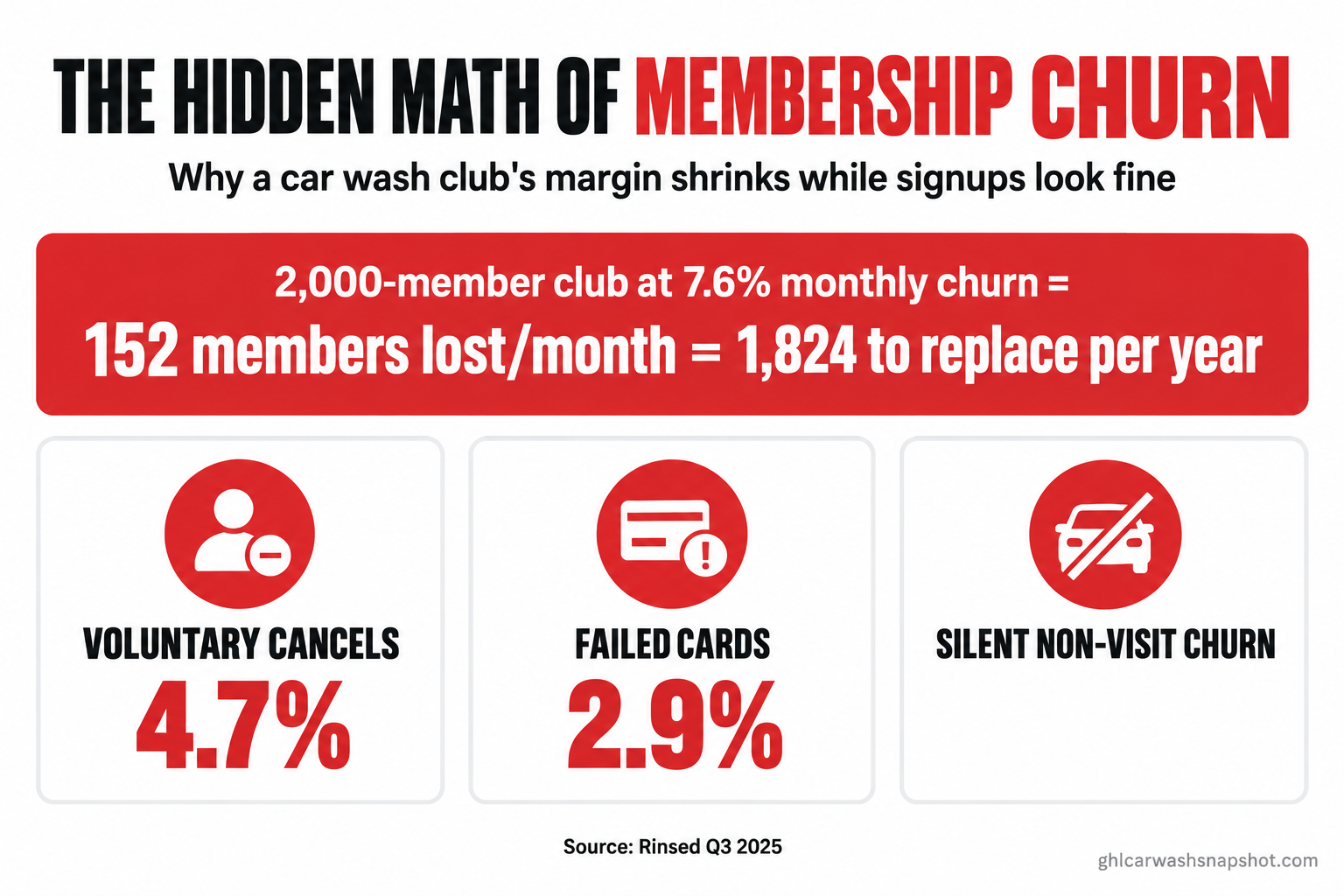
Your signups look healthy. The kiosk is converting, attendants are pitching the club, the new-member count climbs every week. But the month-end deposit is flat, maybe shrinking, and you cannot work out why. You are doing more to grow the club than two years ago and the margin is worse. The number nobody put on the whiteboard is the one draining you: how many members walk out the back while you are busy filling the front.
Here is the answer up front. Membership churn hurts your margin before it hurts your revenue, because every member who leaves has to be replaced with acquisition dollars just to keep the club flat. At the US average of about 7.6% monthly churn, a 2,000-member club loses roughly 152 members a month, so you must sign about 1,824 new members a year to grow by zero. That replacement spend is pure cost with no new revenue attached, which is why margin shrinks even when signups look fine. This guide has the real math, the three leaks behind the number, and the six-part system that plugs them.
Table of contents
- Why churn hits your margin harder than your revenue
- The three leaks draining your club
- The six-part system that plugs the leak
- Steal these: the exact messages
- The math at one, three, and eight locations
- The cancellation rules that actually apply
- Objections, answered
- FAQ
Why churn hits your margin harder than your revenue
Start with where the money is. In Q3 2025, membership revenue across US unlimited-wash clubs rose about 10% year over year and drove nearly all of the growth, while retail (pay-per-wash) revenue fell about 3% (Rinsed). The club is not a nice extra, it is the engine. At Mister Car Wash, unlimited club sales reached about 77% of total wash sales that quarter, up from 74% a year earlier, across more than 2.2 million members (Mister Car Wash). When the engine leaks, everything downstream slows.
Now the part most operators never put on paper. A churned member first shows up as a small dip in recurring revenue, one plan’s worth, easy to shrug off. But to keep the club from shrinking you have to replace that member, and replacement is not free: marketing spend, kiosk promos, the discounted first month, attendant time. Acquiring a customer costs 5 to 25 times what it costs to keep one (HBR). So a churned member hits you twice, once as lost revenue and again as the acquisition cost to stand still. That second hit lands on margin, which is why the deposit shrinks while the signup report looks great.
This is the treadmill. At 7.6% total monthly churn, a club of 2,000 members loses about 152 people a month. Sign 152 new members and you have grown by zero, after spending real money to do it. The faster the leak, the harder you run just to hold position.
One more number makes the whole case. Average member lifespan is roughly the inverse of your monthly churn rate. At 7.6% a month the average member stays about 13 months. Drag churn to 6% and that stretches to about 17 months; get it to 5% and it is 20. Same signup machine, same plan price, and every member is worth more than 50% more in lifetime revenue with no extra acquisition spend. That is the margin lever hiding inside churn. To run your own numbers, the membership churn and LTV calculator does this math for your club.
The three leaks draining your club
“Churn” is one word for three different holes in the bucket, and you cannot fix a hole you have not named. Treating all three the same is the most expensive mistake operators make.
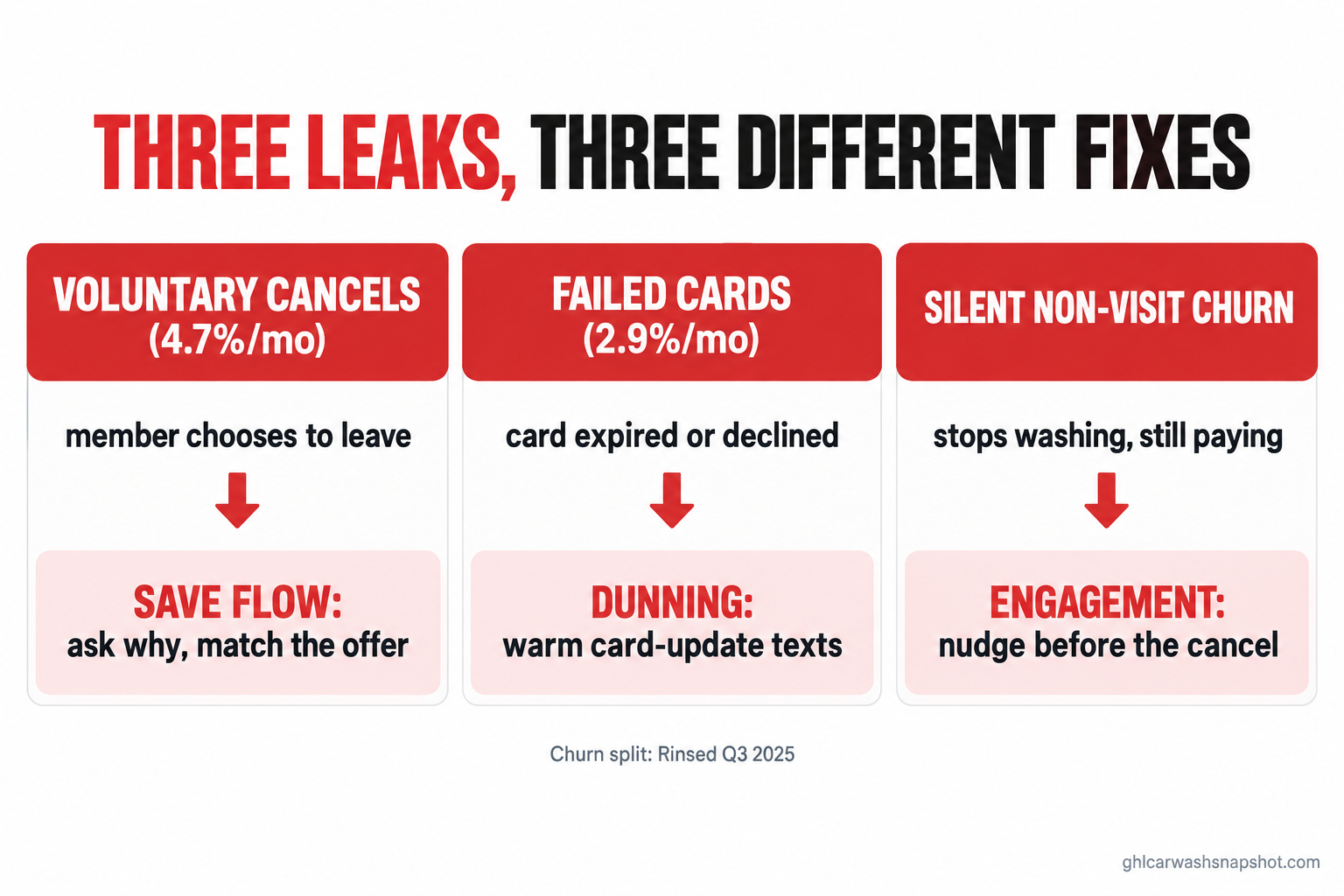
Leak one: voluntary cancels. A member decides to leave: they moved, money got tight, they feel they are not washing enough, or a closer lane opened. This ran about 4.7% of members a month in Q3 2025 (Rinsed). You fight it with value, timing, and a save offer at the moment of cancel.
Leak two: failed cards. A card expired or a bank declined the charge, and the member never meant to leave. This ran about 2.9% a month in the same data. Sending a win-back discount to someone whose Visa merely expired gives away margin. You fight this with a dunning sequence, the quiet recovery flow covered in silent card churn.
Leak three: silent non-visit churn. This one hides. A member stops washing weeks before they cancel. They are still paying, so your report looks fine, but they are already gone in their head. The ICA’s Q2 2026 Pulse flagged a rewash gap as evidence of exactly this building under the surface (ICA via Rinsed). You fight it with engagement before the cancel ever happens.
One word, three different fixes
The trap: one 'retention' promo blasted at everyone. The expired-card member ignores it, the disengaged member never reads it, and you discounted people who were going to stay anyway. Margin down, churn unchanged.
The fix: a card-update flow for failed cards, a save flow for voluntary cancels, an engagement nudge for members who go quiet. Each leak gets the one tool that closes it, and you stop paying to fix problems that do not exist.
The first job of any real system is to stop treating an expired Visa like a breakup, and a quiet member like a happy one.
The six-part system that plugs the leak
Each part targets a specific leak, and each has a way it breaks that you need to guard against.
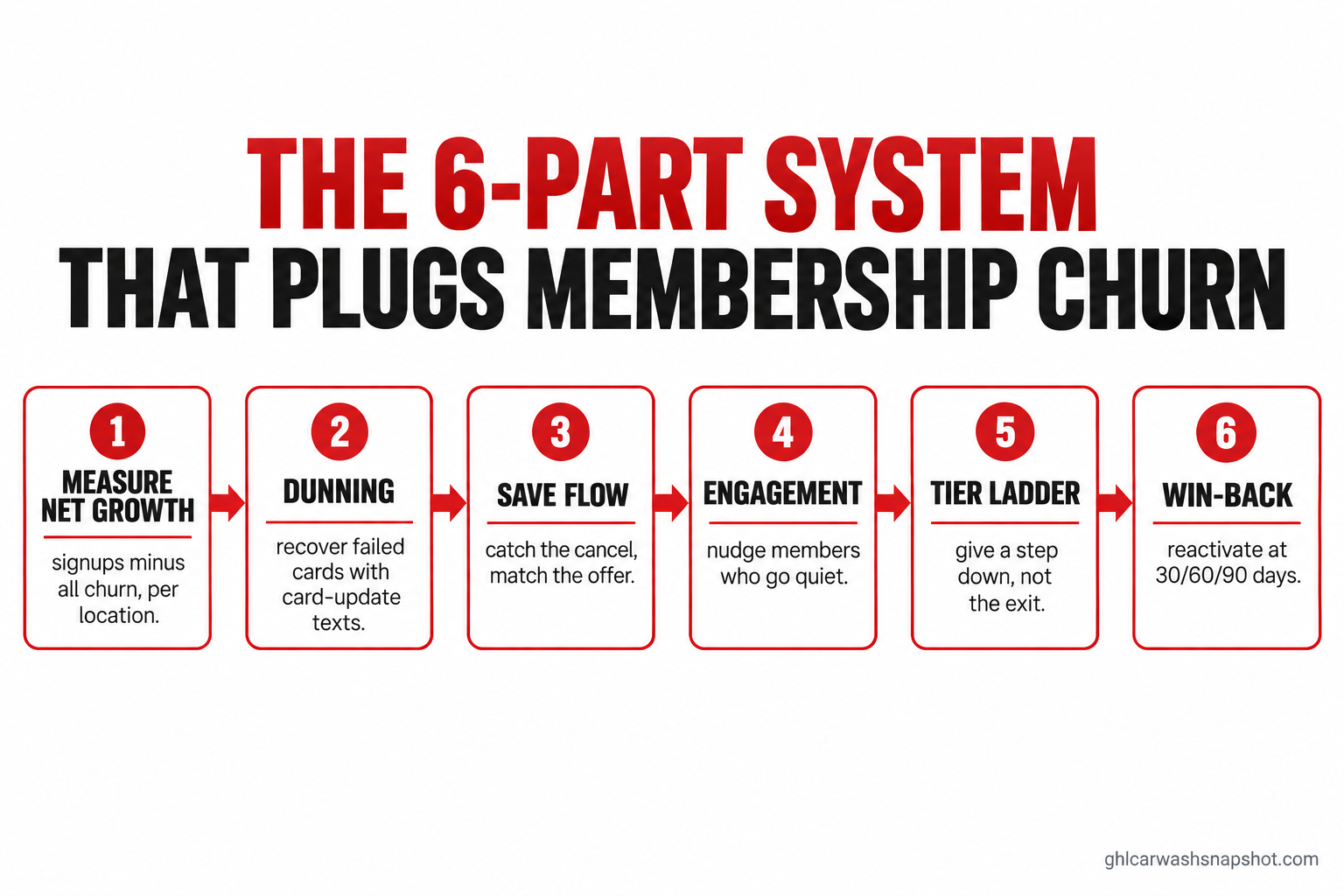
Part 1: Measure net member growth, not gross signups. The report that fixes your blind spot is net new members: signups minus all three kinds of churn, monthly, per location. Gross signups feel good and hide the leak. The failure mode is counting a reactivated former member as a brand-new signup, which hides the treadmill, so tag reactivations separately. In Q4 2025, nearly 30% of new memberships industry-wide were former members returning (Rinsed via carwash.org).
Part 2: Plug the failed-card leak with dunning. This is the cheapest churn you will ever recover, because the member already wants to stay. The moment a charge fails, a short sequence fires: a friendly text and email with a one-tap link to update the card, a retry over the next several days, then a final notice before the plan lapses. The failure mode is a flow that sounds like a collections agency and scares a loyal member off. Keep it warm. The full build is in the silent card churn playbook.
Part 3: Catch the voluntary cancel with a save flow. When a member signals they want out, in the portal, by text, or to an attendant, a flow fires within a minute. It acknowledges them, asks one diagnostic question, then makes the one offer that fits: a pause for “not washing enough,” a downgrade or time-boxed discount for “too expensive,” a real human fix for “something broke,” a clean exit for “moving.” The failure mode is leading with a 50%-off blast at everyone, which trains members to cancel just to get the deal. Match the offer to the reason: paused members resume at up to 89% versus about 22% for a cancel-moment discount (Churnkey). The deep build is the save flow.
Part 4: Stop silent non-visit churn before it becomes a cancel. This is the part almost nobody runs, and where the quiet margin bleed lives. Watch wash frequency by member. When someone who washed weekly goes quiet for three weeks, a light nudge fires: a reminder the plan is sitting unused, a rainy-day prompt, a “we miss you” with a free add-on. The failure mode is nagging. One good nudge beats five annoying ones. This is the frequency habit the retention playbook is built around.
Part 5: Price and tier so members climb instead of leave. A good tier ladder gives a price-sensitive member somewhere to go that is not the exit: a cheaper base plan catches the “too expensive” member who would otherwise walk, and a clear premium tier gives your best members a reason to spend more. Mister Car Wash’s top Titanium 360 tier reached about 25% penetration in Q3 2025 (Mister Car Wash), which shows the upgrade room inside an existing book. The failure mode is an intro rate so low it devalues the plan and makes cancellation more likely when the promo ends. The membership pricing guide has the ladder math.
Part 6: Win back the ones who still left. A cancel is not a goodbye. About 54% of former members still wash at the same location after they cancel (Rinsed). A short win-back sequence at 30, 60, and 90 days, timed to a weather surge or seasonal promo, pulls a real slice of them back. The failure mode is treating a clean exit as a dead end: they left the plan, not the parking lot.
Steal these: the exact messages
The system is only as good as the copy. Here is the real text for each flow. Keep it short, keep it human, and send from a number members can reply to.
Failed-card recovery (Part 2), message one, within minutes of the decline:
Hey {first_name}, this is {wash_name}. Heads up, your card on file for
the Unlimited plan didn't go through this month, usually an expired or
replaced card. You can fix it in 20 seconds here so your wash keeps
rolling: {update_link}. Reply HELP if you want a hand.
Failed-card recovery, final notice, day 5 to 7:
{first_name}, last heads up, we couldn't run your {plan_name} payment
and the plan pauses tomorrow. Keep your unlimited washes going:
{update_link}. Already updated it? Ignore this and thanks.
Save flow (Part 3), the diagnostic question, within a minute of a cancel request:
Got it, {first_name}, we can cancel that for you. Quick one so we do
right by you, what's the main reason?
1) Costs too much  2) Not washing enough  3) Moving  4) Something broke
5) Just done. Reply with a number.
Save flow, the “not washing enough” branch (lead with the pause, not a discount):
Totally fair. Instead of canceling, want to PAUSE for up to 3 months?
No charge while it's paused, your plate stays on file, and it picks
right back up when you're ready. Reply PAUSE and you're set, or CANCEL
and we'll take care of it right now.
Re-engagement (Part 4), after ~3 weeks of no visits:
Hey {first_name}, we noticed your {plan_name} plan has been sitting
unused the last few weeks, that's money you've already paid for. Pull
in anytime this week and the first wash is on us. Lanes are quiet
before 11am.
Win-back (Part 6), day 30 after a clean cancel:
Miss that just-washed feeling, {first_name}? Come back to {wash_name}
Unlimited this month and your first month is {winback_offer}. Same
plate-on-file, no re-signup hassle: {rejoin_link}.
Every one is a template with merge fields, not a one-off you type. The flow fires on the trigger, pulls the member’s name and plan, and sends in seconds while the moment is live.
The math at one, three, and eight locations
The system pays off differently by size, because the leak scales with member count.
Solo operator, one site, about 1,200 members. At 7.6% churn you lose about 91 members a month, roughly 1,095 a year, every one of which you pay to replace. Cutting churn to 6% saves about 23 members a month from the treadmill, worth about $6,900 a year at a $25 plan, most of it dropping to margin. Start with Part 2 (dunning) and Part 3 (the save flow): fastest to stand up, most recovered for the least effort.
Three locations, about 5,000 members. Now you lose about 380 members a month, and a strong location masks a leaking one in the group total. This is where Part 1 matters most: net growth per location, every month. Trim churn to 6% and you keep roughly 80 extra members a month off the treadmill, about $24,000 a year at a $25 plan, before the acquisition dollars you no longer spend.
Eight locations, about 16,000 members. At this scale a point of churn is a full-time salary. You lose about 1,216 members a month. All six parts run as one engine, and win-back (Part 6) becomes its own revenue line, because those 54% of former members are cheaper to reactivate than to acquire fresh. Part 1 reporting becomes how you spot a sick location before it drags the group down.
The cancellation rules that actually apply
A fair warning before you build any of this. When churn hurts, the temptation is to make canceling hard: a hidden button, a phone-only cancel, a hoop to jump through. Do not. A trapped member leaves a one-star review and a legal problem.
Here is what actually governs you in 2026, because the headline most operators remember is wrong. The FTC’s “click-to-cancel” negative-option rule, the one everyone assumed now applies, was vacated by the Eighth Circuit in July 2025 and is not in force (Mayer Brown, Sidley). That does not let you off the hook. State auto-renewal laws still apply, the California ARL foremost among them, generally requiring clear up-front disclosure of the recurring charge, affirmative consent, and an easy cancel through the channel the member signed up in, with FTC Act Section 5 barring deceptive practices on top. The full breakdown is in car wash membership auto-renewal laws.
The practical rule: make the save offer good, and make the exit honest. A pause instead of a cancel is retention; a cancel button that leads to a maze is a lawsuit waiting to happen.
Objections, answered
“My signups are strong, so churn isn’t really my problem.” Strong signups are exactly how churn hides. Revenue can look flat while margin erodes, because you spend more and more acquisition dollars just to replace the members leaking out. Pull one report, net new members per location per month, for the last year. Flat while signups climbed means you are on the treadmill and paying for the privilege.
“Won’t the automated texts annoy members and cause more cancels?” Only if you spam. The flows fire on specific triggers, a failed card, a cancel request, three weeks of no visits, not on a blast schedule. A member with a declined card wants the heads-up. The danger is nagging, which is why Part 4 caps the nudge and lets it rest. Done right, members read these as the wash looking out for them.
“We already pay for a POS or membership platform. Isn’t this covered?” Most car wash POS and membership tools handle billing and plate recognition well, and stop there. They rarely run a real save flow, a warm multi-step dunning sequence, non-visit engagement, and timed win-back as connected automations with editable copy. This sits on top of the billing you already have. If you are weighing platforms, the membership software cost teardown covers what each includes.
“Do I need to be technical to run this?” No. The point of shipping it as a pre-built snapshot is that the triggers, flows, and message templates come wired. You edit the copy to sound like your wash, connect your number, and it runs. If you would rather not touch it at all, that is what the done-for-you install is for.
FAQ
Car wash membership churn and margins: common questions
What is a good membership churn rate for a car wash?
The US average was about 7.6% total monthly churn in Q3 2025, split roughly 4.7% voluntary and 2.9% failed-card, per Rinsed. Well-run clubs push toward 5 to 6%. Because lifespan is roughly the inverse of monthly churn, moving from 7.6% to 5% stretches the average member from about 13 months to 20, raising lifetime value more than 50% with no extra acquisition spend.
Why are my margins shrinking even though my signups are up?
Because churn forces you to spend acquisition dollars just to replace lost members and stay flat, and that replacement spend lands on margin, not revenue. At 7.6% monthly churn a 2,000-member club must sign about 1,824 new members a year to grow by zero. Track net new members per location per month to see the leak signups hide.
How much does cutting churn actually improve profit?
The classic Reichheld and Sasser research found that cutting the defection rate by 5% raised profit about 30% in an auto-service chain, the closest analog to a wash club (Bain / HBR). Retained members cost nothing new to acquire, so every point of churn avoided is close to pure margin.
What is silent churn and why is it dangerous?
Silent churn is a member who stops washing weeks before they cancel. They are still paying, so your revenue report looks healthy, but they have already mentally left. The ICA's Q2 2026 Pulse flagged a rewash gap as evidence of exactly this. Catch it with non-visit engagement nudges before the cancel happens.
Is it legal to make members cancel through a save flow?
Yes, as long as canceling stays easy. The FTC click-to-cancel rule was vacated in July 2025, but state auto-renewal laws like the California ARL still require clear disclosure, affirmative consent, and an easy cancel through the channel the member signed up in. A genuine pause offer is fine; a cancel button that leads to a maze is not. See our auto-renewal laws guide.