

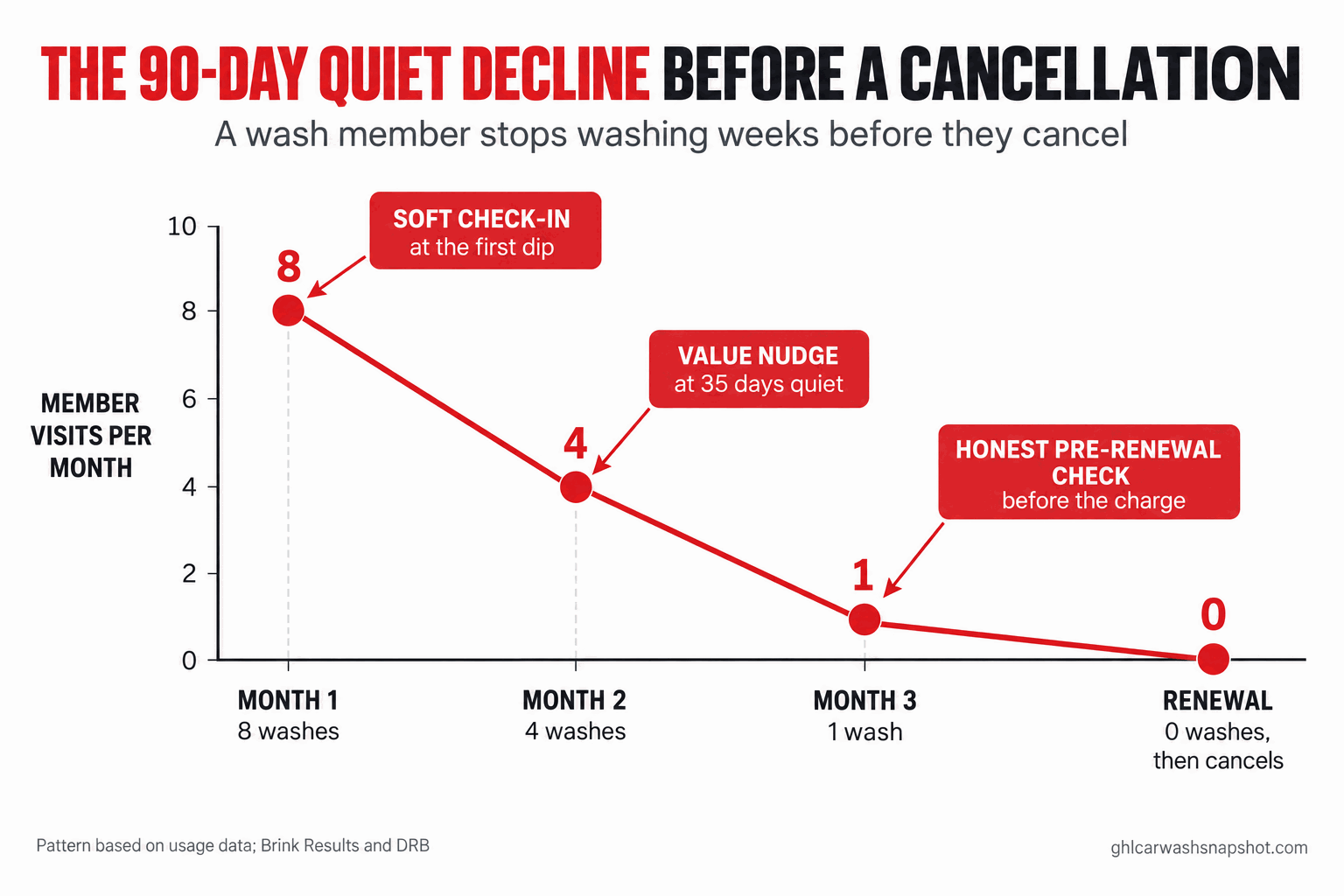
A member cancels on a Tuesday afternoon. The reason box says “not using it enough.” Their card charged fine for nine months and you never heard a complaint. So you pull their scan history, and there it is: eleven washes in the first two months, then four the next month, then one, then nothing for six weeks before they hit cancel. The cancellation did not happen on Tuesday. It happened two and a half months earlier, when they went quiet.
Here is the answer up front. Most unlimited-wash members decide to leave long before they click cancel, and the tell is their wash frequency falling off. A member who washed eight times a month and drops to one has already decided; the cancel button is just paperwork. React only at cancellation or a failed card and you catch churn when you can do least about it. The fix is to watch usage, flag the drop, and re-engage the quiet member while they are still paying. This guide gives you the usage signal, a six-stage early-warning system, the exact texts to steal, and how to run it without breaking cancellation law.
Table of contents
- Why “not using it enough” is a signal, not a surprise
- The usage data proves it: washing less means leaving sooner
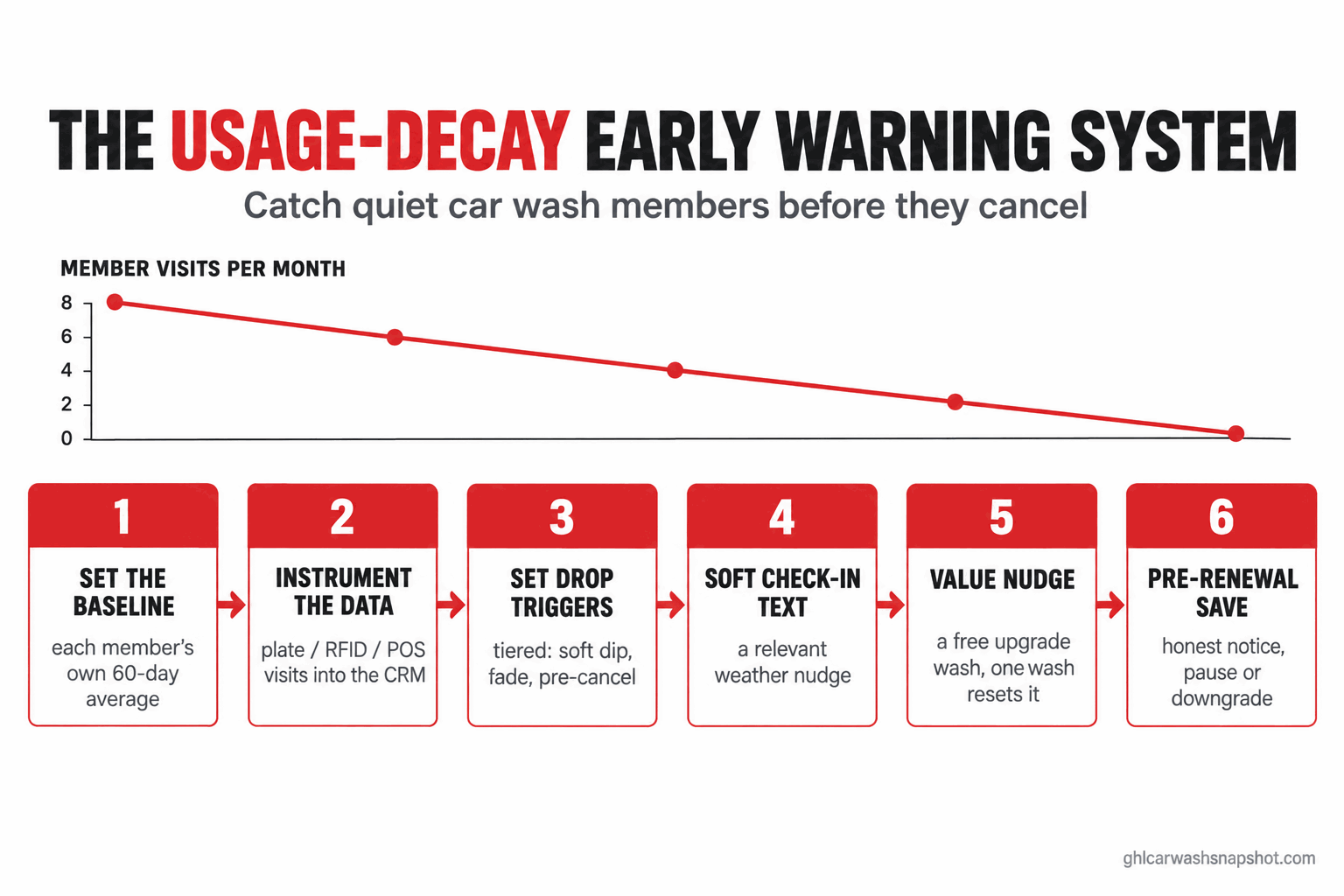
- The six-stage usage-decay early-warning system
- Steal these: the exact re-engagement messages
- What the system looks like at one, three, and five locations
- The cancellation rules you have to respect
- Objections, answered
- FAQ
Why “not using it enough” is a signal, not a surprise
Every operator I know watches the wrong number: cancellations, because cancellations hit the dashboard and the deposit. But a cancellation is the end of a story that started weeks earlier. By the time it lands you have lost almost all your room to act, because the member has already mentally quit. You are trying to talk back someone who decided to go a month ago.
The thing to watch instead is the quiet. A member stops washing, but the card keeps charging, so nothing on your reports changes. Revenue looks fine, member count looks fine, and the only place the truth shows up is the scan data, where this person went from eight visits a month to two to zero. Industry trade coverage is blunt: a member who stops washing usually keeps paying for a while before cancelling, which makes visit cadence the earliest churn signal you have (Professional Carwashing & Detailing). The money keeps coming, so you feel safe. You are not. You are in the one window where you could still save them, doing nothing, because nothing is flashing red.
A quiet member is rarely angry. They have just drifted: life got busy, the car got garaged for winter, they forgot the plan was active. That is a faded habit, not a grievance you have to win, and habits restart with a nudge at the right time, but only if you notice the fade.
The usage data proves it: washing less means leaving sooner
You do not have to take my word that usage predicts churn. Brink Results, which consults with large unlimited-wash-club operators, put a number on it: their clients find a new member who uses the plan 10 to 14 times in the first 90 days typically stays 12 to 18 months, and about 80% stick around. Churn, they say, is very predictable based on how early a customer uses the plan (Professional Carwashing & Detailing). Flip that around and it is a warning system: a new member who barely washes in the first three months is already most of the way out the door.
DRB, analysing more than 100 US wash sites, found the same shape earlier. Members averaging 1.7 washes or fewer in their first 30 days were 75% less likely to reach a second month. Members washing three or more times in the first month were 76% more likely to recharge, and those hitting four or more were 61% more likely to still be a member at month six. DRB calls two to four washes a month the retention sweet spot (DRB).
Put the two together and the lesson is simple: wash frequency is the single best early read on whether a member stays, and it moves weeks or months before the cancellation. These members are worth chasing: about 91% of unlimited-wash subscribers say they plan to renew (ICA Car Wash Pulse, Q2 2026). The chart below shows what DRB measured.
The six-stage usage-decay early-warning system
Here is the system I install to stop operators losing members they never saw go. It is a sequence that watches usage, reacts at the right moment, and escalates only if the member stays quiet. Each stage has a setup, a trigger, and the way it breaks.
Stage 1: Define your usage baseline
You cannot spot a drop without knowing what normal is for each member, and it is personal: a member who has washed twice a month for a year is healthy, while one who fell from ten a month to twice is in trouble on the same count. Set the baseline from each member’s own rolling 60-day average, recalculated weekly, and give new members the DRB sweet spot of two to four washes a month as a floor until they build history.
Failure mode: a single blanket threshold like “under two washes a month is at risk” buries you in false alarms from low-frequency members who are perfectly happy. Personalise the baseline or the system cries wolf and you stop trusting it.
Stage 2: Instrument the data so a drop is visible
You cannot act on usage you cannot see. Most washes already capture every visit through plate recognition, an RFID tag, or the POS scan at the pay station. The missing piece is getting that scan data out of the wash controller and into the system that sends messages, so a falling count can fire a workflow. If you run Rinsed, Washify, or DRB, work the triggers in their platform or export the data; if you run billing and marketing through GoHighLevel, push visit events in by webhook so the contact record carries a live wash count.
Failure mode: the data lands in a dashboard someone has to remember to check, and nobody does on a busy Saturday. If a drop does not start a workflow on its own, the system does not exist.
Stage 3: Set the drop triggers, tiered
Define what counts as a meaningful drop and react in tiers, because not every dip deserves the same response.
- Tier 1, the soft dip: rolling average falls 40% or more below the member’s own baseline, or 21 days with no wash for someone who washed weekly. Your earliest, highest-return touch.
- Tier 2, the fade: 35 days since the last wash. The habit is genuinely breaking.
- Tier 3, the pre-cancel: 50-plus days quiet, or the renewal is inside two weeks with usage collapsed. Last chance before this becomes a win-back for an ex-member.
Failure mode: firing the hard save offer at Tier 1. Hit a member with “here is 50% off, please stay” the first week they skip and you train your best members to go quiet on purpose. Match intensity to the stage.
Stage 4: The soft re-engagement touch
At Tier 1 you are not selling anything, just reminding them the plan exists and the car is dirty. The best message is useful, short, and has zero save-the-membership desperation. A weather hook works because it is relevant: pollen season, a stretch of rain, the first salt of winter. Send one text; if they come wash, the system resets their baseline and drops them from the sequence.
Failure mode: making it about you. “We miss you” is about the wash. “Fresh pollen coat this week, your plan covers unlimited washes, swing by” is about them, and it is the one that gets cars through the tunnel.
Stage 5: The value nudge
If they stay quiet after the soft touch, remind them what they are leaving on the table: a free upgrade wash this visit, a note that they have used zero of this month’s washes, or a cheap “add a family vehicle” offer, since family plans run longer than single-vehicle ones on average (Professional Carwashing & Detailing). The goal is to get them back in the lane, not renegotiate: one wash restarts the habit and buys you months.
Failure mode: jumping straight to a price discount. That teaches members the plan is negotiable and trains the quiet behaviour. Lead with value and usage; hold price concessions for the save flow.
Stage 6: The pre-renewal check and save handoff
By Tier 3 the member is nearly gone and the renewal charge is coming. Be honest and direct: a member who has not washed in seven weeks and sees a renewal hit is a prime chargeback risk, so surface it. If they engage, route them into a real save conversation, pause the plan a month, downgrade a tier, or switch to a family plan, whatever keeps the relationship alive. The mechanics are their own system, broken down in the cancellation save flow playbook.
Failure mode: using the pre-renewal touch to sneak a charge past a disengaged member. That is exactly what cancellation law punishes, and it turns a quiet non-renewal into a chargeback and a complaint. Be straight with them.
Steal these: the exact re-engagement messages
Here is the copy I deploy, by tier. Swap in your brand name and site, keep every message short, and set up STOP handling before any of it goes out.
Tier 1, the soft weather nudge (text):
Hey [First Name], pollen is brutal this week and your [Brand] unlimited plan covers as many washes as you want. Swing by [Site] and knock it off the car. Reply STOP to opt out.
Tier 2, the value reminder (text):
[First Name], quick heads up: you have paid for unlimited washes this month and have not used one yet. That is money sitting on the table. Here is a free [top-tier] upgrade on your next visit this week. See you at [Site]?
Tier 3, the honest pre-renewal check (text):
[First Name], your [Brand] plan renews on [date]. We noticed you have not been in for a while. If the plan still works for you, great, nothing to do. If not, you can pause it for a month or switch plans here: [link]. Either way, no surprises.
Tier 3, the save handoff (text, after they reply or click cancel):
Totally get it, [First Name]. Before you go, two options that keep you covered: pause your plan free for 30 days, or move to the [lower tier] plan at [price]. Want me to set either one up?
The pattern: no guilt or desperation at the top, and a real, specific reason to come back in. You escalate the offer only as the member nears the door. For the full save conversation once someone commits to cancelling, use the cancellation save flow system; to see what each saved member is worth, run the membership churn and LTV calculator.
What the system looks like at one, three, and five locations
The system is the same idea at any size, but what you build and who runs it changes with scale.
The single-site operator. One tunnel, a few hundred to a couple thousand members, no marketing staff. Skip the enterprise analytics. You need your POS or plate system feeding a wash count into one CRM, a few triggers, and the texts above on autopilot. Set it once and spend ten minutes a week on who got flagged and who came back. The biggest win is simply noticing quiet members at all, because right now you find out at cancellation. Catching even a quarter of them early moves your deposit.
The three-location operator. Real volume, a member base that washes across sites, someone part-time on marketing. Set baselines per member across all sites, not per site, or a member who switched location looks like a drop when they are fine. Start segmenting by tenure: a new member who goes quiet gets the onboarding nudge, a long-time member the loyalty-tone one. Track save rate by tier so you know which touch actually pulls cars back.
The four-to-five-location operator. Now churn is a line item the owner watches monthly, and a 1% move in voluntary churn is real money. Run the full tiered system with cohort reporting, A/B test the Tier 1 message, and feed usage data back into acquisition to see which sign-up sources produce members who wash. You are not just saving quiet members, you are learning which were never worth acquiring. For the math on how churn drains margin, see the membership churn and margins breakdown.
The cancellation rules you have to respect
Re-engagement and renewal messaging sit close to real law, so get this part right. A lot of operators still think the FTC “click-to-cancel” rule governs them. It does not, not right now: the Eighth Circuit vacated it in its entirety in July 2025, days before it was due to take effect (Fenwick).
That does not mean anything goes. You are still bound by ROSCA, Section 5 of the FTC Act, and your state’s automatic-renewal law, several of which are strict. California’s, for example, is fully in force and requires clear renewal disclosure and an easy way to cancel. Two rules follow. First, your Tier 3 pre-renewal message is not optional politeness, it is close to good-faith renewal practice: tell the member the charge is coming and make opting out easy. Second, never use a quiet member’s disengagement as cover to slide a renewal past them, because that is exactly what these laws target.
Treat this as operator guidance, not legal advice: I am not your lawyer and these personas are not licensed advisors. For the full picture after the rule was struck down, read the car wash membership auto-renewal laws guide.
Objections, answered
“Won’t all these texts annoy my members?” Only if you blast everyone. The usage trigger means you only message members who have gone quiet, and it stops the moment they wash again. A happy, active member never hears from it. One relevant nudge to someone who drifted is service, not spam. The version that annoys is the one that keeps firing after they came back, which is why the reset rule matters.
“I don’t have plate recognition or RFID. Can I still do this?” Yes. Any system that records a member visit works, including a POS scan or a barcode on the app. You need a timestamp per member per visit, not a specific technology. If your setup records nothing per member, that is the first fix: you cannot run retention blind, and you are probably missing acquisition data too.
“Isn’t this just a win-back campaign?” No. Win-back targets members who already left, a cold, low-converting ask. This targets members who are still paying and still technically yours, and nudges them before they leave. Catching someone at the soft-dip stage is far cheaper than reactivating an ex-member months later. Win-back is the ambulance; this is the guardrail.
“What about members who leave because their card failed?” Different leak, and this system does not fix it. Failed-card, or involuntary, churn needs a dunning and card-recovery sequence, not a usage nudge, because those members did not choose to go, their card just expired. Usage-decay catches voluntary churn. Run both, because together they cover most of that 7.6% monthly bleed. The customer retention playbook covers how the voluntary and involuntary pieces fit together.
FAQ
How early can you predict a car wash membership cancellation?
Weeks to months. Wash frequency drops well before a member cancels. Brink Results reports members washing 10 to 14 times in their first 90 days last 12 to 18 months, and DRB found members averaging 1.7 or fewer washes a month are 75% less likely to reach a second month.
What usage drop should flag a member as at risk?
Use a personal baseline, not a clubwide number. A good first trigger is a rolling 60-day average falling 40% or more below that member's normal, or 21 days with no wash for someone who washed weekly. Escalate near 35 days quiet, and again near renewal if usage has collapsed.
Won't re-engagement texts just annoy my members?
Only if you message everyone. The usage trigger contacts just the small group that has gone quiet, and the sequence stops the instant they wash again. A happy, active member never hears from it. One relevant nudge to a drifting member is service, not spam.
Does it work without plate recognition or RFID?
Yes. Any per-member visit record works, including a POS scan at the pay station or an app barcode. You need a timestamp per member per wash, not a specific technology. If nothing is recorded per member today, fixing that is step one.
Does catching the usage drop keep me compliant with cancellation laws?
It helps, but this is not legal advice. The FTC click-to-cancel rule was vacated in July 2025, but ROSCA, FTC Act Section 5, and state auto-renewal laws like California's still apply. Give an honest pre-renewal notice, make cancelling easy, and check your state's rules with a lawyer.