
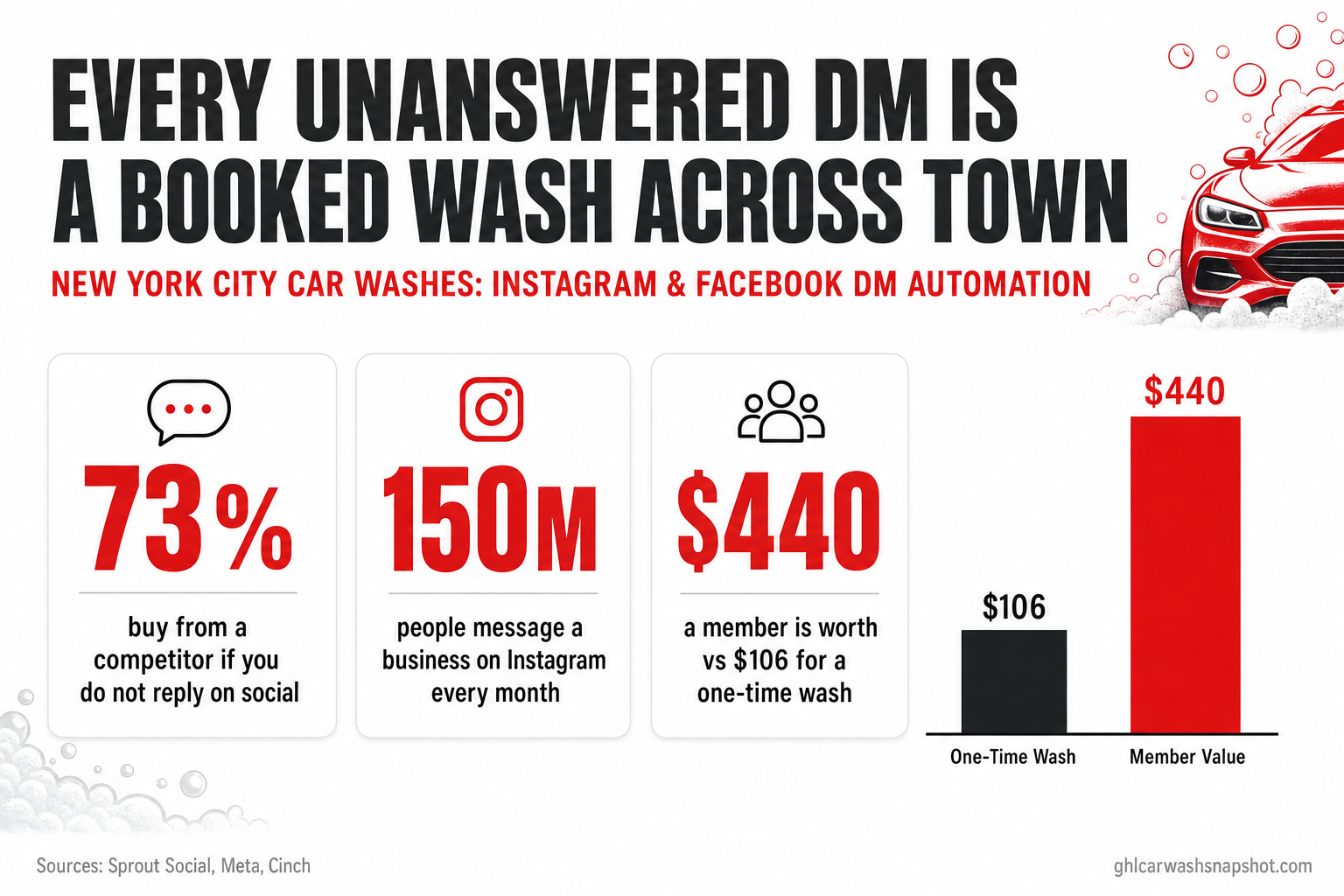
Instagram and Facebook DM automation is an AI agent that reads every direct message and comment on your car wash’s social pages, answers the driver in your brand voice, qualifies them, and books the wash or detail straight onto your calendar — 24/7, in seconds, without anyone at the wash touching a phone. For a New York City operator, that speed is the whole game: a driver in Astoria who comments “how much for a full detail?” under your Reel is deciding right now, and if your page goes quiet for three hours while your crew is heads-down in the bays, they’ve already messaged the wash two blocks over. Across social, 73% of consumers say they’ll buy from a competitor when a brand doesn’t respond to them (Sprout Social 2025 Index). Every dead DM in your inbox is a wash that got booked somewhere else.
This is a playbook for the NYC wash and detail operator who already knows the DMs and comments are piling up unanswered — what those dead messages actually cost, why New York makes the leak worse, and how to plug it in 30 days without hiring a social media manager.
Table of contents
- What DM automation is for a car wash
- The four dead-message leaks draining NYC washes
- What an unanswered DM actually costs
- Why the leak hits New York City washes harder
- How DM & comment automation books the wash
- DM automation vs hiring vs doing it yourself
- The 30-day rollout for an NYC wash
- What DM automation can’t do
- FAQ
What DM automation is for a car wash
Skip the “AI chatbot” cliché. DM automation for a car wash is a purpose-built agent connected to your Instagram and Facebook pages that does three concrete things a busy crew can’t: it reads every incoming DM and comment the moment it lands, it answers like someone who works at your wash (prices, hours, ceramic packages, the unlimited plan, whether you do fleet), and it collects the driver’s name, phone, and vehicle and books the detail straight onto your calendar — or texts a membership signup link on the spot.
It runs on two agents working together. The AI Comment Agent replies under your Reels and posts so “how much?” and “open Sunday?” never go cold in public — and high engagement is exactly what the Instagram and Facebook algorithms reward with more reach on your next wash clip. The AI DM Agent handles the private conversation that follows, qualifies the driver, and lands the booking. The point isn’t to sound clever; it’s that the message gets answered and the job gets booked in the 90 seconds while the driver is still deciding. For how this fits the rest of your social presence, see our breakdown of why a car wash page isn’t filling bays; this post is specifically about the inbox, and specifically for the NYC operator.
The four dead-message leaks draining NYC washes
Every wash with a social page has these four leaks. In New York they run faster because the competition is one tap away.
1. DMs pile up while the crew is on the floor. Your busiest inbox hours are your busiest bay hours — the Saturday rush, the after-work surge, the first clear day after a nor’easter dumps road salt on every car in the five boroughs. Nobody is watching Instagram then. The high-value messages — ceramic quotes, fleet inquiries, “do you have an unlimited plan?” — are exactly the ones that need a real answer, and they’re the first to rot.
2. Public comments die on the vine. A driver comments “price for a full detail on a Tahoe?” under your Reel. It sits for six hours. By the time anyone sees it, they’ve booked elsewhere — and the algorithm read your silence as a low-engagement post and quietly throttled its reach. One dead comment costs you the booking twice.
3. The after-hours gap is a black hole. Drivers in New York scroll and DM late — on the train home, on the couch at 10 p.m. Your page is dark from close until morning, which is precisely when a huge share of “I’ll book a detail this weekend” impulses fire and then fade.
4. Slow beats you even when you eventually reply. Answering a DM three hours later isn’t a save. By then the driver has messaged three other pages and gone with whoever answered first. This is the leak operators most underrate — and the data on it is brutal, which is the next section.
What an unanswered DM actually costs
The reason a dead DM stings more at a wash than at most local businesses is the lifetime value hiding behind it. A one-time washer is worth roughly $106; a converted unlimited-club member is worth about $440 over three years (Cinch). A ceramic coating is a several-hundred-dollar ticket. A fleet account is recurring four-figure revenue. When a DM rings out, you’re not losing a $20 wash — you’re losing the front door to your highest-value relationships.
Then there’s speed, and this is where most washes quietly lose. Research on lead response is unambiguous: contact a new lead within five minutes and you’re about 100× more likely to reach them than if you wait 30 minutes, and roughly 21× more likely to qualify them — after that the odds of even connecting fall off a cliff (MIT / InsideSales Lead Response Management Study, reported in HBR). A DM you answer tomorrow morning is competing against a decision the driver already made last night. An automated agent answers in the only window that reliably wins the job: the first minute.
Why the leak hits New York City washes harder
Every wash misses DMs. New York washes lose more bookings to it, for reasons baked into the market.
The audience is enormous and always in the inbox. Instagram reports that 90% of its users follow at least one business, 200 million people visit a business profile every day, and 150 million have a conversation with a business on Instagram every month (Meta / Instagram). In a city where a huge share of drivers live on their phones on the subway and the sidewalk, your page’s DMs and comments aren’t a side channel — they’re the front counter.
There are a lot of cars, and a lot of washes. New York State has roughly 9.36 million registered motor vehicles (Federal Highway Administration, 2023), a dense pool of drivers dealing with road salt, brake dust, and street parking that trashes a finish. That demand feeds a crowded market: the US supports about 57,900 car wash and auto-detailing businesses (IBISWorld, 2024), and it’s still growing — the US car wash service market is projected to climb from $12.25 billion in 2025 to $21.26 billion by 2035 (Market Research Future). Great for demand; brutal for the slow responder. When your DM goes unanswered in NYC, the driver has a dozen other washes one search away.
Drivers expect fast, and they punish slow. Nearly three-quarters of consumers expect a brand to respond on social within 24 hours or sooner, and 73% will take their business to a competitor if you don’t respond at all (Sprout Social 2025 Index). New Yorkers are not the patient exception to that rule. A silent inbox reads as “closed.”
How DM & comment automation books the wash
Here’s the actual flow, end to end, for an NYC detail-and-membership operation. Nothing here is theoretical — it’s what the Instagram DM and Facebook Messenger agents do out of the box.
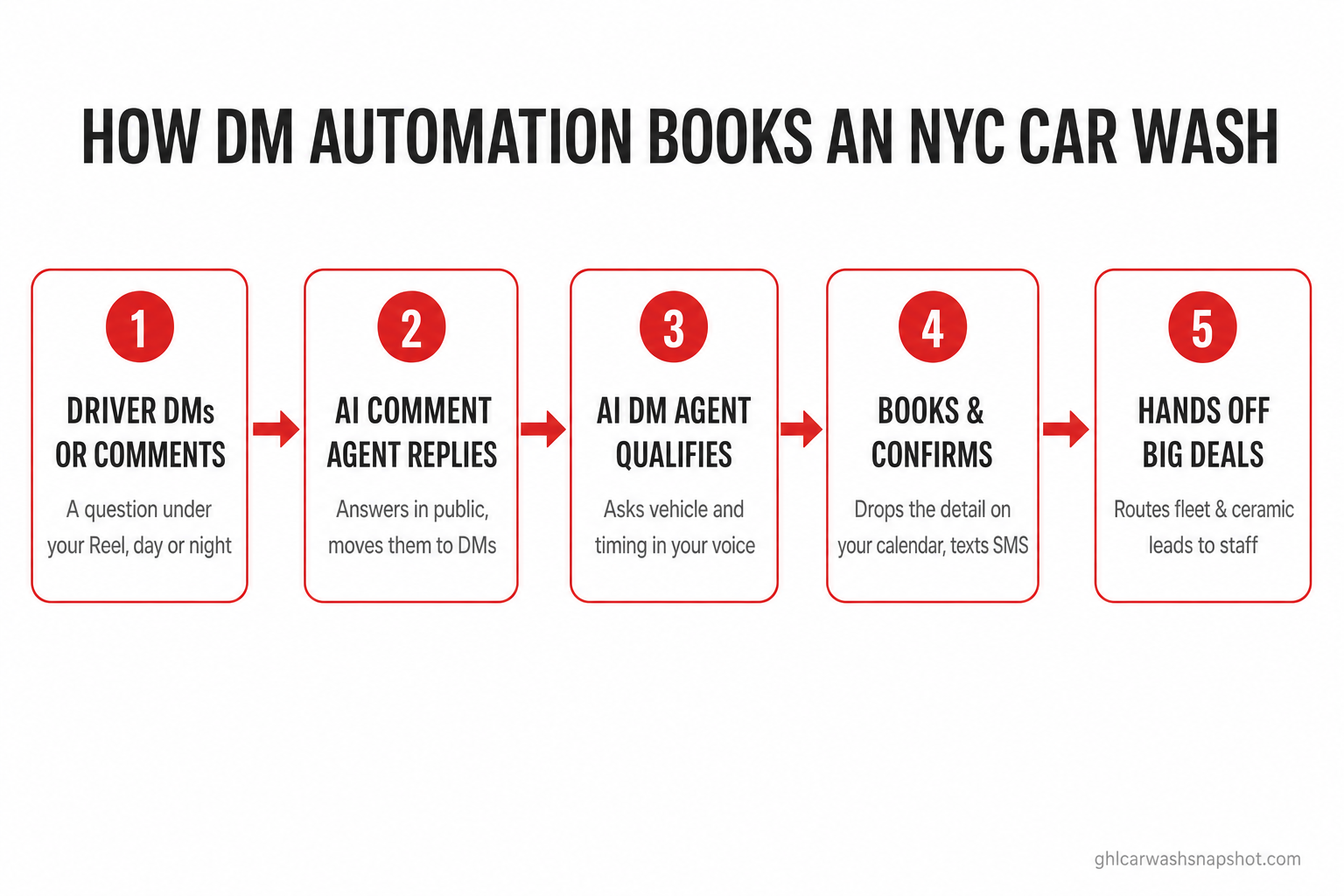
- A driver engages — publicly or privately. They comment “price for ceramic on an Escalade?” under your Reel, or open a DM after seeing your before-and-after. Either way, the agent sees it the instant it lands, day or night.
- The comment agent replies in public, fast. It answers the question under the post and invites them to DM for a quote — so the thread stays warm, other lurkers see you’re responsive, and the algorithm reads the engagement as a signal to push your Reel to more New York drivers.
- The DM agent qualifies. In the private message it answers price/service questions in your wash’s voice and asks the two things that turn a chat into a booking: what vehicle, and when. For fleet or ceramic, it captures the extra detail a quote needs.
- It books and confirms. For a detail or coating, it offers real open slots and books straight into the same calendar your team uses — the appointment automation your front desk already runs — then texts an SMS confirmation. For memberships, it sends a signup link on the spot.
- It hands warm leads to your team. A five-truck fleet inquiry or a complex ceramic job gets routed to a human with the vehicle, contact, and context already captured — so your best deals land on someone’s desk, not in an unread request folder.
DM automation vs hiring vs doing it yourself
Operators usually try one of three ways to keep up with the inbox. Here’s the honest comparison.
| Approach | Response speed | After-hours coverage | Monthly cost | Books the job? |
|---|---|---|---|---|
| Do it yourself, between bays | Hours, if at all | None | “Free” (your time) | Rarely — you see it too late |
| Hire a social/front-desk person | Minutes, when they’re on shift | None (they clock out) | $2,500–4,000+ | Sometimes, on shift only |
| DM & comment automation | Seconds, every message | 24/7 | From $397/mo | Yes — qualifies and books |
Doing it yourself feels free until you price the leak: a handful of missed DMs a week, each potentially a $440 member, is a five-figure annual hole. A dedicated hire is a real option and great on the floor — but they can’t answer at 10 p.m., during the Saturday rush, or three conversations at once, and in New York the payroll math is steep. Automation isn’t about replacing your people; it’s about making sure a message is never the reason you lost the wash. Most operators run both: people for the bays and the big deals, AI for the always-on inbox.
The 30-day rollout for an NYC wash
You don’t need a six-month project. Here’s the sequence that gets an NYC wash from leaking inbox to booked calendar in about a month.
- Week 1 — Connect and script. Link your Instagram and Facebook pages, load your services, prices, hours, ceramic and fleet options, and the unlimited-plan tiers. Set the brand voice so replies sound like your wash, not a bot. No passwords are shared — the agents connect through the platform.
- Week 2 — Turn on comments and after-hours DMs. Start conservative: let the agents handle public comments and after-hours messages only, while your team keeps daytime DMs. Watch the transcripts and tune the answers.
- Week 3 — Go full inbox and wire booking. Hand the agents all DMs, connect the calendar so they book details and coatings directly, and turn on SMS confirmations to cut no-shows.
- Week 4 — Route the big deals and measure. Set rules so fleet and high-ticket ceramic inquiries route to a human with context attached. Review what booked, what got handed off, and where drivers dropped — then tighten. For the broader booking system this plugs into, see the car wash online booking playbook.
What DM automation can’t do
Straight talk, in the brand’s spirit: automation is a tool, not magic.
- It won’t fix a page nobody engages with. If you never post, there are no DMs or comments to answer. Automation multiplies engagement you’re already getting; it doesn’t create an audience from nothing. That’s what the full social service — 5 posts a week across 9 channels — is for.
- It won’t close every high-ticket deal on its own. A $2,000 ceramic package or a 12-truck fleet contract often wants a human conversation. The agent’s job there is to capture and route a warm, qualified lead — fast — not to hard-close it.
- It isn’t a payment processor. It books the job and takes deposits through your existing tools; recurring member billing still runs through your merchant account.
- It needs your real numbers to sound like you. Garbage in, garbage out. The better you script your prices, hours, and packages up front, the more bookings it lands — which is exactly what Week 1 above is for.
Handled honestly, none of these are dealbreakers. They’re the difference between “install a bot and hope” and running the inbox like the revenue channel it is.
FAQ
What is Instagram and Facebook DM automation for a car wash?
It's an AI agent connected to your Instagram and Facebook pages that reads every incoming DM and comment, answers in your wash's brand voice with your real prices and hours, qualifies the driver (vehicle, service, timing), and books the detail or membership straight onto your calendar — 24/7, in seconds. It handles public comments under your Reels and posts as well as private messages, so no question about pricing, hours, ceramic, or fleet ever goes unanswered.
Why do New York City car washes lose so many bookings in the inbox?
Your busiest DM hours are your busiest bay hours, so messages pile up unanswered while the crew is on the floor. New York drivers also DM late at night and expect fast replies — nearly three-quarters of consumers expect a response within 24 hours, and 73% will buy from a competitor if you don't respond at all (Sprout Social 2025 Index). With ~9.36 million registered vehicles in the state and a dense, competitive market, a driver whose DM goes cold simply messages the next wash.
How much does an unanswered DM actually cost a car wash?
More than the wash itself. A one-time washer is worth about $106, but a converted member is worth roughly $440 over three years (Cinch), and a ceramic coating or fleet account is worth far more. Because your DMs are the front door to your highest-value relationships, a few missed messages a day can add up to a five-figure annual leak — which is why answering in the first minute matters.
Is DM automation better than hiring a social media or front-desk person?
It's usually a complement, not a replacement. A great hire handles the floor and complex deals but can't answer after hours, during the Saturday rush, or several conversations at once, and in NYC that role costs $2,500–4,000+ a month. DM automation answers every message the second it lands, every hour, for a fraction of that, and hands genuine high-ticket leads to your team with the context already captured. Most operators run both.
Will drivers know they're messaging an AI, and does it hurt engagement?
Modern agents reply naturally and, more importantly, usefully — they answer the question and book the job in under a couple of minutes, which is what drivers actually want. Fast public replies under your posts also raise engagement, which the Instagram and Facebook algorithms reward with more reach on your next wash clip. The goal isn't to trick anyone; it's to make sure the message gets answered and the appointment gets made.
How fast can I get DM automation running at my NYC wash?
About 30 days end to end: connect your pages and script your services in Week 1, turn on comments and after-hours DMs in Week 2, go full inbox with calendar booking in Week 3, and route your big fleet and ceramic deals in Week 4. You can start conservatively — public comments and after-hours only — and expand to every message once you see it working.
Does DM automation replace posting content?
No. It answers and books from the engagement your content generates; it doesn't create an audience on its own. If your page is quiet, pair it with a done-for-you content engine — our social service ships 5 posts a week across all 9 channels and includes the comment and DM agents, so you're generating conversations and booking them in the same system.
About the author
Wyatt Coleman is a Local Demand & Fleet Acquisition Specialist based in Kansas City, Missouri. He grew up around his family’s full-service wash in the Midwest and now helps independent operators chase the deals they leave on the table — the after-hours DMs, the weekend surges, and the corporate fleet contracts that fill empty bays. He’s happiest writing a 30-day playbook that turns a cold comment under a Reel into a booked, recurring member.
Related reading
- Car Wash Social Media Marketing in Miami: Why Your Page Isn’t Filling Bays
- AI Receptionist for Phoenix Car Washes: Stop Losing Members to Missed Calls
- Car Wash AI Chat Widget in Seattle: Turn Website Visitors Into Booked Washes
- Car Wash Online Booking: The 24/7 Booking Playbook
- AI for Car Washes: Answer Every Call, Book Every Detail, Recover Every Member
Sources & further reading
- Sprout Social — 2025 Sprout Social Index (73% buy from a competitor when brands don’t respond; expectation of a reply within 24 hours)
- MIT / InsideSales, via Harvard Business Review — The Short Life of Online Sales Leads (100× / 21× lead-response odds)
- Meta / Instagram — Instagram for Business (90% follow a business; 200M daily business-profile visits; 150M monthly business conversations)
- Federal Highway Administration — Highway Statistics 2023 (~9.36M registered vehicles in New York State)
- IBISWorld — Car Wash & Auto Detailing in the US (~57,900 US car wash & detailing businesses, 2024)
- Market Research Future — US Car Wash Service Market ($12.25B in 2025 → $21.26B by 2035)
- Cinch — Car Wash Retail-to-Member Report ($440 member vs $106 one-time value over 3 years)