
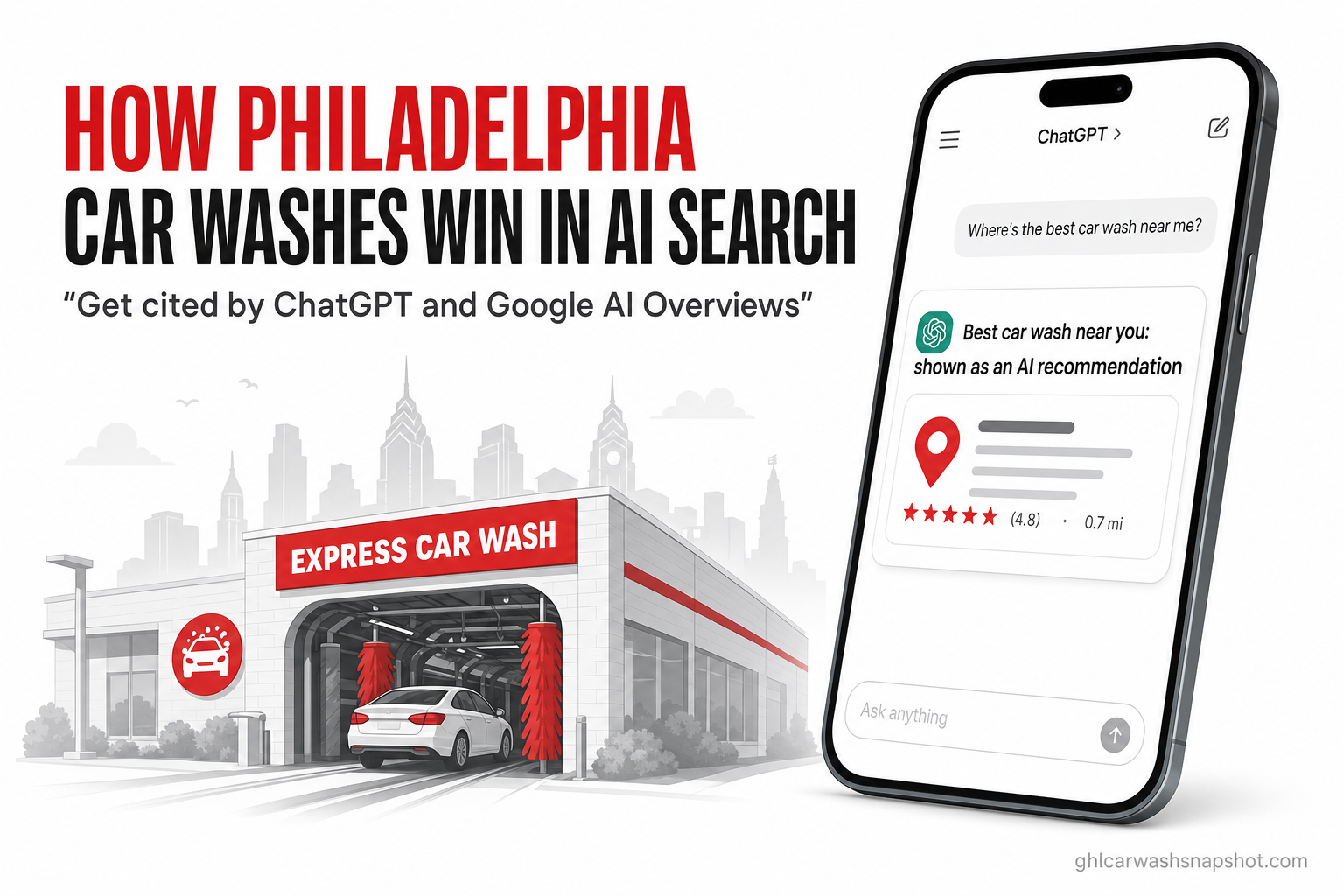
Answer engine optimization (AEO) is the work of getting your car wash named inside AI answers — the Google AI Overview at the top of the results and the recommendations ChatGPT, Gemini, and Perplexity hand a driver who asks “best unlimited car wash near me in Philadelphia.” Where old-school SEO fought for one of ten blue links, AI search collapses the whole page into a single spoken-style answer that usually names one wash. If that wash isn’t yours, the driver never sees your site — they just drive to the wash the AI recommended. And this isn’t a someday problem: Google showed an AI summary on roughly 18–20% of searches by March 2025 (Pew Research Center), and when that summary appears, people click a normal result 8% of the time versus 15% without one — a drop of nearly half.
This is a playbook for the Philadelphia wash or detail operator who has noticed fewer clicks from search and wants to be the wash the AI actually names — what AEO is, why it now decides who gets the car, and the six concrete steps to win the answer.
Table of contents
- The short answer for a Philadelphia wash
- What AEO is (and how it’s different from SEO)
- Why AI search now decides who gets the wash
- How AI engines pick which car wash to name
- The Philadelphia angle: local AI is winnable
- The 6-step AEO playbook for a Philadelphia car wash
- What AEO can’t do
- FAQ
The short answer for a Philadelphia wash
If your question is “how do I get my wash into ChatGPT and Google’s AI answers,” the honest answer is: give the AI a fast, clearly-structured site that plainly states who you are, where you are, what you charge, and what other people say about you — then earn the reviews and citations that make the AI trust it.
AI answer engines don’t invent recommendations. They assemble them from web pages they can crawl, parse, and trust. A wash with a slow, plugin-heavy site, no schema, one generic “Home” page for the whole city, and thin reviews gives the model almost nothing to work with — so it names a competitor whose site spells everything out. AEO is simply the discipline of making your wash the easiest, clearest, most trustworthy source for the AI to quote. It’s the 2026 evolution of local SEO, and for a Philadelphia operator it’s still wide open.
What AEO is (and how it’s different from SEO)
AEO (answer engine optimization) is optimizing to be the answer, not just to rank. Traditional SEO gets you onto a page of ten links and hopes the driver clicks yours. AEO gets your wash named inside the AI’s single answer — the Google AI Overview, the ChatGPT reply, the Perplexity summary — so you win the recommendation before a link is ever clicked. People also call it GEO (generative engine optimization); the goal is the same.
Three things change when the answer replaces the list:
- There’s usually one winner, not ten. A blue-link page has room for a 3-pack and a scroll of results. An AI answer names a couple of businesses and moves on. Second place is invisible.
- Clarity beats keyword stuffing. Models reward pages that answer a question plainly and completely — a real price, real hours, a real FAQ — over pages padded with “car wash Philadelphia” fifty times.
- Trust signals are quoted, not just counted. Reviews, consistent name/address/phone across the web, and structured data tell the model your wash is real and well-regarded, so it feels safe recommending you.
AEO doesn’t replace SEO — it sits on top of it. The same foundations that win Google’s local map pack (fast pages, schema, location pages, reviews) are what feed the AI answer. Do the foundation once and you compete in both.
Why AI search now decides who gets the wash
The shift from links to answers isn’t hype — it’s measurable, and it happened fast.
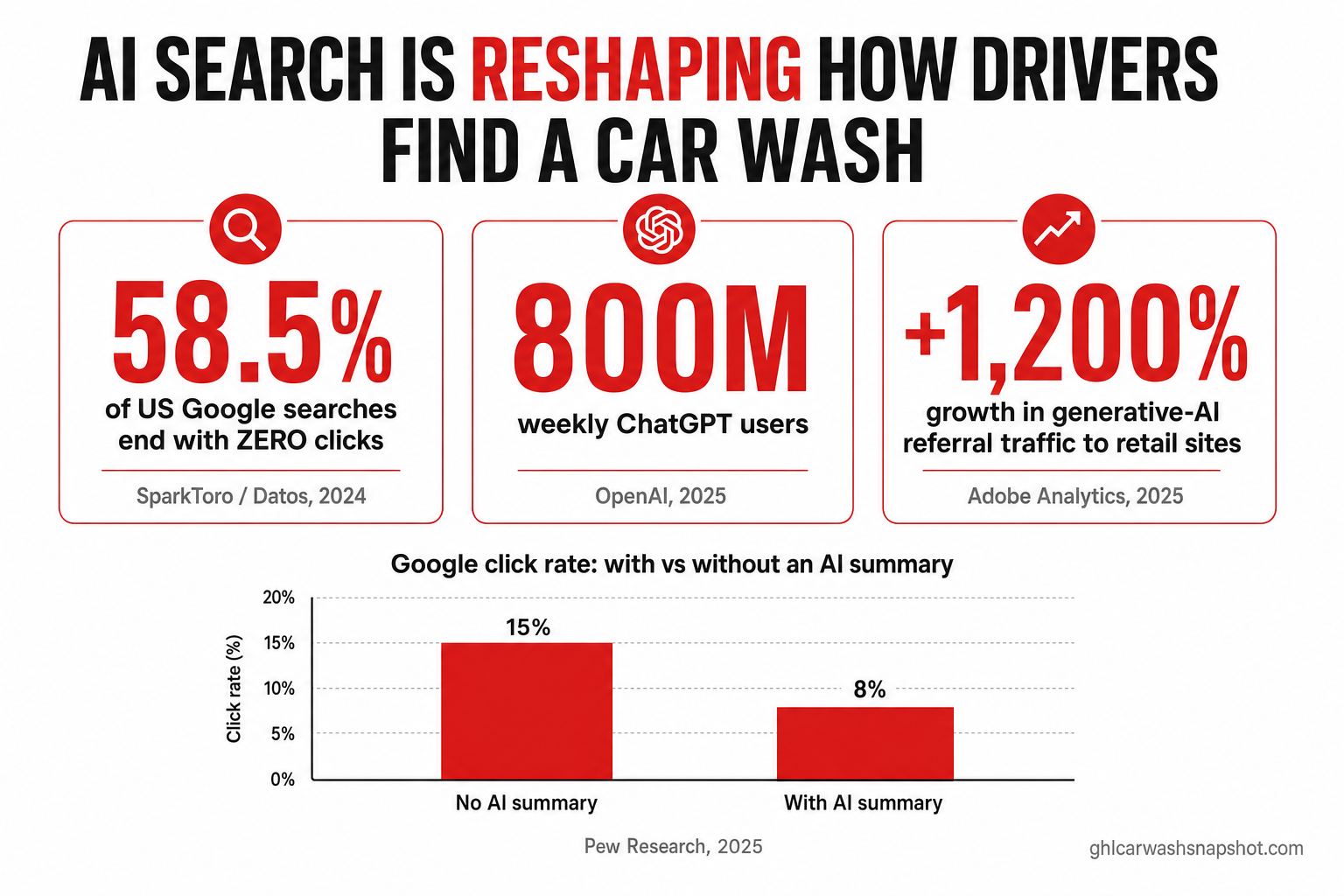
AI Overviews went mainstream in 2025. Semrush, tracking 10 million keywords, found Google AI Overviews appeared in 6.49% of queries in January 2025, 13.14% by March, peaked around 24.61% in July, and settled near 15.69% by November (Semrush). Pew’s independent analysis of ~68,000 real searches put AI summaries on roughly 18–20% of them by March 2025 (Pew Research Center). Either way, a large and growing slice of “car wash near me” searches now open with an AI answer.
And the AI answer eats the click. Pew found that when an AI summary is present, users click through to a regular search result just 8% of the time, versus 15% when there’s no summary — and they click a link inside the AI summary only about 1% of the time (Pew Research Center). Layer that on top of the reality that 58.5% of US searches already end with no click at all (SparkToro / Datos, 2024), and the message is blunt: if you’re not in the answer, the search increasingly ends without you.
The drivers are already in AI. ChatGPT passed 800 million weekly active users in late 2025 (OpenAI, via TechCrunch), and about 38% of US consumers have used generative AI for shopping or research, with over half planning to (Adobe). Adobe measured generative-AI referral traffic to US retail sites climbing roughly 1,200% year over year (Adobe Analytics, 2025). When a Philadelphia driver types “unlimited car wash near me” into ChatGPT instead of Google, the wash that AEO’d its site is the one that gets named.
How AI engines pick which car wash to name
You can’t see the model’s weights, but the inputs are well understood — and they’re the same signals Google and the AI crawlers both read.
1. Can the AI even read your site? AI crawlers reward clean, fast HTML. If your page is a slow, JavaScript-heavy WordPress or Wix build, a crawler may render it poorly or skip content. Google’s own bar for a good Largest Contentful Paint is under 2.5 seconds (web.dev); a static, edge-served site clears that easily and gives the model complete text to quote.
2. Is your wash spelled out in structured data? Schema markup (JSON-LD) hands the engine a machine-readable fact sheet: you’re a LocalBusiness, here’s your address, hours, services, price range, and FAQs. Google’s case studies credit structured data with a 25% higher CTR for Rotten Tomatoes and an 82% higher rich-result CTR for Nestlé (Google Search Central). The same clarity that earns rich results makes your wash easy for an AI to cite correctly.
3. Do you answer the actual question? Models pull from passages that plainly answer what was asked. A page that says “An unlimited monthly plan at our Fishtown location is $29.99 and includes free vacuums” is quotable. A page that says “we offer competitive membership options” is not.
4. Do other sources agree you exist and you’re good? Consistent name, address, and phone across your site, Google Business Profile, and directories — plus a healthy stream of recent Google reviews — are the trust signals that make an engine comfortable recommending you over an unknown.
The Philadelphia angle: local AI is winnable
Here’s the good news for a Philly operator: local AI search is far less crowded than you’d fear, because most of your competitors haven’t done the work.
Local intent is huge — and immediate. About 46% of all Google searches have local intent (Google, via Search Engine Roundtable), and 76% of people who run a “near me” search on a phone visit a business within 24 hours (Think with Google). A driver in Center City, Fishtown, or Northeast Philly asking an AI for a wash is a driver who’s about to pull in somewhere today.
Most Philadelphia washes are invisible to AI. One industry directory (Rentech Digital SmartScraper) counts roughly 1,983 car washes in Pennsylvania with Philadelphia the top city at about 401, and reports that hundreds of Pennsylvania washes have no website at all (Rentech Digital). Treat that as directional, not gospel — but the pattern is real: a market full of washes with no site, no schema, and no reviews strategy is a market where a properly structured wash gets named by the AI almost by default. In a national industry worth about $18.7 billion in 2025 across roughly 60,000 US car washes (IBISWorld; International Carwash Association), the local operators who move first on AEO capture the members before anyone else even notices the shift.
A Philadelphia driver asks an AI for a wash
They open ChatGPT and type 'best unlimited car wash near Fishtown.' The AI pulls from sites it can read — and your slow, schema-less one-page site isn't one of them. It names two washes with clear pricing, strong reviews, and a real location page. The driver taps one and buys a membership. You never knew the search happened.
Same question. Your Astro site loads instantly, your Fishtown location page states the plan and price in plain English, your LocalBusiness schema confirms the details, and your recent 5-star reviews back it up. The AI names your wash first, links your booking page, and the driver signs up before they've left the parking lot they're in.
The 6-step AEO playbook for a Philadelphia car wash
Here’s the concrete sequence. You can run it yourself or have it done for you — either way, the order matters, because each step feeds the next.
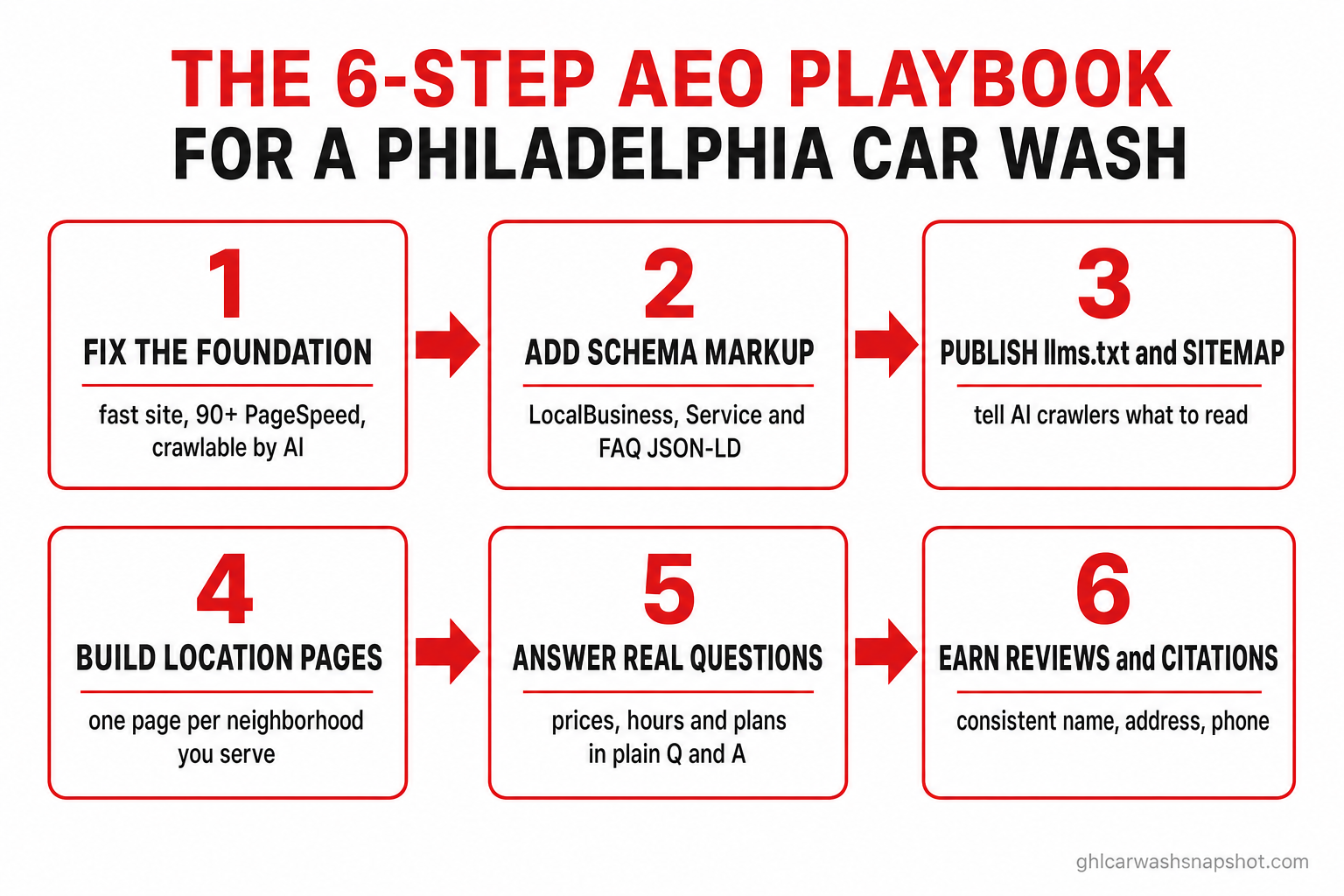
Step 1 — Fix the foundation: a fast, crawlable site. Before anything else, the AI has to be able to read you. That means fast, static HTML — not a plugin-bloated build that renders slowly or hides content behind JavaScript. A modern Astro site serves pre-rendered pages from the edge, clears Google’s LCP bar, and gives crawlers complete text. This is the base every other step stands on.
Step 2 — Add schema markup (JSON-LD). Mark up your wash as a LocalBusiness, each wash format as a Service, and your common questions as an FAQPage. This is the machine-readable fact sheet AI engines quote from — address, hours, price range, services, and answers, all unambiguous. It’s the difference between the model guessing about your wash and knowing.
Step 3 — Publish llms.txt, a clean sitemap, and robots.txt. Tell the crawlers what to read. A correct sitemap.xml lists every page, robots.txt welcomes the AI crawlers, and an llms.txt file (an emerging standard from llmstxt.org) points models straight at your most important content. Small files, outsized effect on whether you’re indexed cleanly.
Step 4 — Build real location pages. One generic “Serving Philadelphia” line won’t rank you across a city this big. Give each area you serve its own page — Center City, Fishtown, South Philly, Northeast Philly — each with local details, the nearest bay, and its own schema. Location pages are still the single most effective way for a local operator to win both the map pack and the AI answer for a specific neighborhood.
Step 5 — Answer the real questions in plain language. Publish the questions drivers actually ask, answered completely: “How much is an unlimited plan?” “Do you offer ceramic coating?” “Are you open on Sundays?” “Do you do fleet accounts?” Plain, self-contained answers are exactly the passages an AI lifts into its response. A regular content engine of operator-focused posts compounds this over time.
Step 6 — Earn reviews and keep citations consistent. Finally, feed the trust signals. A steady flow of recent Google reviews and identical name/address/phone everywhere online tell the AI your wash is real and well-regarded — the last box it checks before naming you. Automating the review ask is the highest-ROI habit here.
What AEO can’t do
Keeping it honest — AEO is powerful, but it’s not magic:
- It won’t fix a bad wash. If your reviews are poor because the service is poor, structuring your site just helps more people find a business they’ll complain about. AEO amplifies reality; it doesn’t replace it.
- It’s not instant. Rankings and AI citations build over months, not days — expect 3–5 months for a well-structured local site to gain real traction. Anyone promising overnight AI placement is selling something.
- The models keep changing. AI Overview prevalence swung from 6% to nearly 25% and back within 2025. The foundation (fast, structured, reviewed, consistent) is what stays stable through the churn — chase tactics and you’ll be rebuilding constantly.
- It doesn’t book the wash by itself. Getting named is step one; you still need online booking and an AI chat widget to turn the click into a member. AEO fills the top of the funnel; your site has to convert it.
For a Philadelphia operator, the takeaway is simple: the drivers have moved to AI answers faster than the washes have. The ones who structure their site now — fast, schema’d, location-paged, reviewed — become the default recommendation while the competition is still arguing about whether any of this matters.
FAQ
What is AEO for a car wash?
AEO (answer engine optimization) is the practice of structuring your car wash's website and online presence so AI answer engines — Google's AI Overview, ChatGPT, Gemini, and Perplexity — name your wash inside their answers. Instead of fighting for one of ten blue links, you aim to be the single business the AI recommends when a driver asks for a car wash near them. It's built on fast pages, schema markup, clear answers, location pages, and reviews.
How is AEO different from SEO?
Traditional SEO gets you ranked on a page of links and hopes the user clicks yours. AEO gets you cited inside the AI's single answer, before any link is clicked. The foundations overlap heavily — fast site, schema, location pages, reviews — but AEO puts more weight on plain, complete, quotable answers and on trust signals the model can repeat. Do the foundation once and you compete for blue links, the map pack, and the AI answer together.
Do Philadelphia drivers really use ChatGPT to find a car wash?
Increasingly, yes. ChatGPT passed 800 million weekly users in late 2025, about 38% of US consumers have used generative AI for shopping or research, and roughly 45% of consumers have used an AI tool to find a local business recommendation (BrightLocal). With ~46% of all Google searches carrying local intent and 76% of near-me searchers visiting within 24 hours, a growing share of 'car wash near me' moments now start with an AI answer.
What actually gets my wash named in an AI Overview?
Four things: (1) a fast, crawlable site the AI can read — Google's good LCP bar is under 2.5 seconds; (2) schema markup that spells out your business, services, hours, and FAQs; (3) plain, complete answers to the questions drivers ask, plus real location pages; and (4) trust signals — consistent name/address/phone and a steady flow of recent reviews. Google's own data shows structured data lifting click-through by 25–82% in its case studies, and the same clarity makes you easy for an AI to cite.
Is llms.txt worth adding?
It's a low-cost, emerging best practice. llms.txt (from llmstxt.org) is a small file that points AI crawlers at your most important content, alongside a correct sitemap.xml and a robots.txt that welcomes AI crawlers. There's no verified adoption statistic yet, so treat it as sensible hygiene rather than a silver bullet — but it costs almost nothing and helps ensure models index your wash cleanly.
How fast will I see results, and what does it cost to have it done?
Expect 3–5 months for a well-structured local site to gain real traction in both search and AI answers — not overnight. Our Get a Website service builds your wash on Astro with schema, llms.txt, per-neighborhood location pages, an AI chat widget, and a guaranteed 90+ PageSpeed for $497 one-time plus $97/month (managed hosting, domain, SSL, and maintenance included). Auto blog posting is available at $197/month total.
About the author
Wyatt Coleman is a Local Demand & Fleet Acquisition Specialist based in Kansas City, Missouri. He grew up around his family’s full-service wash in the Midwest and now helps independent operators win the deals they leave on the table — the after-hours calls, the weekend surges, and the local searches that fill empty bays. In 2026 that increasingly means being the wash the AI recommends, and he’s happiest turning a “car wash near me” moment into a signed membership.
Related reading
- Car Wash Local SEO: How to Rank in the Google Maps 3-Pack
- Astro vs WordPress for Dallas Car Wash Websites: Page Speed & Bookings Compared
- How to Get More Google Reviews for Your Car Wash (Atlanta Playbook)
- Instagram & Facebook DM Automation for NYC Car Washes
- Car Wash Industry Statistics: The Numbers That Matter
Sources & further reading
- Pew Research Center — Google users are less likely to click on links when an AI summary appears (AI summary on ~18–20% of searches; 8% vs 15% click rate; 1% click inside summary)
- Semrush — AI Overviews commercial search study (AI Overview prevalence across 2025: 6.49% → 13.14% → 24.61% → 15.69%)
- SparkToro / Datos — 2024 Zero-Click Search Study (58.5% of US searches end with zero clicks)
- OpenAI (via TechCrunch) — ChatGPT weekly active users (800M weekly users in late 2025)
- Adobe Analytics — Generative-AI traffic to US retail sites jumps ~1,200%
- Adobe — The explosive rise of generative AI referral traffic (~38% of US consumers used GenAI for shopping/research)
- BrightLocal — Consumers using AI for local business recommendations (~45% used an AI tool to find a local business)
- Google Search Central — Intro to structured data (Rotten Tomatoes +25% CTR; Nestlé +82% rich-result CTR)
- Google (via Search Engine Roundtable) — 46% of searches have local intent
- Think with Google — Micro-moments / near-me search (76% of near-me searchers visit within 24h)
- Google / web.dev — Largest Contentful Paint (good LCP under 2.5s)
- IBISWorld — US car wash & auto detailing market size (~$18.7B, 2025)
- International Carwash Association — Industry information (~60,000 US car washes)
- Rentech Digital SmartScraper — Pennsylvania / Philadelphia car wash directory (directional local counts — aggregator data)